
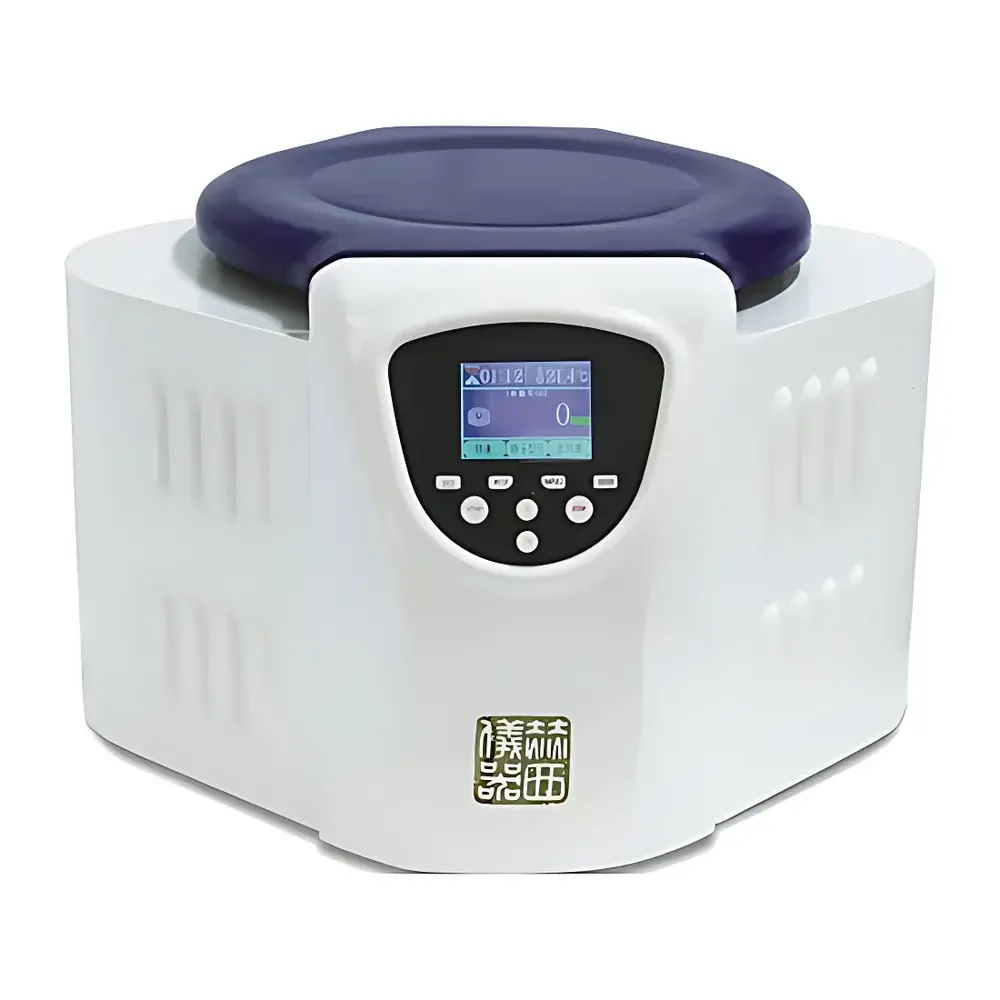
Herx HT12MM Cell Washing Centrifuge
| Brand | Herx |
|---|---|
| Model | xidi-HT12MM |
| Type | Benchtop Low-Speed Centrifuge |
| Max Speed | 4000 rpm |
| Max RCF | 2200 ×g |
| Capacity | 12 × 15 mL tubes |
| Dimensions | 550 × 440 × 330 mm |
| Weight | 35 kg |
| Drive System | High-torque brushless DC motor |
| Control | Microprocessor-based with LCD touchscreen interface |
| Timer Range | 1 min – 99 h 59 min (continuous & short-spin modes) |
| Speed Accuracy | ±50 rpm |
| Noise Level | ≤60 dB(A) |
| Power Supply | AC 220 V, 50 Hz |
| Power Consumption | 120 W |
| Rotor Types | SERO rotor (4000 rpm / 1842 ×g), HLS rotor (4200 rpm / 2200 ×g) |
| Safety Features | Automatic door interlock, imbalance detection, overspeed protection, self-diagnostic system, stainless steel chamber, multi-layer explosion-resistant construction |
Overview
The Herx HT12MM Cell Washing Centrifuge is a purpose-engineered benchtop centrifuge designed specifically for standardized cell washing protocols in immunohematology and transfusion medicine laboratories. Operating on the principle of low-speed sedimentation under controlled gravitational force (RCF), it enables reproducible separation of erythrocytes, leukocytes, and platelets from plasma or serum while preserving cellular integrity and antigenic surface expression. Unlike general-purpose centrifuges, the HT12MM integrates application-specific rotor geometries, precise timing control, and integrated safety logic to support critical workflows including saline/albumin washing of red blood cells prior to antiglobulin testing (Coombs test), microcolumn gel card processing, and lymphocyte isolation for HLA typing. Its operational envelope—optimized between 1000–4200 rpm and up to 2200 ×g—aligns with CLSI EP17-A2 and AABB Technical Manual guidelines for pre-transfusion serological testing.
Key Features
- Application-optimized dual-rotor system: SERO rotor (4000 rpm / 1842 ×g) for routine ABO/Rh typing and antibody screening; HLS rotor (4200 rpm / 2200 ×g) for lymphocyte enrichment and platelet depletion via thrombin-assisted aggregation.
- Microprocessor-controlled LCD touchscreen interface with real-time display of rpm, RCF, elapsed time, and remaining time—enabling parameter adjustment during active runs without interruption.
- Automatic balancing algorithm compensates for minor tube mass discrepancies, reducing vibration and extending bearing life under repeated 12-tube loading conditions.
- Stainless steel chamber and reinforced polycarbonate lid meet ISO 13485 design requirements for medical device manufacturing environments.
- Brushless DC motor delivers rapid acceleration/deceleration (<15 s ramp-up to 4000 rpm), zero carbon dust generation, and maintenance-free operation over ≥10,000 cycles.
- Integrated safety architecture includes door interlock verification, dynamic imbalance sensing, overspeed cutoff, and automatic fault logging compliant with IEC 61010-2-020.
Sample Compatibility & Compliance
The HT12MM accommodates standard 12 × 15 mL conical polypropylene or glass tubes (e.g., BD Vacutainer® 15 mL, Greiner Bio-One PP 15 mL). Rotor adapters support 5 mL, 7 mL, and 10 mL formats without performance degradation. All rotors are certified for autoclaving at 121°C for 20 minutes (EN 285), ensuring compatibility with GLP/GMP cleanroom workflows. The instrument conforms to ISO 15189:2022 clause 5.3.2 for equipment verification, supports audit-ready event logs per FDA 21 CFR Part 11 Annex 11 requirements (when paired with optional data export module), and meets essential performance criteria outlined in ASTM E2917–21 for clinical centrifuge validation.
Software & Data Management
While the HT12MM operates as a standalone instrument, its embedded firmware records all run metadata—including date/time stamp, rotor ID, speed, duration, RCF, and fault codes—in non-volatile memory. Optional USB-C data export enables traceable transfer of up to 1,000 recent run records into LIMS or ELN platforms. Firmware versioning and calibration history are accessible via service menu for internal QA review. No proprietary software installation is required; exported .csv files integrate natively with Microsoft Excel, LabArchives, or Veeva Vault QMS.
Applications
- Red blood cell washing prior to indirect antiglobulin test (IAT) and direct antiglobulin test (DAT).
- Preparation of washed RBC suspensions for microcolumn gel card assays (e.g., ID-Micro Typing System, Ortho Clinical Diagnostics).
- Lymphocyte isolation from peripheral blood mononuclear cells (PBMCs) using density gradient media followed by low-speed pelleting.
- Thrombin-mediated platelet removal in platelet-poor plasma (PPP) preparation for coagulation factor assays.
- Routine serum/plasma separation in clinical chemistry and immunoassay sample prep workflows.
- Cell pellet recovery in basic molecular biology protocols requiring gentle centrifugation (e.g., plasmid preps, RNA extraction).
FAQ
What is the maximum recommended tube volume for the SERO rotor?
The SERO rotor is validated for 12 × 15 mL tubes filled to nominal capacity (15 mL); overfilling beyond 16 mL may compromise balance stability and RCF uniformity.
Does the HT12MM support continuous operation mode?
Yes—continuous centrifugation is enabled via timer setting “00:00” and remains active until manually stopped or interrupted by safety event.
Can the HLS rotor be used for platelet-rich plasma (PRP) preparation?
No—the HLS rotor is optimized for high-yield lymphocyte pelleting and thrombin-assisted platelet depletion; PRP requires lower RCF (≤200 ×g) and specialized swing-out rotors not included with this model.
Is rotor calibration traceable to national standards?
Each rotor carries a unique serial number and factory-certified RCF curve; users may perform in-house speed verification using ISO 15197-compliant tachometers and document results per internal SOP.
What maintenance intervals are recommended?
Visual inspection of chamber gasket and rotor threads every 200 runs; full lubrication and bearing assessment by authorized service technician every 24 months or 5,000 operating hours—whichever occurs first.
Related Products



