
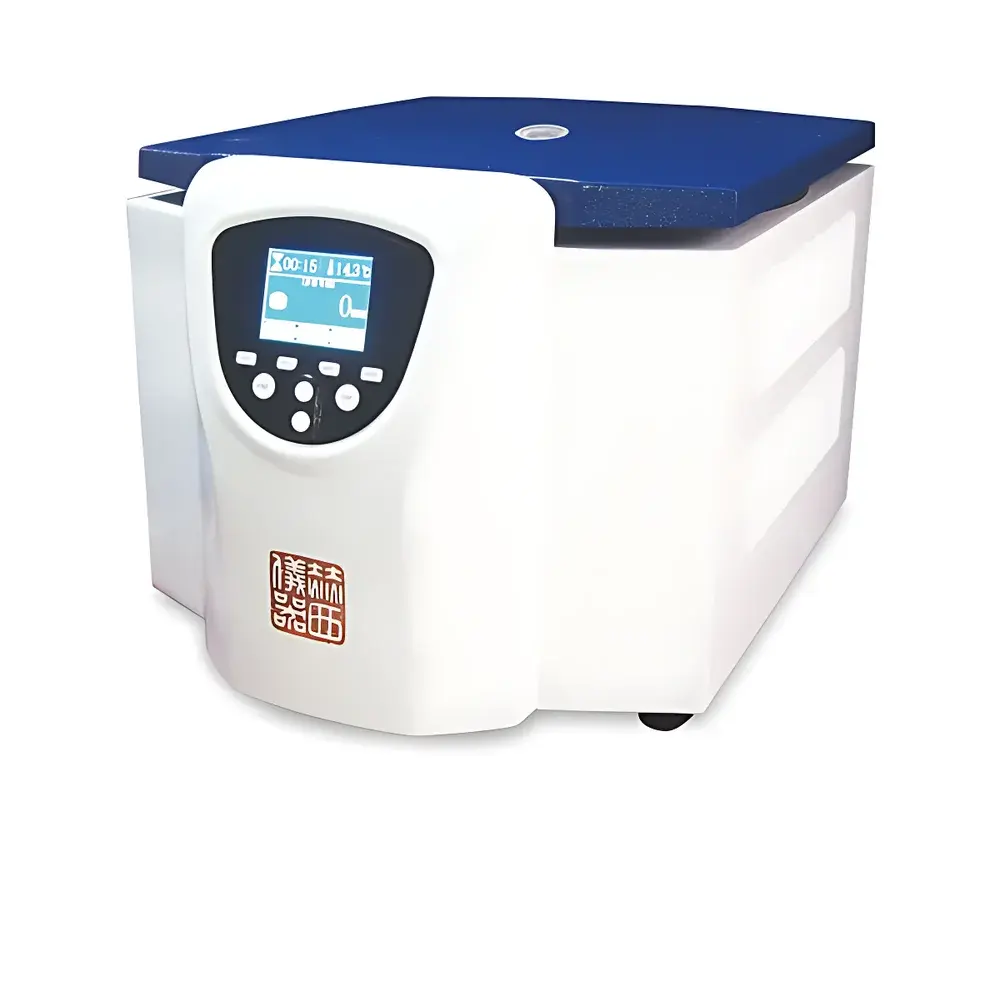
HEREXI TDZ5-WS Benchtop Low-Speed Centrifuge
| Brand | HEREXI |
|---|---|
| Origin | Hunan, China |
| Instrument Type | Benchtop Centrifuge |
| Maximum Capacity | 4 × 100 mL |
| Maximum Speed | 5000 rpm |
| Maximum RCF | 4800 × g |
| Acceleration/Deceleration Profiles | 10 selectable rates |
| Programmable Methods | 20 stored protocols |
| Display | 4.3-inch TFT true-color touchscreen |
| Drive System | Brushless AC frequency-converter motor |
| Rotor Type | Fixed-angle rotor (standard configuration) |
| Chamber Material | Stainless steel |
| Noise Level | ≤65 dB(A) |
| Dimensions (L×W×H) | 500 × 400 × 300 mm |
| Weight | 25 kg |
| Power Supply | AC 220 V, 50 Hz |
| Rated Power | 350 W |
| Speed Accuracy | ±50 rpm |
| Timer Range | 0–99 h 59 min |
| Door Lock | Electromechanical interlocked safety latch |
Overview
The HEREXI TDZ5-WS is a benchtop low-speed centrifuge engineered for routine separation tasks in academic laboratories, clinical diagnostics, food safety testing, and pharmaceutical quality control environments. Operating on the principle of sedimentation under controlled gravitational force (RCF), this instrument achieves reliable phase separation of heterogeneous mixtures—including whole blood, cell suspensions, precipitates, and coarse particulates—without inducing thermal or mechanical stress associated with high-speed operation. With a maximum rotational speed of 5000 rpm and an RCF ceiling of 4800 × g, the TDZ5-WS delivers sufficient centrifugal force for applications such as serum/plasma separation, yeast harvesting, and polymer pellet recovery, while maintaining operational safety and sample integrity at lower energy input. Its compact footprint (500 × 400 × 300 mm) and 25 kg mass ensure stable placement on standard laboratory benches without requiring anchoring or vibration-damping platforms.
Key Features
- 4.3-inch TFT true-color touchscreen interface with dual-control logic: simultaneous real-time display of set parameters (speed, time, RCF) and actual running values—enabling precise monitoring and intervention during operation.
- Brushless AC frequency-converter motor: eliminates carbon brush wear, reduces electromagnetic interference, ensures consistent torque delivery across speed ranges, and maintains ultra-low acoustic emissions (≤65 dB[A])—critical for shared lab spaces and noise-sensitive facilities.
- Stainless-steel centrifuge chamber and fully welded steel frame: provides corrosion resistance against common reagents (e.g., ethanol, saline, buffered solutions) and structural rigidity to withstand repeated acceleration cycles over extended service life.
- 10-step programmable acceleration and deceleration profiles: allows optimization of pelleting efficiency and supernatant clarity—particularly beneficial for fragile samples such as peripheral blood mononuclear cells (PBMCs) or protein aggregates.
- 20-user-programmable methods with non-volatile memory storage: supports method standardization across shifts or operators; each protocol retains speed, time, ramp/deceleration settings, and rotor identification metadata.
- Electromechanical interlocked door latch with automatic rotor recognition logic: prevents accidental operation with incompatible rotors or open lid, satisfying IEC 61010-2-020 safety requirements for laboratory centrifuges.
Sample Compatibility & Compliance
The TDZ5-WS accommodates standard conical-bottom centrifuge tubes (15 mL, 50 mL), universal tubes (up to 100 mL), and microcentrifuge tube adapters when used with optional accessory carriers. It is validated for use with aqueous buffers, isotonic saline, ethanol-based precipitates, and low-viscosity biological fluids. While not certified for biosafety level 3 (BSL-3) containment, its sealed stainless-steel chamber meets basic hygiene standards for routine clinical and QC workflows. The device complies with CE marking directives (2014/30/EU EMC Directive and 2014/35/EU LVD Directive) and conforms to ISO 13485-aligned manufacturing controls. Documentation includes traceable calibration records for speed and timer functions, supporting GLP-compliant recordkeeping where required.
Software & Data Management
The TDZ5-WS operates via embedded firmware with no external PC dependency. All 20 stored protocols are retained after power loss due to EEPROM-backed memory. Timestamped run logs—including start/stop time, final RCF, total runtime, and error codes—are accessible via the touchscreen history menu for up to 100 recent cycles. Though lacking network connectivity or FDA 21 CFR Part 11-compliant electronic signatures, the system supports audit-ready manual documentation through printed parameter sheets (via optional thermal printer interface) and screen-capture functionality for training and SOP validation purposes.
Applications
- Clinical laboratories: Separation of serum from clotted blood (e.g., for ELISA or chemistry analyzers); preparation of packed red blood cells prior to hemolysis assays.
- Food microbiology labs: Pellet recovery of Salmonella or E. coli from enrichment broths prior to plating or PCR extraction.
- Agricultural research: Clarification of plant tissue homogenates for enzyme activity assays or metabolite profiling.
- Pharmaceutical QA/QC: Recovery of insoluble excipients or active pharmaceutical ingredient (API) crystals following solvent evaporation steps.
- Academic teaching labs: Demonstrating sedimentation kinetics, density gradient principles, and rotor physics fundamentals without high-risk operational complexity.
FAQ
What rotor configurations are supported by the TDZ5-WS?
The instrument ships with a fixed-angle aluminum rotor (4 × 100 mL capacity) compatible with standard polypropylene or glass centrifuge tubes. Optional swing-bucket and adapter sets are available for 15 mL and 50 mL tubes.
Is rotor imbalance detection included?
Yes—the microprocessor continuously monitors vibration amplitude during acceleration and triggers automatic shutdown if imbalance exceeds ISO 21501-4 thresholds (≥0.5 mm displacement at 3000 rpm).
Can the TDZ5-WS be operated in cold rooms?
It is rated for ambient operation between 5 °C and 40 °C; condensation ingress is mitigated by sealed electronics housing, though prolonged exposure below 10 °C may affect touchscreen responsiveness.
Does the centrifuge support GMP documentation requirements?
While it lacks electronic audit trails or user-level access control, its deterministic timer accuracy (±50 rpm, ±1% time deviation) and non-volatile protocol storage enable manual compliance with Annex 11 and USP verification protocols when paired with external logbooks.
What maintenance intervals are recommended?
Brushless motor requires no scheduled servicing; annual inspection of door latch mechanism, chamber seal integrity, and rotor thread condition is advised per manufacturer guidelines.



