
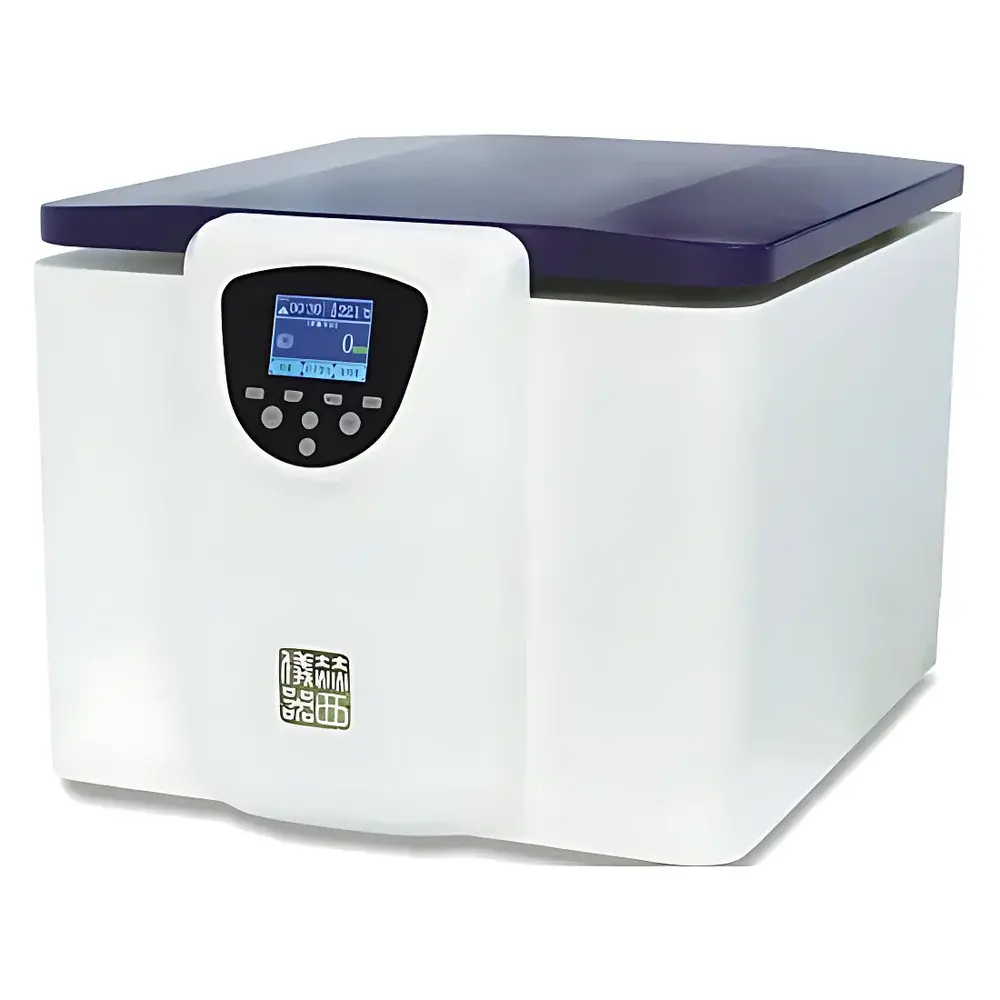
Hesix DD5 Benchtop Low-Speed High-Capacity Clinical Centrifuge
| Brand | Hesix |
|---|---|
| Origin | Hunan, China |
| Model | DD5 |
| Instrument Type | Benchtop Centrifuge |
| Speed Range | 0–5000 rpm |
| Max RCF | 4800 ×g |
| Max Capacity | 4 × 500 mL |
| Acceleration/Deceleration | 10-step programmable |
| Timer Range | 1–99 min, continuous, or short-spin mode |
| Noise Level | ≤60 dB(A) |
| Power Supply | AC 220 V, 50 Hz |
| Motor | Brushless AC servo motor |
| Display | TFT-LCD color touchscreen with bilingual (English/Chinese) interface |
| Certifications | CFDA registered, ISO 9001:2015 & ISO 13485:2016 certified |
| Dimensions (L×W×H) | 630 × 500 × 420 mm |
| Weight | 65 kg |
Overview
The Hesix DD5 Benchtop Low-Speed High-Capacity Clinical Centrifuge is engineered for routine separation tasks in clinical diagnostics, blood banking, biobanking, and core laboratory environments. Designed around a robust brushless AC servo motor and precision-engineered mechanical architecture, the DD5 operates within a controlled low-speed regime (0–5000 rpm, up to 4800 ×g), optimized for gentle yet efficient pelleting of whole blood, platelet-rich plasma (PRP), peripheral blood mononuclear cells (PBMCs), sedimentation rate assays (ESR), and large-volume biological suspensions. Its fixed-angle and horizontal rotor configurations support standardized workflows compliant with CLSI H18-A3 and ISO 15189 requirements for preanalytical sample processing. Unlike high-speed or ultracentrifuge systems, the DD5 prioritizes operational safety, thermal stability, and reproducible sedimentation kinetics—critical for maintaining sample integrity during extended batch processing.
Key Features
- Brushless AC servo motor with integrated drive module (Infineon-based control) ensures stable rotational performance, minimal mechanical wear, and noise level ≤60 dB(A) — suitable for shared laboratory spaces.
- Triple-stage damping system combined with asymmetric counterbalance detection prevents rotor wobble and eliminates sample resuspension during deceleration.
- TFT-LCD full-color touchscreen with physical shortcut keys enables dual-mode operation; real-time display of setpoint vs. actual rpm, RCF, time remaining, and temperature (for refrigerated variants).
- Biocontainment-compliant angular rotors feature seamless silicone O-rings meeting EU RoHS Directive 2015/863, minimizing aerosol generation during lid opening post-run.
- Stainless-steel 304 centrifuge chamber, powder-coated steel housing, and triple-layer reinforced front panel meet IEC 61010-2-020 mechanical safety standards for Class II laboratory equipment.
- Electromechanical door lock with auto-engagement mechanism activates upon gentle lid closure — no manual latching required.
- 20 programmable protocols with non-volatile memory; retains last-used method on power-up; supports 10-step acceleration/deceleration ramping for sensitive cell preparations.
Sample Compatibility & Compliance
The DD5 accommodates a broad spectrum of clinical and research sample formats via interchangeable rotors: fixed-angle rotors for rapid 10–15 mL tube processing (up to 2600 ×g), swing-bucket rotors supporting up to 4 × 500 mL conical tubes (3580 ×g), and specialized microplate carriers for 96-well ELISA or PCR plates (2360–3580 ×g). Adapters are available for vacuum blood collection tubes (5/7/10 mL), cryovials, and deep-well plates. All rotors undergo static and dynamic balancing per ISO 15830-1 and are traceably calibrated using NIST-traceable tachometers. The device carries CFDA registration for in vitro diagnostic use in China and complies with ISO 13485:2016 for medical device quality management systems — supporting audit readiness under GLP and CAP-accredited laboratory frameworks.
Software & Data Management
While the DD5 operates as a standalone instrument without network connectivity, its embedded firmware provides full audit trail functionality for critical parameters: start/stop timestamps, rotor ID recognition, speed/RCF/time settings, and fault logs (e.g., imbalance alerts, overtemperature events). All user-modifiable parameters are recorded in nonvolatile memory with timestamped entries. Firmware updates are performed via USB port using digitally signed binaries, ensuring integrity per IEC 62304 Class B software lifecycle requirements. Language localization includes English, Chinese, Russian, and Portuguese — facilitating multi-site deployment across APAC and EMEA regions.
Applications
- Clinical hematology: ESR determination, red blood cell washing, buffy coat isolation.
- Blood bank operations: Platelet concentration, plasma fractionation, cryoprecipitate preparation.
- Diagnostic microbiology: Mycobacterial pellet concentration prior to AFB staining or NAAT extraction.
- Biobanking: Large-volume serum/plasma separation from donor collections (up to 2 L/batch).
- Cell therapy labs: Gentle harvesting of mesenchymal stromal cells (MSCs) and hematopoietic progenitors.
- Research core facilities: High-throughput processing of PBMCs, exosome precursors, and extracellular vesicle isolates.
FAQ
Is the DD5 compatible with refrigerated operation?
The base DD5 model is air-cooled and non-refrigerated. A dedicated refrigerated variant (DD5-R) is available with compressor-based cooling (4–25°C range) and condensate management system.
Does the DD5 support FDA 21 CFR Part 11 compliance?
As a Class I standalone centrifuge without electronic signature capability or networked data export, it does not implement Part 11 controls. However, its audit log structure aligns with ALCOA+ principles for raw data integrity in GxP environments.
What rotor certification documentation is provided?
Each rotor ships with individual calibration certificate, material test report (MTR) for forged aluminum (AMS 4041), and RoHS/REACH compliance statement.
Can the DD5 be integrated into LIS/HIS systems?
No native HL7 or ASTM E1384 interfaces are included. Integration requires third-party middleware or barcode-triggered protocol execution via external PLC.
What maintenance intervals are recommended?
Annual verification of speed accuracy, RCF calibration, and door interlock function is advised per ISO/IEC 17025 Clause 6.4.1; rotor lifetime is tracked via embedded usage counters.



