
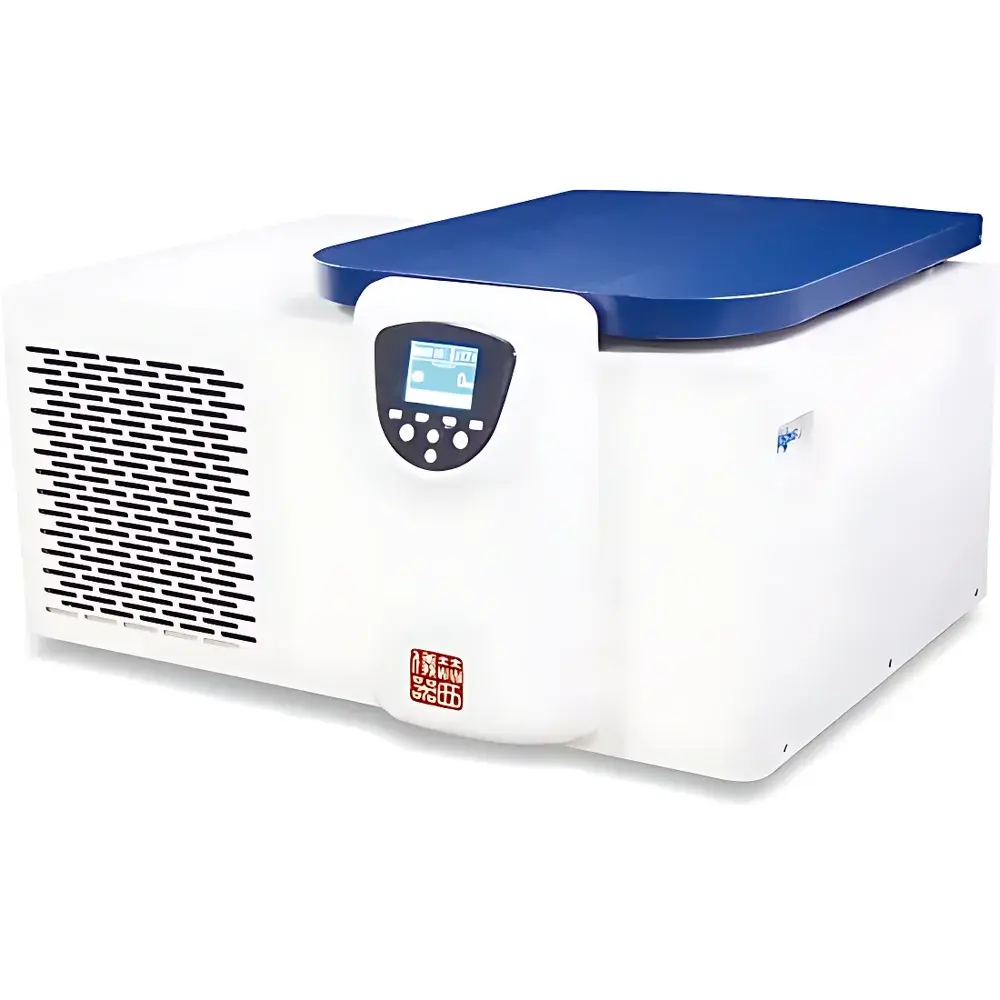
Hesix TGL20MW Benchtop High-Capacity Refrigerated High-Speed Centrifuge
| Brand | Hesix |
|---|---|
| Origin | Hunan, China |
| Model | TGL20MW |
| Maximum Capacity | 6 × 250 mL |
| Maximum Speed | 20,600 rpm |
| Maximum RCF | 30,550 × g |
| Temperature Range | −20 °C to +40 °C |
| Temperature Accuracy | ±1 °C |
| Refrigerant | R404a (non-CFC) |
| Dimensions (W×D×H) | 630 × 760 × 400 mm |
| Weight | 110 kg |
| Noise Level | ≤60 dB(A) |
| Acceleration/Deceleration Control | 10 selectable rates |
| Programmable Protocols | 20 user-defined methods |
| Rotor Recognition | Automatic |
| Timer Range | 1 min – 99 h 59 min (including continuous and short-spin modes) |
| Power Supply | 220 V / 50 Hz |
| Total Power | 1.8 kW |
| Speed Accuracy | ±50 rpm |
Overview
The Hesix TGL20MW is a benchtop refrigerated high-speed centrifuge engineered for precision separation of biological, clinical, and industrial samples under controlled thermal conditions. Utilizing fixed-angle and swing-out rotor configurations, it operates on the principle of sedimentation acceleration via radial force generation—governed by rotational speed (rpm), rotor radius, and sample density differential. Designed for laboratories requiring high-throughput processing without floor-standing footprint constraints, the TGL20MW delivers up to 30,550 × g at 20,600 rpm, enabling efficient pelleting of subcellular organelles, viral particles, macromolecular complexes, and precipitated nucleic acids or proteins. Its integrated R404a refrigeration system maintains precise temperature stability across extended runs, critical for heat-sensitive biomolecules such as enzymes, antibodies, and RNA. The unit complies with IEC 61010-1 safety standards for laboratory electrical equipment and incorporates mechanical and electronic safeguards aligned with ISO 13485–informed quality system expectations for in vitro diagnostic support instrumentation.
Key Features
- High-torque brushless frequency-controlled motor with dsPIC30F microcontroller-based digital regulation and FAIRCHILD FSBB30CH intelligent gate driver modules—ensuring stable torque delivery and long-term operational reliability.
- Dual-control interface: 4.3-inch TFT true-color touchscreen with tactile key overlay; real-time simultaneous display of setpoints (speed, time, temperature, acceleration/deceleration rate) and actual running parameters.
- Comprehensive safety architecture: automatic imbalance detection, overspeed cutoff, overtemperature lockout, door interlock with silent electromechanical latch, and adaptive vibration damping via composite elastomeric suspension system.
- Full rotor auto-identification: eliminates manual rotor configuration errors by reading embedded RFID tags or optical codes during installation—critical for method traceability and GLP-compliant workflows.
- Flexible protocol management: 20 programmable run profiles with independent ramp/brake control (10-step acceleration/deceleration grading), memory retention after power loss, and support for both timed and continuous operation modes.
- Low-noise design (<60 dB[A] at 1 m distance) achieved through optimized airflow ducting, balanced rotor dynamics, and acoustic insulation—suitable for shared lab environments and QC areas requiring ambient noise control.
Sample Compatibility & Compliance
The TGL20MW accommodates a broad spectrum of primary and secondary containers—including conical-bottom and round-bottom tubes (1.5–500 mL), vacuum blood collection tubes (5/7/10 mL), microplates (2 × 2 × 96-well), and custom adapter sets for specialized formats. Its rotor library supports both fixed-angle and horizontal configurations, allowing optimization for either high-RCF pelleting (e.g., mitochondrial isolation at 29,280 × g) or gentle layering applications (e.g., Ficoll density gradients at 2,360 × g). All rotors are certified to ISO 21501-4 for dimensional tolerances and undergo full dynamic balancing per ISO 1940-1 Grade G2.5. The instrument meets CE marking requirements under Directive 2014/30/EU (EMC) and 2014/35/EU (LVD), and its software architecture supports audit trail generation compatible with FDA 21 CFR Part 11 Annex 11 principles when paired with validated LIMS integration.
Software & Data Management
While the TGL20MW operates autonomously via its onboard embedded controller, it provides RS232 and optional USB interfaces for external data logging and remote parameter synchronization. Each run stores timestamped metadata—including rotor ID, speed profile, temperature history, energy consumption, and fault logs—in non-volatile memory. Exportable CSV files facilitate integration into laboratory information management systems (LIMS) and electronic lab notebooks (ELN). Firmware updates are performed via secure USB drive with cryptographic signature verification, ensuring integrity in regulated environments. Optional PC-based HesixCentriControl™ software (v3.2+) enables centralized fleet monitoring, SOP-driven method deployment, and automated report generation aligned with ISO/IEC 17025 documentation requirements.
Applications
- Biochemistry: Purification of ribosomes, lysosomes, and synaptic vesicles via differential centrifugation protocols.
- Clinical Diagnostics: Serum/plasma separation from whole blood (including EDTA, heparin, and serum separator tubes); preparation of PBMCs using density gradient media.
- Pharmaceutical QA/QC: Clarification of monoclonal antibody harvests, removal of host cell proteins, and particulate analysis in final fill formulations.
- Food Safety Testing: Concentration of pathogens (e.g., Salmonella, Listeria) from enrichment broths prior to PCR or immunoassay detection.
- Agricultural Research: Extraction of plant-derived exosomes, chloroplast isolation, and starch granule fractionation from cereal suspensions.
- Blood Banking: Large-volume red blood cell washing and platelet-rich plasma (PRP) preparation under temperature-controlled conditions.
FAQ
What refrigerants are used, and are they compliant with current environmental regulations?
The TGL20MW employs R404a—a hydrofluorocarbon (HFC) refrigerant approved under current EU F-Gas Regulation (EU) No 517/2014 for laboratory equipment with annual charge <5 kg. While not ozone-depleting, users should consult local phase-down schedules and consider future transition paths to lower-GWP alternatives.
Is rotor calibration required before first use or after maintenance?
No routine recalibration is needed—the rotor identification system validates geometry and mass distribution automatically upon mounting. However, periodic verification of speed accuracy (±50 rpm tolerance) and temperature uniformity (±1 °C across chamber volume) is recommended per ISO/IEC 17025 Clause 6.4.10.
Can the centrifuge be integrated into a networked laboratory automation system?
Yes—via RS232 serial communication or optional Ethernet module, supporting Modbus RTU or ASCII command protocols for triggering runs, retrieving status, and exporting event logs to middleware platforms.
Does the unit meet requirements for Good Manufacturing Practice (GMP) environments?
It satisfies core infrastructure criteria for Category C cleanrooms (ISO 14644-1 Class 8), including low particle shedding, ESD-safe housing, and documentation-ready validation packages (IQ/OQ templates available upon request).
How is rotor lifetime managed and tracked?
Each rotor carries a unique ID linked to cumulative runtime and maximum speed exposure history. The system enforces hard limits based on manufacturer-specified fatigue cycles and alerts operators when service intervals approach.



