
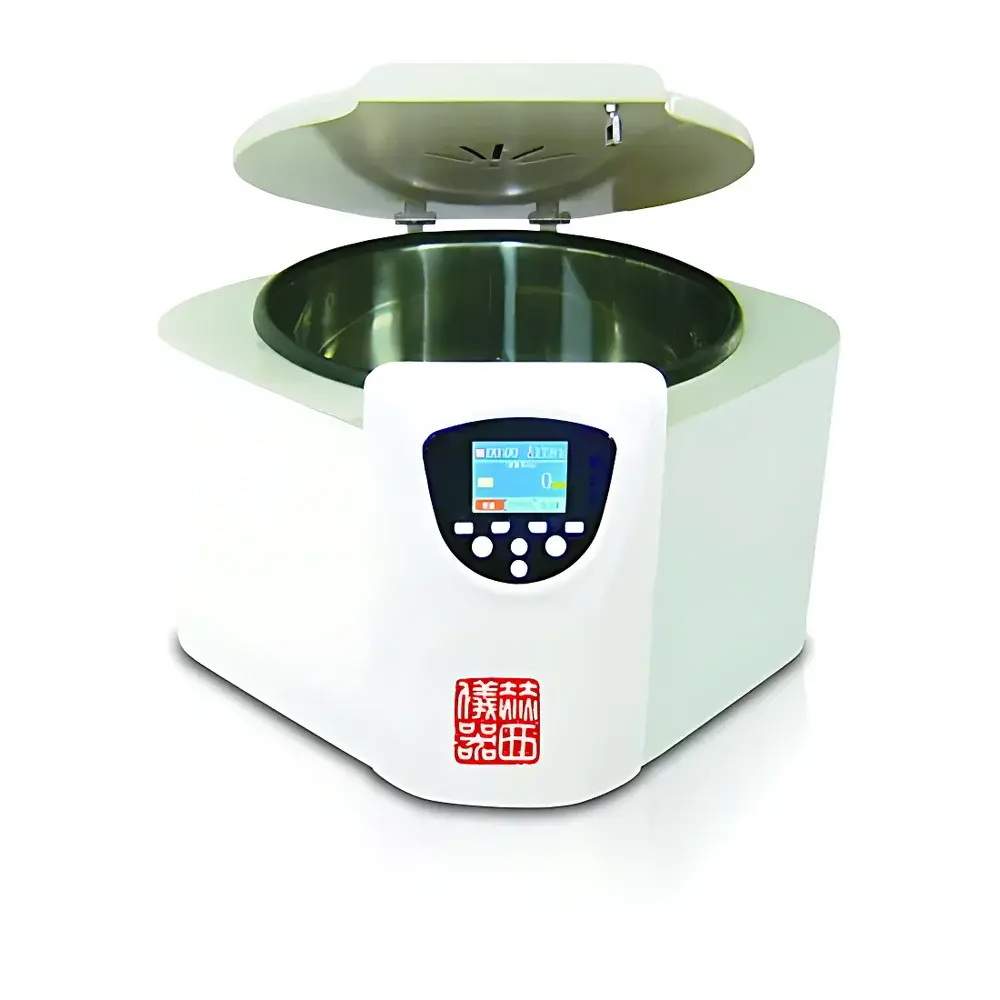
Hesley TD5 Pulp Water Retention Value (WRV) Centrifuge
| Brand | Hesley |
|---|---|
| Origin | Hunan, China |
| Model | TD5 WRV Centrifuge |
| Instrument Type | Benchtop Centrifuge |
| Max Speed | 5000 rpm |
| Max RCF | 4800 ×g |
| Max Capacity | 4 × 250 mL |
| Acceleration/Deceleration | 10-step control |
| Timer Range | 1–99 h 59 min / Continuous / Short-spin |
| Speed Accuracy | ±50 rpm |
| Noise Level | ≤60 dB(A) |
| Power Supply | AC 220 V, 50 Hz |
| Dimensions (L×W×H) | 600 × 540 × 360 mm |
| Weight | 35 kg |
| Certifications | ISO 9001:2015, ISO 13485:2016, CFDA registered |
| Compliance | GB/T 29286–2012 |
Overview
The Hesley TD5 Pulp Water Retention Value (WRV) Centrifuge is a purpose-built benchtop centrifuge engineered specifically for standardized determination of water retention capacity in wood pulp and recycled fiber suspensions. It operates on the principle of controlled mechanical dewatering under defined centrifugal force to isolate bound (swelling) water from free and surface water—enabling quantitative assessment of fiber hydration, swelling behavior, and fibrillation degree. This method is directly aligned with GB/T 29286–2012, the Chinese national standard equivalent to ISO 23703 (Determination of water retention value of pulps), which specifies sample preparation via vacuum filtration into uniform pulp cakes followed by centrifugation at precisely regulated speed and duration. The resulting WRV—expressed as grams of water retained per 100 g of oven-dry pulp—is a critical rheological and structural indicator used across pulp & paper R&D, quality control, and process optimization.
Key Features
- High-precision DC brushless motor with high-torque output and microprocessor-based speed regulation ensures stable operation at 5000 rpm with ±50 rpm accuracy—critical for reproducible WRV results across repeated batches.
- Dual-mode human interface: 5.7-inch TFT-LCD color display with both capacitive touch and physical keypad support; real-time simultaneous display of setpoints (speed, time, RCF) and actual running parameters; parameter adjustment possible during active spin without interruption.
- 10-step programmable acceleration and deceleration profiles minimize shear-induced fiber re-suspension and preserve cake integrity during braking—essential for maintaining measurement fidelity in low-density pulp matrices.
- Triple-stage damping system including asymmetric counterweight design, silicone gel shock absorbers, and reinforced chassis mounting delivers <60 dB(A) acoustic performance and eliminates vibration transmission to adjacent instrumentation.
- Robust safety architecture: stainless steel 304 rotor chamber, triple-layer steel front shield, auto-locking motorized door with aviation-grade latch mechanism, and comprehensive fault detection (imbalance, overtemperature, overvoltage, undervoltage, overspeed).
- 20-user-programmable protocols stored in non-volatile memory; automatic recall of last-used method at power-on; multi-language UI (English, Chinese, Russian, Portuguese) for international laboratory deployment.
Sample Compatibility & Compliance
The TD5 supports standardized WRV testing of all major pulp types—including bleached/unbleached kraft, mechanical, thermomechanical (TMP), chemithermomechanical (CTMP), and recycled deinked pulp—when prepared as 250 mL filter cakes using ASTM TAPPI T261 or GB/T 29286–2012 compliant filtration apparatus. Its 4 × 250 mL angular rotor configuration enables parallel processing of four replicate samples per run, significantly improving throughput in QC labs. Optional accessories include polyamide fiber adapters for 5–50 mL filtration cups and horizontal rotors for auxiliary applications such as supernatant recovery. The instrument complies with ISO 9001:2015 (quality management) and ISO 13485:2016 (medical device QMS), and holds CFDA registration—making it suitable for GLP-regulated environments where audit-trail documentation and traceable calibration are required.
Software & Data Management
While the TD5 operates as a standalone instrument with embedded firmware, its parameter logging capability supports manual data capture for lab notebook integration. All run records—including date/time stamp, selected program ID, final speed, elapsed time, and RCF—can be exported via USB port for external archiving. Though no proprietary software suite is bundled, the device’s adherence to GB/T 29286–2012 test logic facilitates seamless incorporation into LIMS workflows. For laboratories requiring electronic record compliance (e.g., FDA 21 CFR Part 11), optional third-party data acquisition modules may be interfaced via RS-232 or analog output ports (available upon request).
Applications
- Quantitative evaluation of pulp refining efficiency and fiber development during mechanical or chemical refining stages.
- Correlation of WRV with sheet strength properties (tensile index, burst factor, tear resistance) in predictive modeling of paper machine performance.
- Monitoring consistency of recycled fiber blends in packaging board production lines.
- Validation of enzyme treatment efficacy in biorefinery applications targeting cellulose accessibility enhancement.
- Comparative assessment of nanocellulose dispersion stability and hydrogel-forming capacity in advanced material research.
FAQ
What standard does the TD5 centrifuge comply with for WRV testing?
It is fully aligned with GB/T 29286–2012, which references ISO 23703 methodology and defines sample preparation, centrifugation conditions (4000 rpm for 15 min), and calculation protocol.
Can the TD5 be used for applications beyond pulp WRV testing?
Yes—the 4 × 250 mL angular rotor and programmable speed/timing allow adaptation for general low-speed sedimentation tasks, including sludge dewatering assays, polymer gel separation, and coarse particle settling studies.
Is rotor imbalance protection active during WRV runs with asymmetric pulp cakes?
Yes—real-time dynamic imbalance sensing triggers immediate deceleration and error flagging before reaching unsafe vibration thresholds, preventing damage to both rotor and sample integrity.
Does the instrument support GLP-compliant audit trails?
Native firmware logs essential run metadata; full 21 CFR Part 11 compliance requires integration with validated external data capture systems, which the TD5’s RS-232 interface supports.
What maintenance intervals are recommended for long-term WRV accuracy?
Annual verification of speed calibration against NIST-traceable tachometer and biannual inspection of rotor threads, O-rings, and brake pad wear are advised per manufacturer guidelines.
Related Products



