
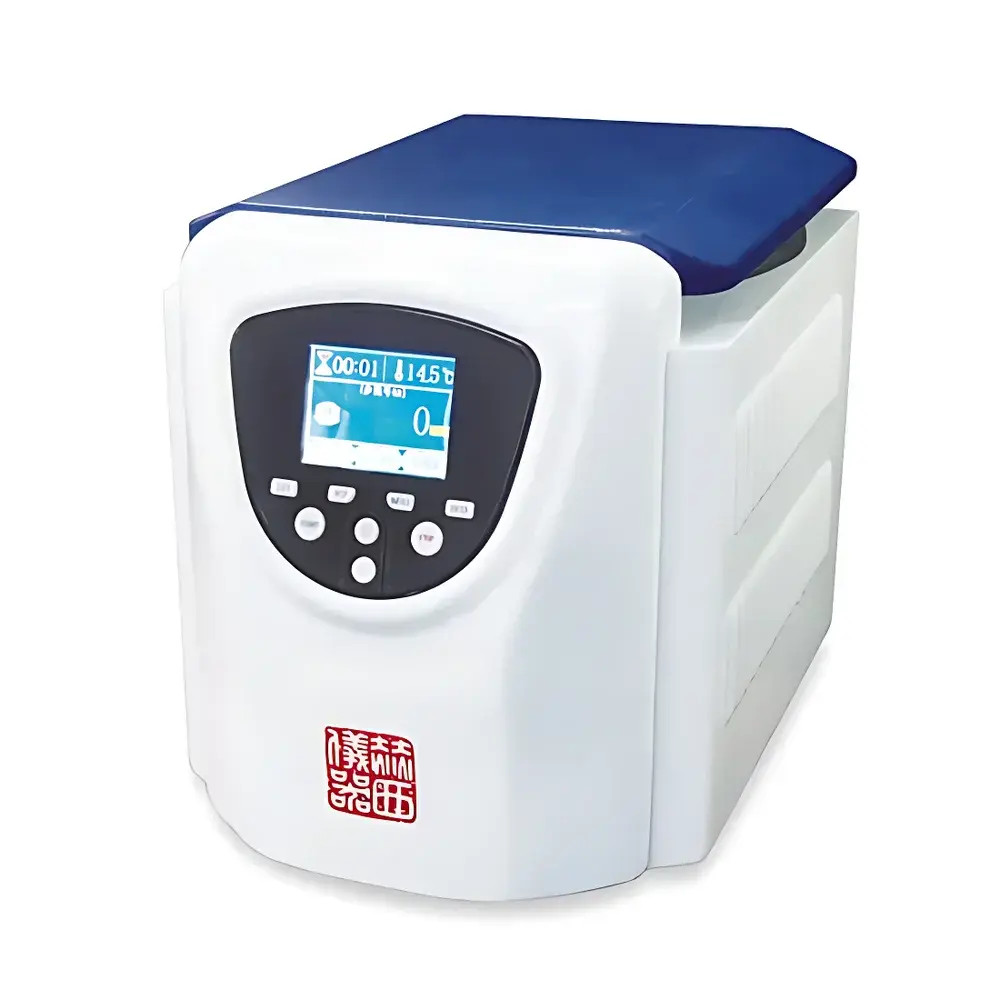
Hettich TG16MW Benchtop High-Speed Centrifuge
| Brand | Hettich |
|---|---|
| Origin | Hunan, China |
| Manufacturer Type | Authorized Distributor |
| Country of Origin | China |
| Model | TG16MW |
| Instrument Type | Benchtop Centrifuge |
| Speed Range | High-Speed (10,000–30,000 rpm) |
| Function | General-Purpose Centrifugation |
| Configuration | Fixed-Angle Rotor |
| Max Capacity | 12 × 10 mL |
| Max Speed | 16,500 rpm |
| Max RCF | 19,600 × g |
| Dimensions (L×W×H) | 380 × 260 × 310 mm |
| Weight | 17 kg |
| Power Supply | AC 220 V, 50 Hz |
| Motor | Brushless Frequency-Controlled AC Motor |
| Control System | Microprocessor-Based with TFT Touchscreen |
| Noise Level | ≤60 dB(A) |
| Acceleration/Deceleration | 10 Programmable Ramp Profiles (Fastest: 30 s to full speed and 30 s to stop) |
| Timer Range | 1 min – 99 h 59 min |
| Stored Protocols | 20 User-Defined Programs |
| Rotor Compatibility | Standard Fixed-Angle Rotors for 1.5/2.0 mL, 5 mL, 7 mL, and 10 mL Tubes |
Overview
The Hettich TG16MW is a compact, benchtop high-speed centrifuge engineered for precision separation in resource-constrained or space-limited laboratory environments. It operates on the principle of sedimentation under controlled rotational force (RCF), enabling rapid pelleting of cellular components, subcellular organelles, macromolecules, and particulates from low-volume liquid samples. Designed for ambient-temperature operation—without refrigeration—the TG16MW serves laboratories where thermal sensitivity is not a primary concern but high RCF and reproducible rotor dynamics are essential. Its maximum rated speed of 16,500 rpm delivers up to 19,600 × g, making it suitable for routine nucleic acid isolation, protein precipitation, cell harvesting, and microfiltration support across academic, clinical, agricultural, and food safety testing labs.
Key Features
- Robust all-steel construction with stainless-steel centrifuge chamber for corrosion resistance and long-term mechanical stability.
- 4.3-inch TFT true-color touchscreen interface with dual-control logic (touch + physical key backup), displaying real-time setpoints and actual parameters including speed (rpm), RCF (×g), time remaining, and rotor temperature (ambient).
- Brushless frequency-controlled AC motor ensures quiet operation (≤60 dB[A]), minimal vibration, zero carbon dust generation, and extended service life without brush replacement.
- Dedicated RCF calculation key allows instant conversion between rpm and relative centrifugal force—critical for method transfer and protocol standardization.
- Electromechanical door lock system with automatic engagement verification provides fail-safe rotor containment during operation.
- Ten programmable acceleration and deceleration profiles—including “soft stop” for delicate pellets—support method optimization; fastest ramp-up and ramp-down each complete within 30 seconds.
- Onboard memory stores up to 20 user-defined protocols with independent naming, parameter locking, and recall functionality—enhancing workflow continuity and operator traceability.
Sample Compatibility & Compliance
The TG16MW accommodates common fixed-angle rotors supporting standard microcentrifuge tubes (1.5/2.0 mL), conical tubes (5 mL, 7 mL, and 10 mL), and multi-tube configurations (e.g., 12 × 10 mL). All rotors are dynamically balanced and certified to ISO 15528:2018 (laboratory equipment — requirements for rotors and adapters). While the unit does not include active cooling, its ambient-temperature design complies with IEC 61010-1:2010 for electrical safety in laboratory instruments. The control firmware supports audit-ready operation logs (timestamped start/stop events and program selections), aligning with GLP documentation practices for non-regulated research environments. It is compatible with standard biosafety cabinet placement due to its low heat dissipation (<350 W total power draw) and compact footprint (380 × 260 × 310 mm).
Software & Data Management
The TG16MW operates via embedded microprocessor firmware—no external PC or proprietary software required. All operational data (run history, rotor ID recognition, error codes, and executed protocols) are retained in non-volatile memory. Timestamped event logging includes date/time stamps for every run initiation, termination, and emergency stop. Though not FDA 21 CFR Part 11 compliant out-of-the-box (as it lacks electronic signature capability and encrypted audit trails), the device supports manual record-keeping workflows consistent with ISO/IEC 17025:2017 clause 7.5.2 (control of recorded data). Optional RS-232 or USB-to-serial interfaces (available as field-upgrade kits) enable integration into LIMS environments for automated run logging—subject to local validation.
Applications
- Routine pelleting of mammalian, bacterial, and yeast cells prior to lysis or storage.
- Clarification of crude lysates and supernatants in molecular biology workflows (e.g., plasmid preps, PCR cleanup).
- Sedimentation of nanoparticles, colloids, and emulsions in food science and material characterization labs.
- Separation of serum/plasma from whole blood in point-of-care or veterinary diagnostic settings.
- Preparative isolation of mitochondria, nuclei, or membrane fractions using differential centrifugation steps (in combination with lower-speed units).
- High-throughput sample concentration in environmental microbiology (e.g., waterborne pathogen recovery).
FAQ
Is the TG16MW suitable for use in a biosafety cabinet?
Yes—its compact dimensions, low acoustic emission (≤60 dB[A]), and absence of active cooling fans allow safe integration into Class II A2 cabinets without airflow disruption.
Does it support rotor auto-recognition?
No—the TG16MW requires manual rotor selection via touchscreen; however, each rotor’s maximum speed and RCF limits are preloaded and enforced by firmware to prevent overspeed conditions.
Can I export run logs externally?
Not natively; data remains stored internally. Export requires optional serial interface hardware and custom scripting on the host side.
What safety certifications does it hold?
It meets IEC 61010-1:2010 (Safety Requirements for Electrical Equipment for Measurement, Control, and Laboratory Use) and carries CE marking per EU Directive 2014/30/EU (EMC) and 2014/35/EU (LVD).
Is rotor balancing mandatory before each run?
Yes—users must ensure symmetrical tube loading per the rotor’s balance diagram; the unit does not feature active imbalance detection or automatic shutdown for minor imbalances.



