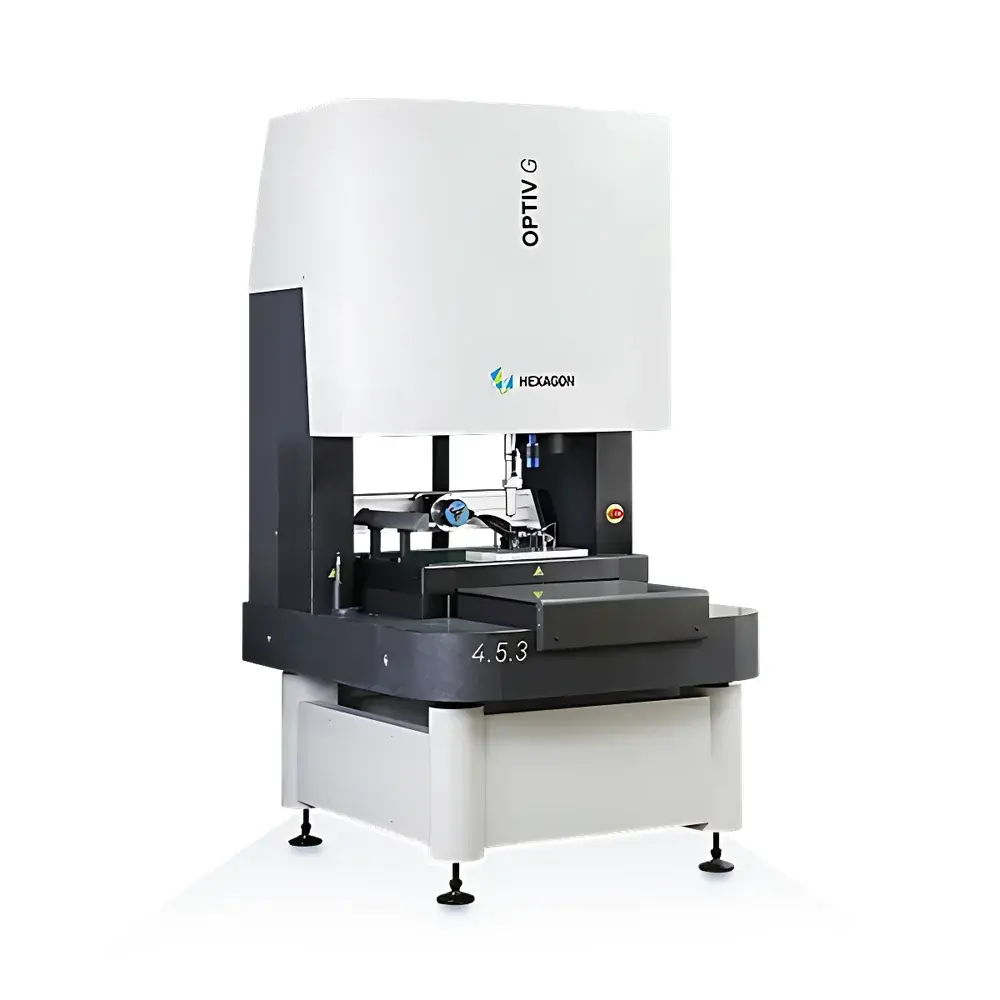
Hexagon Metrology OPTIV PERFORMANCE/M/G Series Multi-Sensor Coordinate Measuring Machine (CMM) with Vision, Contact, and Confocal Capabilities
| Brand | Hexagon Metrology |
|---|---|
| Origin | China (Shandong) |
| Model | OPTIV PERFORMANCE/M/G |
| Structural Design | Fixed-bridge, granite base |
| Drive Configuration | Central drive on all three axes |
| Positioning System | High-accuracy open optical encoder scales |
| Imaging System | Industrial-grade monochrome or color CCD camera |
| Zoom Optics | Motorized zoom lens or 2-step manual zoom |
| Software | PC-DMIS Vision metrology software suite |
| Optional Sensors | Confocal chromatic white-light sensor |
| Optional Accessories | CNC rotary table (for multi-face automated measurement) |
| Z-Axis Configuration | Single-Z (standard) or Dual-Z (high-precision vertical probing & imaging alignment) |
| Compliance | Designed to support ISO 10360-7, VDI/VDE 2617 Part 7, and GD&T evaluation per ASME Y14.5 and ISO 1101 |
Overview
The Hexagon Metrology OPTIV PERFORMANCE/M/G Series is a high-stability, multi-sensor coordinate measuring machine engineered for precision dimensional metrology in quality control laboratories and production environments. Built upon a monolithic granite base and fixed-bridge architecture, the system integrates optical imaging, tactile probing, and optional confocal white-light sensing within a single platform. Its central-drive kinematic design minimizes Abbe error across X, Y, and Z axes—ensuring traceable geometric accuracy and long-term repeatability. The OPTIV platform operates on the principle of coordinate metrology: physical part features are localized in 3D space via calibrated sensors, and their dimensions, form, orientation, and location are evaluated against CAD-based GD&T specifications. This architecture supports both manual operator-guided inspection and fully automated CNC measurement routines—making it suitable for first-article inspection, process validation, and ongoing SPC-driven quality assurance.
Key Features
- Fixed-bridge mechanical architecture with full-granite structural frame for thermal stability and vibration damping
- Central-drive motion system on all three linear axes to reduce cosine and Abbe errors during measurement
- High-resolution open optical encoder scales providing real-time position feedback with sub-micron interpolation capability
- Dual imaging configurations: selectable industrial monochrome CCD (optimized for edge contrast) or color CCD (for surface texture and material differentiation)
- Modular optical zoom systems—including motorized continuous zoom and discrete 2-step zoom lenses—for rapid magnification adjustment without refocusing
- Integrated PC-DMIS Vision software environment supporting ISO-compliant GD&T evaluation, automated feature recognition, and batch reporting
- Dual-Z axis configuration (available on M and G models) enables simultaneous independent control of imaging focus and tactile probe positioning—critical for hybrid measurement strategies involving surface topography and geometric tolerancing
- Optional chromatic confocal white-light sensor for non-contact surface profiling, step-height measurement, and transparent or reflective material analysis
- CNC rotary table integration allows full 360° indexing and automated multi-face measurement within a single program—reducing fixture complexity and operator intervention
Sample Compatibility & Compliance
The OPTIV PERFORMANCE/M/G accommodates parts ranging from small precision components (e.g., watch gears, medical implants, semiconductor fixtures) up to medium-sized machined housings and injection-molded assemblies. Worktable load capacities range from 30 kg to 50 kg depending on model variant (PERFORMANCE: 30–40 kg; M: 30–50 kg; G: 35–50 kg), with maximum part envelopes spanning 400 × 400 mm (smallest) to 1350 × 1745 mm (largest). All models comply with environmental operating requirements per ISO 22983 (metrology laboratory conditions) and are designed to operate within temperature-controlled environments (20 ± 1 °C, 1 °C/h drift limit). Measurement uncertainty statements align with ISO 10360-7 for vision-based CMMs and support verification per VDI/VDE 2617 Part 7. Data integrity and audit readiness are reinforced through PC-DMIS Vision’s built-in 21 CFR Part 11 compliance module—enabling electronic signatures, user access controls, and immutable measurement history logs required under GLP and GMP frameworks.
Software & Data Management
PC-DMIS Vision serves as the unified metrology software platform, offering seamless transition between vision-based edge detection, touch-trigger probing, and confocal scanning workflows. The software supports direct CAD import (STEP, IGES, X_T), automatic feature recognition (holes, slots, circles, planes), and parametric GD&T evaluation—including profile, position, concentricity, and runout. Measurement programs can be created offline using simulation mode and deployed directly to the machine. Reporting is configurable per customer template or industry standard (e.g., AIAG PPAP, IATF 16949), with export options including PDF, Excel, XML, and database-compatible CSV. All measurement data—including raw image frames, point clouds, and sensor timestamps—is stored in a structured project file format with SHA-256 hash integrity verification. Audit trails record operator identity, timestamp, program revision, and any manual overrides—meeting documentation requirements for FDA-regulated device manufacturing and aerospace AS9100 audits.
Applications
Typical applications include geometric validation of machined aluminum and stainless-steel components in automotive powertrain systems; form and position verification of plastic housing assemblies for consumer electronics; micro-feature inspection of PCB stencils and connector pins; thickness and flatness assessment of glass substrates in display manufacturing; and surface roughness correlation studies using confocal white-light profiles. In medical device production, the system verifies critical tolerances on orthopedic implant fixtures and catheter hubs—supporting ISO 13485 compliance. Aerospace suppliers utilize the dual-Z configuration to measure blade root geometry and airfoil section profiles on turbine components where optical focus stability and tactile probe repeatability must be decoupled.
FAQ
What distinguishes the Dual-Z configuration from standard single-Z models?
The Dual-Z architecture provides two physically independent Z-axis mechanisms: one dedicated to objective lens focus control (for optimal image sharpness across varying part heights), and another for tactile probe vertical positioning—eliminating mechanical coupling that could compromise either imaging resolution or probe repeatability.
Can the system perform measurements traceable to national standards?
Yes—when operated within specified environmental conditions and verified using certified artefacts (e.g., calibration spheres, step gauges, grid plates), measurement results are traceable to SI units via national metrology institutes (NMI) through documented calibration chains compliant with ISO/IEC 17025.
Is PC-DMIS Vision validated for regulated industries?
PC-DMIS Vision includes IQ/OQ documentation packages and supports 21 CFR Part 11 compliance when deployed with Windows domain authentication, role-based permissions, and enabled audit trail logging—fulfilling validation requirements for pharmaceutical, biotech, and Class III medical device manufacturers.
What level of training is required to operate the system effectively?
Operators require foundational metrology knowledge and basic CAD literacy. Hexagon-certified training courses (ranging from 2-day fundamentals to 5-day advanced programming) are available globally, with competency assessments aligned to ISO 17025 personnel qualification guidelines.
How does the system handle reflective or translucent surfaces?
Via adaptive lighting control (LED ring light + coaxial illumination), polarization filters, and optional confocal white-light sensing—which measures surface height independently of reflectivity or transparency—enabling reliable edge detection on polished metals, anodized aluminum, and clear polymer films.