Hexagon PC-DMIS Metrology Software
| Brand | Hexagon |
|---|---|
| Origin | USA |
| Model | PC-DMIS |
| Compliance | PTB & NIST Certified |
| CAD Integration | Native IGES, STEP, Parasolid, CATIA, NX, SolidWorks (via DCI/DCT) |
| Programming Modes | GUI-driven QuickStart, Feature-Based Auto-Teach, Scripted Advanced Programming (variables, loops, conditionals, external I/O) |
| GD&T Engine | Full ASME Y14.5 & ISO 1101 compliant geometric tolerance evaluation |
| Reporting | 10+ built-in report templates, 3D PDF, XML, CSV, customizable HTML/PDF |
| Simulation | Real-time CMM kinematic model with collision detection using fixture & part CAD |
| Scanning Support | Linear, circular, helical, surface, section, UV-mapped, mesh-based, and freeform scanning with adaptive point density control |
| Thin-Wall Measurement | Dedicated feature types for edge points, corner points, high points, elliptical slots, polygonal cutouts, and deformable surface fitting |
| Feature Construction | 14+ geometric feature classes with >100 construction methods |
| Certification | Validated for GLP/GMP environments |
Overview
PC-DMIS is Hexagon’s flagship metrology software platform engineered for coordinate measuring machines (CMMs), optical trackers, laser scanners, and portable arms. Built on a modular, object-oriented architecture, it implements ISO/IEC 17025-aligned measurement principles—leveraging calibrated probe kinematics, thermal compensation models, and traceable uncertainty propagation—to deliver repeatable, auditable dimensional verification across production, quality assurance, and R&D workflows. Unlike generic CAD viewers or basic inspection tools, PC-DMIS embeds metrological rigor directly into its core logic: every reported deviation is computed against a mathematically defined nominal geometry, with full propagation of machine volumetric error, probe bending, and temperature-induced drift. Its dual-mode operation—offline programming with real-time simulation and online execution with live path validation—enables zero-risk deployment in high-precision manufacturing environments where first-article approval, PPAP submission, or regulatory audits demand documented metrological traceability.
Key Features
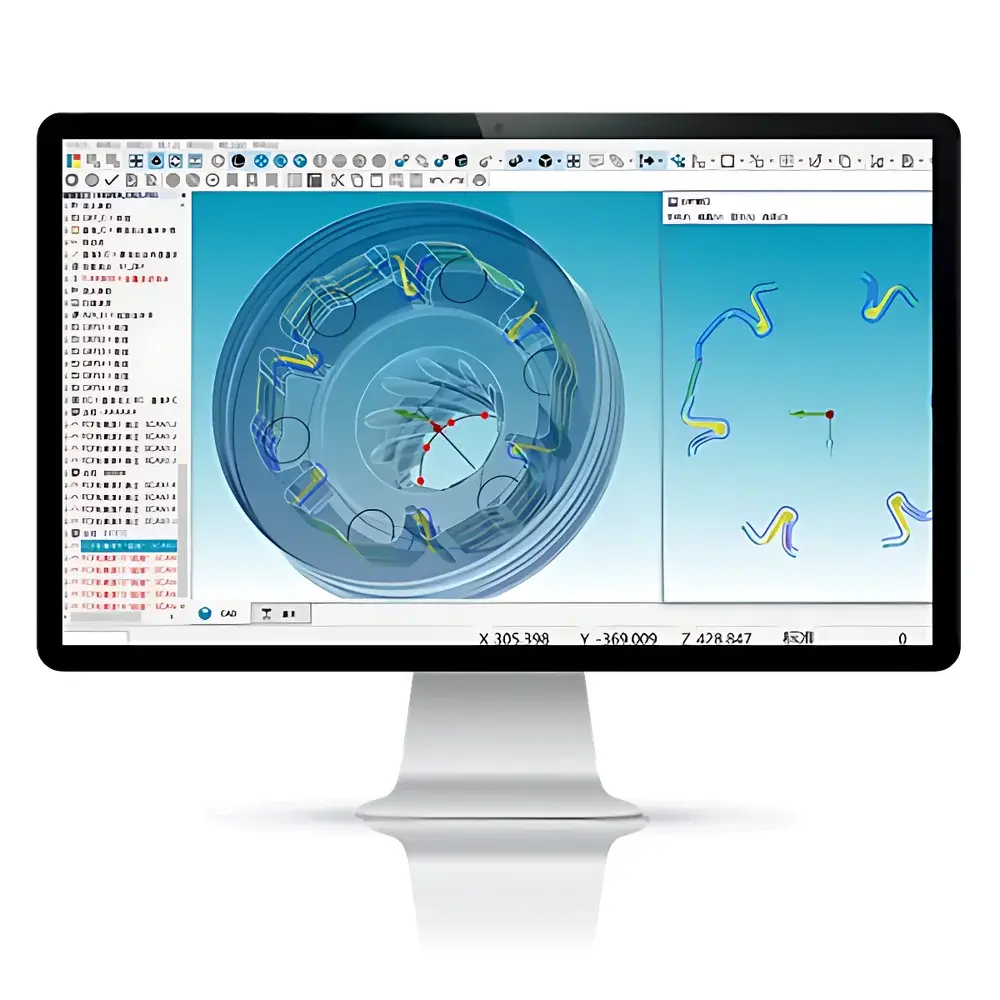
- Object-oriented visual programming interface with drag-and-drop feature trees, contextual toolbars, and real-time graphical feedback showing measured vs. nominal status per feature.
- Auto-feature recognition engine that identifies holes, slots, planes, cylinders, cones, and complex freeform surfaces directly from imported CAD without manual seeding.
- Dedicated thin-wall metrology module supporting deformation-aware probing strategies for sheet metal, plastic housings, glass enclosures, and tubular components—applying localized compensation based on material stiffness estimates and contact force modeling.
- Native CAD interoperability via direct interfaces (DCI) to CATIA V5/V6, Siemens NX, SolidWorks, Creo, and JT formats—enabling bi-directional PMI (Product Manufacturing Information) extraction and GD&T-driven program generation.
- Collision-free path simulation using dynamic CMM kinematic models synchronized with fixture and part CAD assemblies—detecting potential probe-stylus, stylus-body, or machine-structure interference before physical execution.
- Comprehensive GD&T evaluation engine compliant with ASME Y14.5–2018 and ISO 1101:2017 standards—including composite position tolerancing, profile of a surface with datum reference frames, and runout analysis with rotational best-fit alignment.
- Advanced scanning framework supporting high-density point cloud acquisition, adaptive sampling density control, and intelligent mesh reconstruction for reverse engineering and form analysis.
Sample Compatibility & Compliance
PC-DMIS supports measurement of parts ranging from micro-scale medical implants (5 m). It accommodates diverse material behaviors—including thermally unstable polymers, anisotropic composites, and elastically deforming thin-walled structures—through configurable probing strategies, multi-point averaging, and iterative best-fit algorithms. The software complies with international metrological standards including ISO 10360 (CMM acceptance testing), ISO 15530 (calibration of coordinate measuring systems), and ASTM E1316 (non-destructive testing terminology). All measurement reports include full metadata: machine ID, probe calibration certificate number, environmental conditions (temperature, humidity), operator ID, and timestamped audit logs. For regulated industries, PC-DMIS provides 21 CFR Part 11-compliant electronic signatures, role-based access control, and immutable audit trails required under FDA, ISO 13485, and IATF 16949 quality management systems.
Software & Data Management
PC-DMIS employs a centralized project database architecture supporting concurrent multi-user editing with version control and change history tracking. Measurement programs are stored as XML-based .prg files with embedded CAD references, ensuring reproducibility across different hardware platforms. Raw point cloud data, scan trajectories, and statistical process control (SPC) datasets export natively to Minitab, JMP, and Q-DAS formats. Reporting modules generate ANSI Z540-1 traceable certificates, 3D PDFs with interactive cross-sections and deviation heatmaps, and automated HTML dashboards for shop-floor visualization. Optional modules include PC-DMIS SPC for real-time capability analysis (Cp/Cpk, Pp/Ppk), PC-DMIS Report Designer for enterprise-level template customization, and PC-DMIS Cloud Sync for secure offsite backup and remote program review.
Applications
PC-DMIS is deployed globally in Tier-1 automotive powertrain facilities for cylinder head port geometry validation, in semiconductor packaging labs for leadframe coplanarity assessment, in orthopedic device manufacturing for ISO 14242-compliant implant surface finish verification, and in turbine blade foundries for airfoil profile conformity against ASME B46.1 surface texture specifications. Its scanning capabilities support mold cavity verification per ISO 20457, while its GD&T automation reduces programming time by up to 70% for complex castings with hundreds of datums and tolerance zones. In aerospace MRO operations, PC-DMIS CAD++ enables rapid post-maintenance dimensional requalification of repaired wing skins using photogrammetry-derived reference models.
FAQ
Does PC-DMIS require a dedicated hardware dongle or network license server?
Yes—PC-DMIS operates under concurrent or node-locked licensing managed via Hexagon’s FlexNet Publisher infrastructure, supporting both on-premise license servers and cloud-hosted entitlement management.
Can PC-DMIS import GD&T annotations directly from native CAD files?
Yes—through certified DCI connectors, PC-DMIS reads PMI data from CATIA, NX, and SolidWorks, automatically generating measurement routines aligned with annotated tolerances and datum structures.
Is offline programming validated against actual machine kinematics?
Yes—PC-DMIS uses machine-specific volumetric error maps and articulated arm kinematic models to simulate motion accuracy, repeatability, and probe deflection prior to runtime execution.
How does PC-DMIS ensure measurement traceability for ISO/IEC 17025 accreditation?
All measurement results include embedded links to calibration certificates, environmental logs, uncertainty budgets calculated per GUM (JCGM 100), and digital signatures meeting ILAC-P10 requirements.
What file formats does PC-DMIS support for reporting and data exchange?
Standard exports include XML (for MES integration), CSV (for SPC tools), 3D PDF (with embedded deviation color maps), HTML5 dashboards, and proprietary .rpt files with full metrological metadata.