
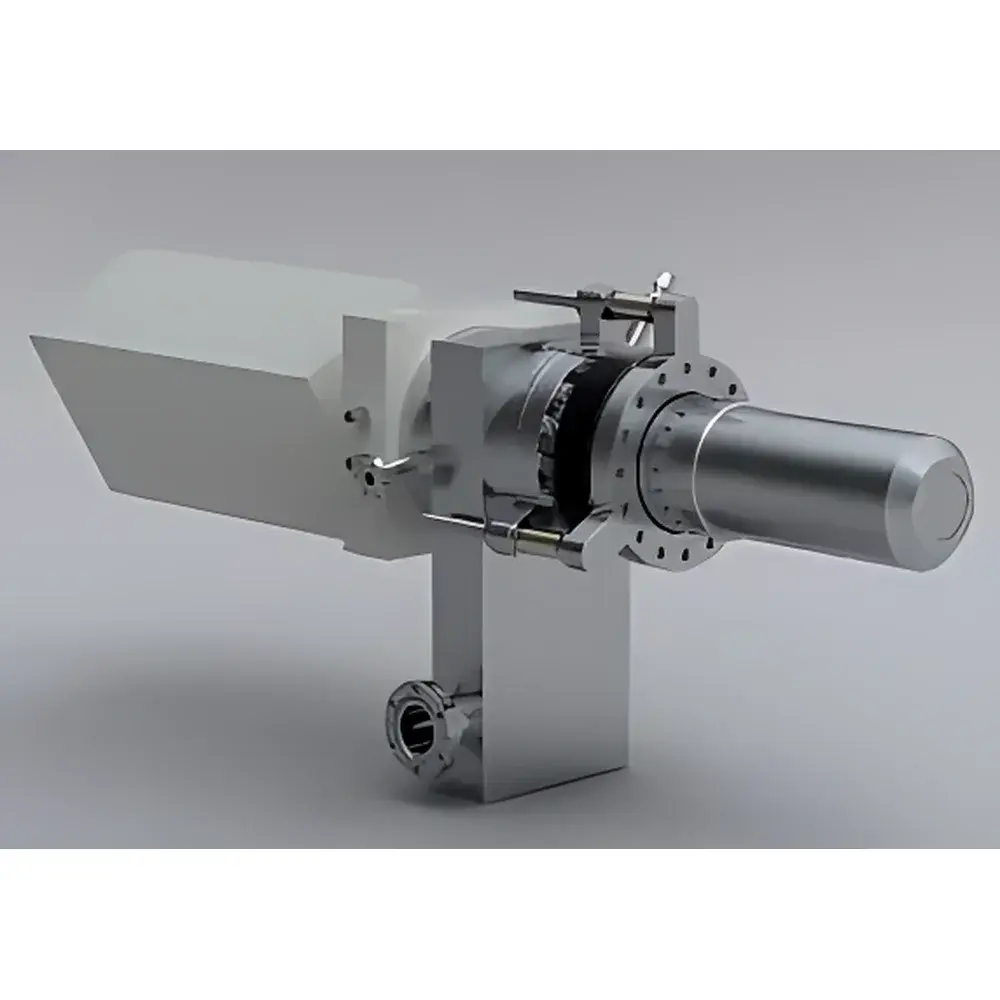
Hiden EPIC Triple-Filter Quadrupole Mass Spectrometer with Pulse Ion Counting and Pole Bias Control
| Brand | Hiden |
|---|---|
| Origin | United Kingdom |
| Model | EPIC |
| Mass Range | 1–300 amu (standard), up to 2500 amu (optional) |
| Detection Limit | 5 × 10⁻¹⁵ mbar (standard), 1 × 10⁻¹⁶ mbar (optional) |
| Energy Range | ±100 eV (standard), ±1000 eV (optional) |
| Resolution | 0.1% valley, 1% valley |
| Dynamic Range | 10⁷ |
| Measurement Speed | 500 points/s |
| Signal Gating Resolution | 0.1 µs |
| Stability | < ±0.5% peak height drift over 24 h |
| Quadrupole Diameter Options | 6 mm, 9 mm, 12 mm |
| Ion Source Control | Adjustable extraction voltage for soft ionization and appearance potential spectroscopy |
| Detector Options | Pulse ion counting (7-decade dynamic range), Faraday cup (up to 5 × 10¹⁰ ions/s) |
| UHV Compatibility | Standard UHV housing |
| Software | MASsoft Professional Suite |
| Upgrade Path | Compatible with Hiden Plasma/SIMS platforms (EQP, EQS, PSM, Maxim) via energy filter integration (Bessel Box, 45° sector, or electrostatic energy analyser) |
Overview
The Hiden EPIC Triple-Filter Quadrupole Mass Spectrometer is a high-performance, ultra-high vacuum (UHV)-compatible analytical instrument engineered for quantitative and qualitative analysis of neutral species, radicals, and positive/negative ions in demanding scientific and industrial environments. Based on a robust triple-filter quadrupole architecture—comprising pre-filter, mass-analyzing, and post-filter stages—the EPIC system delivers exceptional mass selectivity, signal stability, and resistance to contamination. Its core measurement principle relies on radiofrequency (RF) and direct-current (DC) voltage scanning across hyperbolic quadrupole rods to achieve mass-dependent ion transmission, with real-time pulse ion counting enabling detection down to sub-femtogram partial pressures. Designed explicitly for surface science, plasma diagnostics, catalysis research, thin-film deposition monitoring, and reactive gas analysis, the EPIC operates within base pressures as low as 1 × 10⁻¹¹ mbar and supports in situ, time-resolved studies including temperature-programmed desorption (TPD), pulsed laser ablation, and time-of-flight (TOF)-coupled experiments.
Key Features
- Triple-filter quadrupole design with integrated pole bias control for enhanced ion transmission efficiency and background suppression
- Pulse ion counting detector offering 7-decade linear dynamic range (10⁷); optional Faraday cup for high-flux applications (up to 5 × 10¹⁰ ions/s)
- Programmable ion source with independent extraction voltage control—enabling tunable ionization energy for soft ionization and appearance potential mapping
- Configurable quadrupole rod diameters (6 mm, 9 mm, 12 mm) to optimize sensitivity vs. resolution trade-offs for specific application requirements
- Ion energy analysis capability from ±100 eV (standard) to ±1000 eV (optional), supporting electron-impact, metastable, and surface-induced dissociation studies
- Sub-microsecond signal gating (0.1 µs resolution) for time-resolved energy/mass distribution profiling and synchronization with external stimuli (e.g., lasers, RF pulses)
- Integrated UHV-compatible housing with bakeable flanges (CF/ISO-K); optional liquid-nitrogen-cooled shield for cryogenic surface trapping and radical stabilization
- RF-enhanced pre-filter stage improves long-term operational stability in chemically aggressive or particulate-laden process streams
Sample Compatibility & Compliance
The EPIC platform is validated for continuous operation in ultra-high vacuum (UHV) systems (≤1 × 10⁻¹¹ mbar), making it suitable for surface science chambers, molecular beam epitaxy (MBE) reactors, and plasma processing tools. It complies with ISO 20000-1 for service management infrastructure and meets mechanical and electrical safety standards per IEC 61010-1. While not inherently GLP/GMP-certified, the MASsoft Professional software supports audit-trail logging, user-access controls, and electronic signature functionality—enabling alignment with FDA 21 CFR Part 11 requirements when deployed in regulated QC/QA environments. The system adheres to ASTM E1941 (Standard Test Method for Determining Mass Spectral Purity) and ISO 11146 (laser-based diagnostics integration protocols), and its calibration traceability is maintained against NIST-traceable gas standards (e.g., Ar, N₂, CO, CH₄).
Software & Data Management
Control, acquisition, and analysis are executed via MASsoft Professional—a modular, Windows-based software suite developed exclusively for Hiden mass spectrometers. MASsoft provides real-time spectral visualization, multi-channel time-series logging, automated TPD sequence scripting, and synchronized parameter recording (e.g., furnace temperature, RF power, gate timing). All raw data are stored in vendor-neutral HDF5 format with embedded metadata (timestamp, instrument configuration, calibration history), ensuring interoperability with Python (h5py), MATLAB, and third-party chemometrics platforms. Data export options include CSV, ASCII, and XML; batch processing supports peak integration, background subtraction, isotopic ratio calculation, and kinetic modeling (e.g., Arrhenius fitting for desorption activation energies). Remote operation is supported via TCP/IP, and API access enables integration into SCADA and MES environments for continuous process monitoring.
Applications
- Surface science: Adsorption/desorption kinetics, reaction intermediates identification, work function measurements via appearance potential spectroscopy
- Plasma diagnostics: Quantitative speciation of reactive oxygen/nitrogen species (ROS/RNS), electron temperature estimation, ion energy distribution function (IEDF) mapping
- Catalysis research: In situ monitoring of gas-phase products during Fischer–Tropsch synthesis, methanol steam reforming, and ammonia decomposition
- Thin-film and semiconductor processing: Residual gas analysis (RGA) during sputtering, ALD, and etching; detection of precursor fragmentation and chamber wall outgassing
- Radical chemistry: Detection and quantification of short-lived neutral radicals (e.g., OH•, CH₃•) using electron-impact ionization coupled with supersonic jet expansion
- Materials outgassing studies: Identification of volatile organic compounds (VOCs), siloxanes, and plasticizers released from polymers, composites, and adhesives under thermal stress
FAQ
What vacuum level is required for optimal EPIC performance?
The EPIC is designed for UHV environments (≤1 × 10⁻¹¹ mbar). Minimum operational pressure is 1 × 10⁻¹⁰ mbar; stable detection at 5 × 10⁻¹⁵ mbar requires active pumping and proper chamber conditioning.
Can the EPIC be used for real-time process monitoring?
Yes—its 500 points/s acquisition rate, programmable scan sequences, and TCP/IP interface support integration into closed-loop feedback systems for reactor control and endpoint detection.
Is calibration required before each analysis?
Mass calibration is stable for ≥6 months under constant thermal conditions; sensitivity calibration using certified gas mixtures is recommended prior to quantitative work or after hardware maintenance.
How does the triple-filter architecture improve signal-to-noise ratio?
Pre- and post-filters remove non-resonant ions and scattered electrons, reducing chemical noise and secondary electron contributions—particularly critical in plasma and catalytic effluent analysis.
What upgrade paths exist for transitioning to SIMS or plasma analysis?
The EPIC chassis accepts Hiden’s Bessel Box energy analyzer, 45° sector electrostatic analyzer, or EQP-series ion optics—enabling seamless migration to EQP (energy-resolved plasma analysis) or PSM (SIMS depth profiling) configurations.
Related Products





