
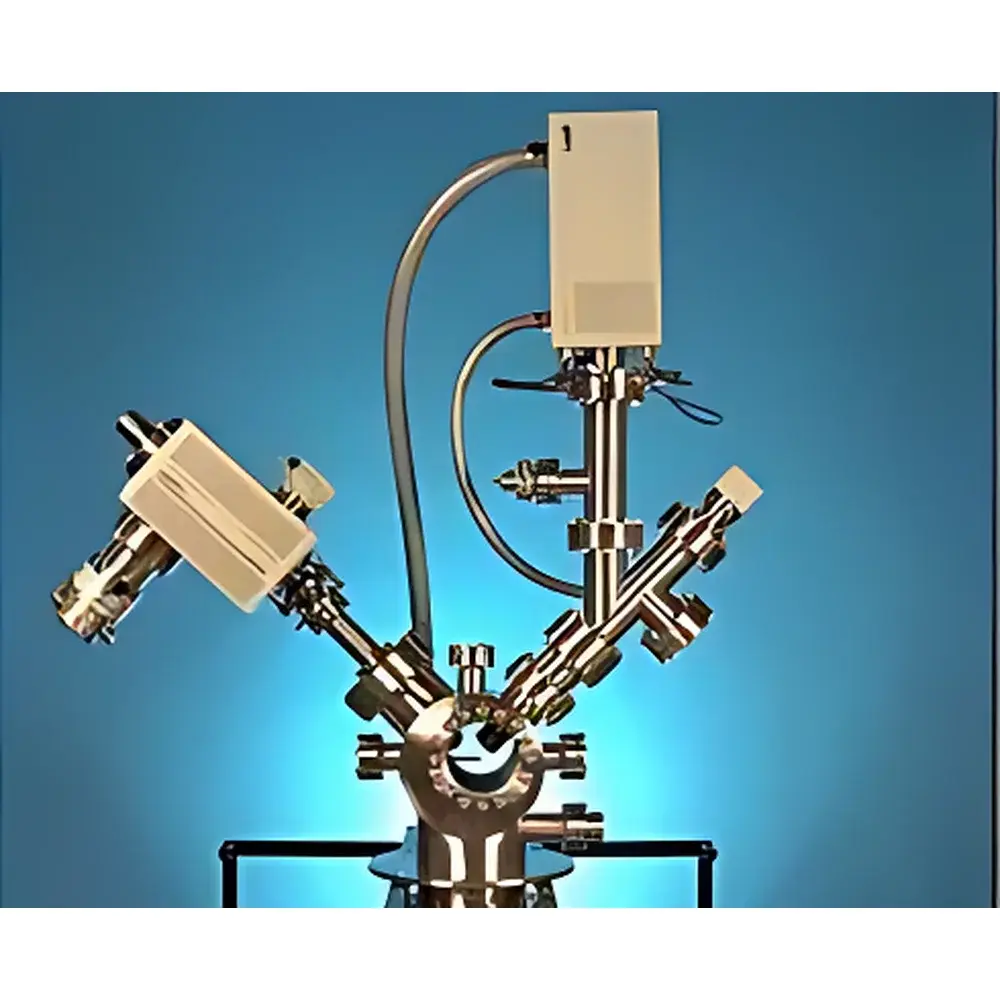
Hiden EQS Bolt-On Secondary Ion Mass Spectrometer Probe
| Brand | Hiden |
|---|---|
| Origin | United Kingdom |
| Manufacturer Type | Authorized Distributor |
| Origin Category | Imported |
| Model | EQS |
| Instrument Type | Quadrupole Mass Spectrometer |
| Mass Range | Up to 2500 u |
| Analyzer Type | 45° Electrostatic Sector |
| Energy Resolution | 0.05 eV step / 0.25 eV FWHM |
| Detection | High-Sensitivity Pulsed Ion Counting Detector (7-decade dynamic range) |
| Pumping | Three-Stage Differential Pumping System |
| Ion Optics | Grating-Controlled Depth Profiling Capability |
| Interface | UHV-Compatible “Bolt-On” Mounting for Existing Surface Science Chambers |
| Compatibility | Fully Integrated with Hiden SIMS Workstation and MASsoft Control Software |
| Safety | Penning Gauge Interlock for Overpressure Protection |
| Communication | RS232, RS485, or Ethernet LAN |
Overview
The Hiden EQS Bolt-On Secondary Ion Mass Spectrometer (SIMS) Probe is a high-performance, ultra-high vacuum (UHV)-compatible analytical module engineered for integration into existing surface science reaction chambers. Unlike standalone SIMS instruments, the EQS operates as a modular “bolt-on” probe—designed to extend the analytical capabilities of UHV systems without requiring chamber redesign or major infrastructure modification. It employs primary ion beam sputtering (e.g., O−, Cs+, Ga+, or Bin+) to generate secondary ions from solid sample surfaces, which are then mass-analyzed using a quadrupole mass filter coupled with a 45° electrostatic sector energy analyzer. This hybrid architecture enables simultaneous acquisition of mass-resolved secondary ion signals across a broad mass range (up to 2500 u) with precise kinetic energy discrimination—critical for static SIMS (sub-monolayer sensitivity), dynamic SIMS (depth profiling), and surface stoichiometry quantification. The system’s differential pumping architecture ensures stable UHV conditions (<1×10⁻⁹ mbar) at the analysis region even when interfaced with chambers operating at marginally higher base pressures.
Key Features
- Modular UHV bolt-on design: Enables direct mounting onto standard CF- or ISO-flanged surface science chambers without breaking vacuum.
- Quadrupole mass spectrometer with three-stage differential pumping: Achieves effective mass resolution and suppresses background gas interference, supporting reliable detection up to 2500 u.
- 45° electrostatic sector energy analyzer: Provides fine energy stepping (0.05 eV increments) and narrow full-width-at-half-maximum (FWHM) energy resolution (0.25 eV), essential for charge-state separation and energy-filtered imaging.
- Pulsed ion counting detector with 7-decade dynamic range: Delivers quantitative signal linearity across orders of magnitude—from trace impurity detection (ppb-level surface concentration) to bulk matrix ion intensities.
- Grating-controlled depth profiling: Synchronizes primary beam rastering, sputter rate calibration, and mass spectral acquisition to enable sub-nanometer depth resolution in layered materials.
- Integrated safety interlocks: Penning gauge feedback loop automatically disables ion sources upon detected overpressure events, ensuring compliance with UHV equipment protection protocols.
- Multi-interface control: Native support for RS232, RS485, and Ethernet LAN enables remote operation and synchronization with external controllers (e.g., sample manipulators, cryostats, or plasma sources).
Sample Compatibility & Compliance
The EQS probe accommodates conductive and semi-conductive solid samples—including single crystals, thin films, catalysts, semiconductors, oxides, and polymer-coated substrates—mounted on standard Omicron-style or SPECS-compatible sample holders. Non-conductive samples may be analyzed under low-energy electron flooding to mitigate charging artifacts. The system complies with ISO/IEC 17025 requirements for test method validation and supports audit-ready data acquisition under GLP/GMP frameworks when used with MASsoft software configured for 21 CFR Part 11 compliance (electronic signatures, audit trails, user access controls). All vacuum components meet ASTM E576 standards for UHV material outgassing performance, and ion optical alignment procedures follow ISO 18115-2 (Surface chemical analysis — Vocabulary — Part 2: Terms used in secondary ion mass spectrometry).
Software & Data Management
Control and data acquisition are managed through Hiden’s MASsoft platform—a Windows-based application certified for scientific instrument control in regulated environments. MASsoft provides real-time spectral display, multi-channel transient acquisition, mass calibration wizards, and batch processing for depth profile reconstruction. Raw data files (.mas) are stored in HDF5 format, enabling metadata-rich archiving and third-party interoperability (e.g., with MATLAB, Python via h5py, or commercial surface analysis suites such as CASA or IGOR Pro). The software supports automated sequence scripting for unattended operation, including beam parameter ramping, dwell time optimization per mass channel, and interlocked stage movement. Audit trail logs record all user actions, parameter changes, and hardware state transitions—fully traceable for FDA or EMA regulatory submissions.
Applications
- Static SIMS for molecular surface mapping of organic monolayers, self-assembled films, and biomaterial interfaces.
- Dynamic SIMS depth profiling of semiconductor heterostructures (e.g., Si/SiGe, GaN/AlGaN), dopant distribution analysis, and interface diffusion studies.
- Contaminant identification and localization in microelectronics packaging, photovoltaic absorber layers, and battery electrode cross-sections.
- In situ reaction monitoring: Coupled with thermal desorption, gas dosing, or plasma exposure within UHV chambers to track surface chemistry evolution in real time.
- Leak detection and residual gas analysis (RGA) via front-end ion source configuration—leveraging the same quadrupole and detector for complementary vacuum diagnostics.
- Combined FAB-SIMS and SNMS workflows using interchangeable ion gun modules for enhanced ion yield from insulating or fragile samples.
FAQ
Can the EQS probe be retrofitted to non-Hiden UHV chambers?
Yes—the probe uses standardized CF-100 or ISO-KF 63 flanges and includes mechanical and electrical interface documentation compliant with ConFlat® and UHV industry conventions.
What primary ion sources are compatible with the EQS?
The probe accepts OEM-standard ion guns including oxygen, cesium, gallium liquid metal ion sources (LMIS), and bismuth cluster sources; FAB and SNMS configurations require optional front-end ion optics kits.
Is depth resolution validated per ISO 18115-2?
Yes—depth resolution characterization follows ISO-defined test protocols using certified multilayer reference materials (e.g., SiO2/Si, Al2O3/Al), with reporting of sputter yield, mixing layer thickness, and instrumental broadening contributions.
Does MASsoft support automated calibration against NIST-traceable standards?
Yes—mass calibration routines include polynomial fitting against known peaks (e.g., 12C1H+, 16O+, 28Si+) and allow import of NIST SRM spectral libraries for peak assignment verification.
How is detector dead-time correction implemented?
The pulsed ion counting system applies real-time FPGA-based dead-time compensation algorithms, with user-selectable correction models (paralyzable vs. non-paralyzable) and automatic saturation flagging during high-flux acquisition.






