
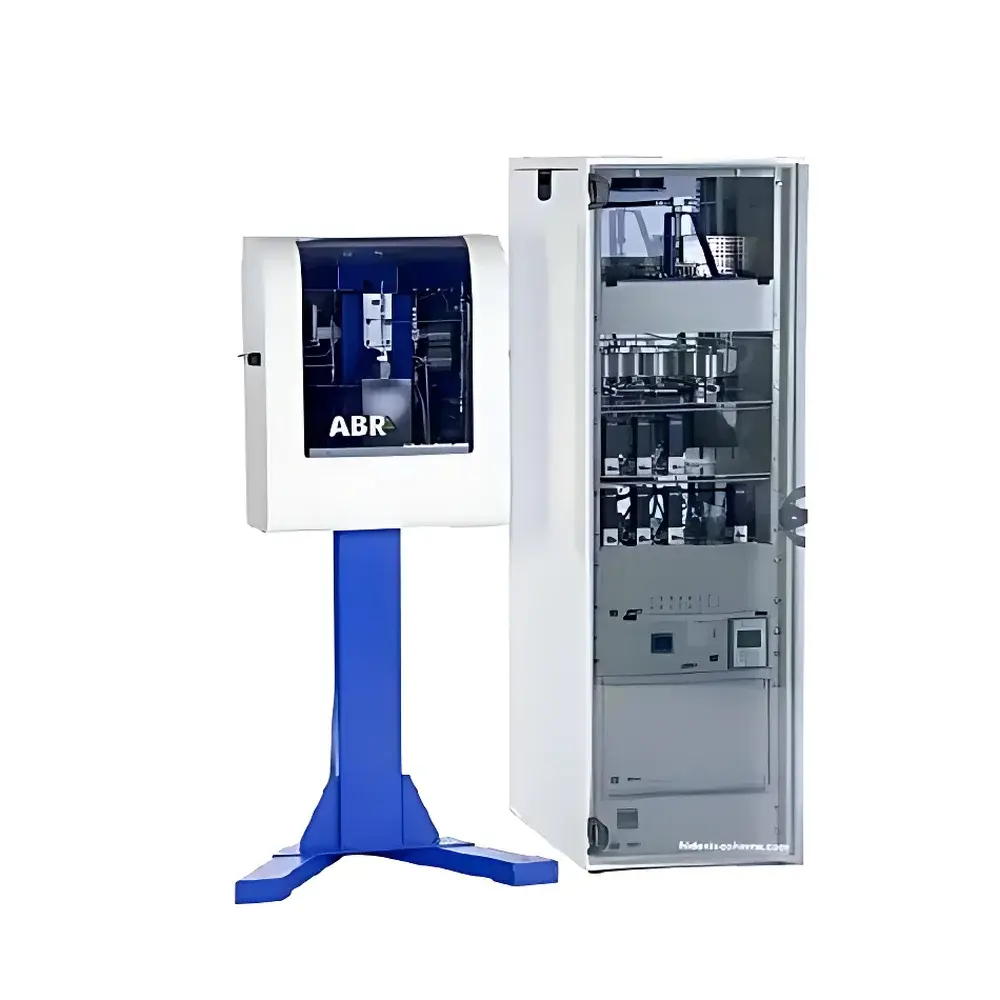
Hiden Isochema ABR Breakthrough Curve Analyzer with Integrated Quadrupole Mass Spectrometer
| Brand | Hiden |
|---|---|
| Origin | United Kingdom |
| Model | ABR |
| Operating Pressure Range | 0.1–50 bar (configurable) |
| Temperature Control Range | 0–300 °C |
| Temperature Stability | ±0.025 °C |
| Flow Rate Range | 3–1000 mL/min |
| Sample Bed Volume | 2 cm³ (interchangeable) |
| Mass Spectrometer | Hiden DSMS, m/z 1–200 amu, response time ≤200 ms |
| Vacuum Option | UHV pump station (1×10⁻⁸ mbar) |
| Compliance | Fully compatible with GLP/GMP data integrity requirements |
Overview
The Hiden Isochema ABR Breakthrough Curve Analyzer is a research-grade, fully programmable dynamic adsorption characterization system engineered for high-precision measurement of gas-phase competitive adsorption behavior under controlled pressure, temperature, flow, and composition conditions. At its core, the ABR implements the breakthrough curve methodology—a transient, column-based technique grounded in mass transport theory—where a gaseous mixture flows through a fixed-bed adsorbent while downstream effluent composition is monitored in real time using an integrated quadrupole mass spectrometer (QMS). This configuration enables quantitative determination of equilibrium isotherms, kinetic selectivity, adsorption capacity, diffusion coefficients, and co-adsorption interference effects—particularly critical for evaluating novel microporous materials such as metal–organic frameworks (MOFs), zeolitic imidazolate frameworks (ZIFs), covalent organic frameworks (COFs), and porous organic cages (POCs). Unlike static volumetric or gravimetric systems, the ABR operates under dynamic, industrially relevant conditions—including elevated pressures up to 50 bar—making it uniquely suited for simulating real-world separation processes including flue gas treatment, noble gas recovery, biogas upgrading, and nuclear off-gas purification.
Key Features
- Fully automated experimental execution: Predefined protocols govern pressure ramping, temperature programming, multi-step gas switching (including vapor–vapor and gas–vapor configurations), and synchronized QMS acquisition.
- Optimized 2 cm³ research-grade sample bed: Designed for minimal axial dispersion and reproducible packing density; interchangeable cartridges support rapid method development across diverse adsorbent morphologies.
- Ultra-low dead volume gas path: Engineered to reduce residence time between reactor outlet and mass spectrometer inlet, ensuring sub-second temporal resolution (<200 ms QMS response) and accurate capture of sharp breakthrough fronts.
- Integrated Hiden DSMS dynamic sampling mass spectrometer: Quadrupole-based detection with unit-mass resolution across m/z 1–200, calibrated for quantitative partial pressure measurement without reliance on relative sensitivity factors.
- Programmable environmental control: Independent regulation of total system pressure (0.1–50 bar), superficial velocity (3–1000 mL/min), binary/multi-component feed composition, and isothermal zone temperature (0–300 °C, stability ±0.025 °C).
- In-situ pretreatment capability: Onboard heating combined with purge gas flow or vacuum evacuation (down to 10⁻⁸ mbar with optional UHV station) enables rigorous activation of moisture-sensitive or air-sensitive samples prior to adsorption testing.
Sample Compatibility & Compliance
The ABR accommodates powders, pellets, extrudates, and monoliths with particle sizes ranging from 2 mm, provided bed permeability permits laminar flow at target velocities. Its modular design supports custom reactor geometries beyond the standard 2 cm³ configuration. All hardware and firmware comply with CE marking requirements for laboratory instrumentation. Data acquisition and storage are structured to meet Good Laboratory Practice (GLP) and current Good Manufacturing Practice (cGMP) documentation standards. When configured with Hiden’s Isochema Control Suite v5.x and optional 21 CFR Part 11 compliance package, the system provides electronic signatures, role-based access control, immutable audit trails, and secure data archiving—enabling regulatory submission of adsorption datasets for pharmaceutical excipient qualification, catalyst certification, or nuclear material licensing.
Software & Data Management
Control, acquisition, and analysis are unified within Hiden Isochema Control Suite—a Windows-based application built on .NET Framework with deterministic real-time scheduling. The software features drag-and-drop experiment sequencing, live overlay of multiple mass channels, automatic baseline correction, and export-ready reporting templates aligned with ASTM D6864 (Standard Test Method for Determination of Adsorption Isotherms of Gases on Solid Sorbents). Raw time-series QMS data (intensity vs. time per m/z) and process parameters (P, T, F, composition) are stored in HDF5 format for long-term integrity and third-party interoperability. Post-processing tools include numerical derivation of fractional breakthrough, moment analysis for axial dispersion estimation, and nonlinear regression fitting to generalized Langmuir, Sips, or IAST models—each with uncertainty propagation based on replicate noise statistics.
Applications
- Air separation: Quantifying N₂/O₂ selectivity and working capacity of novel adsorbents at ambient and elevated pressures.
- Carbon dioxide capture: Evaluating amine-functionalized MOFs under simulated flue gas conditions (15% CO₂, 85% N₂, 40–60 °C, 1–2 bar).
- Nuclear fuel reprocessing: Measuring Xe/Kr separation performance of chabazite-type zeolites and functionalized POCs under trace-concentration, high-radiation-relevant gas matrices.
- Biogas and natural gas upgrading: Assessing H₂S, CO₂, and water vapor co-adsorption interference in activated carbons and Mg-MOF-74 analogues.
- Rare gas recovery: Determining He/Ne/Ar/Xe selectivity hierarchies in self-assembled organic cage materials for semiconductor-grade purification.
- Chiral separations: Characterizing enantioselective binding kinetics of volatile organic compounds (VOCs) in homochiral COF membranes.
FAQ
What types of adsorbents can be tested on the ABR?
The system is optimized for microporous and mesoporous solids including zeolites, MOFs, COFs, activated carbons, silica gels, and polymer-derived carbons. It accommodates both powder and shaped forms (pellets, extrudates) with appropriate bed engineering.
Can the ABR perform multi-component breakthrough experiments?
Yes—up to four independent gas/vapor streams can be blended and dynamically modulated during a single run, enabling true competitive adsorption studies under realistic feed compositions.
Is calibration required for quantitative concentration measurement?
The integrated Hiden DSMS is factory-calibrated for partial pressure response; however, users may perform optional multi-point calibration using certified gas standards to improve accuracy for specific analytes.
How is data validated for regulatory submissions?
With the 21 CFR Part 11 add-on module, all raw data, metadata, user actions, and processing steps are cryptographically timestamped and archived in tamper-evident format—fully auditable during FDA, EMA, or IAEA inspections.
Does the system support in-situ regeneration studies?
Yes—temperature-programmed desorption (TPD) and pressure-swing regeneration cycles can be scripted and executed automatically, with simultaneous mass spectrometric monitoring of desorbed species.




