
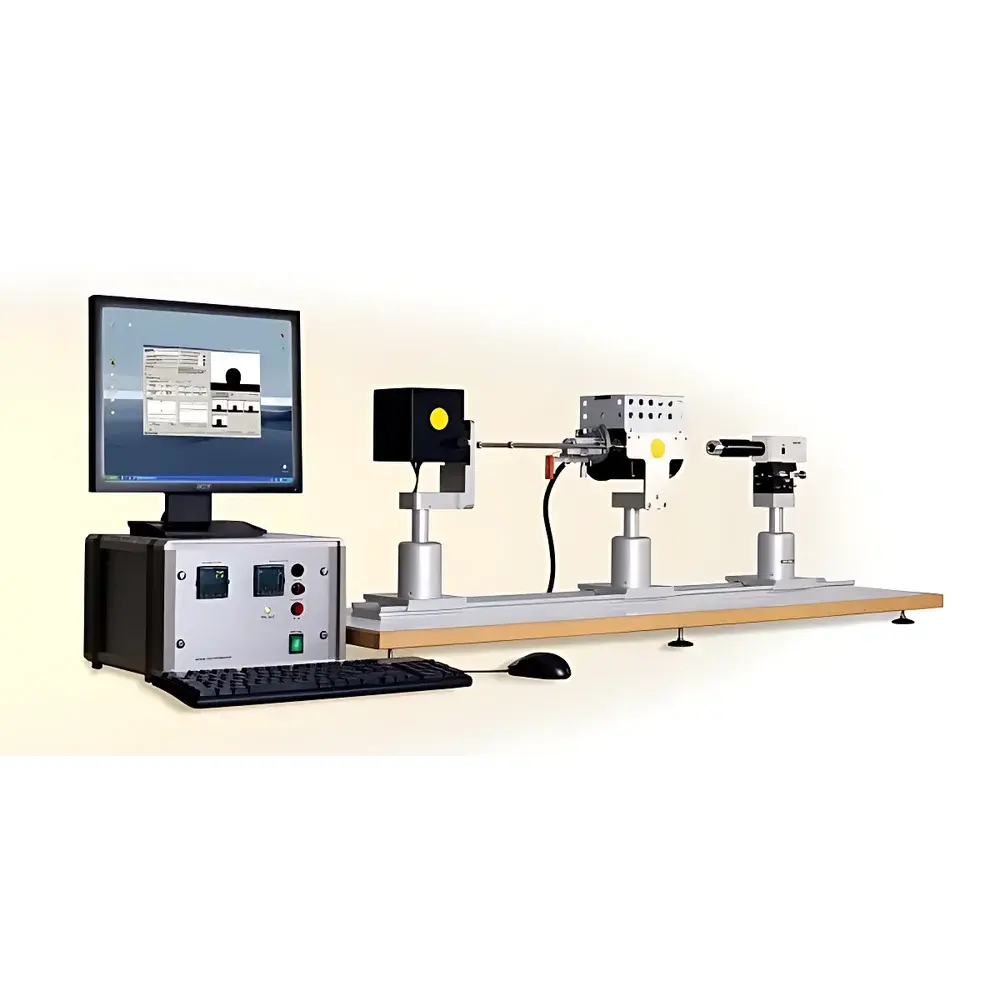
High-Temperature Contact Angle Analyzer EM301-M17 by HESSE (Distributed by Pozhi Electronic)
| Brand | Pozhi Electronic |
|---|---|
| Origin | Germany |
| Manufacturer Type | Authorized Distributor |
| Origin Category | Imported Instrument |
| Model | EM301-M17 |
| Instrument Type | Benchtop Laboratory System |
| Contact Angle Measurement Range | 0–180° |
| Contact Angle Measurement Accuracy | ±1° |
| Maximum Operating Temperature | 1700 °C |
| Temperature Accuracy | ±1 °C |
| Heating Rate Range | 0–80 °C/min |
| Optional Ultra-Low Heating Rate Module | Down to 0.1 K/h |
| Image Resolution Accuracy | 0.1% for Height, Cross-Sectional Area, and Surface Area |
| Shape Factor Calculation Precision | 0.001 |
| Compliance Standard | DIN 51730 / ISO 540:1995 |
Overview
The HESSE EM301-M17 High-Temperature Contact Angle Analyzer is a precision benchtop instrument engineered for quantitative thermal analysis of interfacial behavior in refractory and high-melting-point materials under controlled atmospheric conditions. Unlike conventional room-temperature contact angle meters, this system integrates high-resolution optical imaging with a vertically oriented, vacuum-compatible furnace capable of sustained operation up to 1700 °C. It employs the sessile drop method combined with real-time video microscopy to determine dynamic contact angles—left and right contact angles, apex angles, and wetting front progression—as a function of temperature. The measurement principle relies on geometric contour extraction from high-contrast CCD-captured silhouettes of molten droplets on solid substrates, followed by tangent-based contact angle computation using advanced edge-detection algorithms. This enables direct correlation between interfacial thermodynamics (e.g., surface energy, spreading coefficient) and macroscopic phase transitions including sintering onset, softening, hemispherical deformation, spherical collapse, and fluid flow initiation—critical parameters for metallurgical slags, ceramic precursors, glass formulations, ash fusibility assessment, and refractory lining design.
Key Features
- Vertically aligned high-temperature furnace with quartz viewport and dual-zone PID-controlled heating elements, rated for continuous operation at 1700 °C under inert or reducing atmospheres
- High-stability LED illumination system optimized for thermal glare suppression and consistent contrast across full temperature range
- 1.3 MP monochrome CCD camera with motorized focus and programmable exposure timing synchronized to thermal ramp profiles
- Dual thermocouple configuration (Type S) with independent calibration traceability to NIST standards; integrated cold-junction compensation
- Modular sample holder assembly featuring low-thermal-expansion ceramic crucibles and adjustable substrate positioning stage with micrometer-level vertical resolution (0.1% height accuracy)
- Software-enabled ultra-low heating rate mode (down to 0.1 K/h), essential for resolving subtle structural relaxation events preceding macroscopic deformation
- Automated frame-by-frame image acquisition triggered by temperature thresholds or time intervals, supporting both isothermal holds and dynamic ramps
Sample Compatibility & Compliance
The EM301-M17 accommodates solid substrates (e.g., alumina, magnesia, graphite, silicon carbide) and molten phases including oxide slags (CaO–SiO₂–Al₂O₃–MgO systems), coal ash, protective fluxes, borosilicate glasses, and technical ceramics. Sample dimensions are constrained only by furnace chamber geometry (Ø60 mm × 80 mm usable volume). All hardware and software workflows comply with DIN 51730 (determination of ash fusibility) and ISO 540:1995 (methods for determination of fusibility characteristics of coal and coke ashes). Data acquisition meets GLP requirements with audit-trail logging, user-access controls, and electronic signature support per FDA 21 CFR Part 11 when configured with compliant software licensing.
Software & Data Management
The proprietary HESSE ThermoVision™ analysis suite provides synchronized thermal–optical data fusion. It supports automatic contour detection via adaptive thresholding and B-spline fitting, calculates left/right contact angles independently, and exports time-temperature-angle matrices for post-processing. VFT (Vogel–Fulcher–Tammann) equation fitting is embedded for viscosity–temperature curve reconstruction from contact angle-derived spreading kinetics. All images, metadata, and raw thermal logs are stored in vendor-neutral HDF5 format with embedded calibration certificates. Batch processing allows comparative analysis across multiple runs—including dimensional evolution tracking (height, area, aspect ratio) and derivative-based transition point identification (dT/dt inflection detection).
Applications
- Quantification of slag–refractory wetting behavior in steelmaking ladle linings
- Determination of softening and hemispherical temperatures for coal ash fusibility classification (ASTM D1857)
- Optimization of glass-to-metal sealing interfaces in hermetic packaging
- Thermal stability assessment of ceramic matrix composites during densification
- Interfacial energy modeling of molten electrolytes on electrode substrates in high-temperature electrochemical cells
- Validation of thermodynamic databases for multicomponent oxide systems via experimental wetting constraints
FAQ
What atmosphere options are supported during high-temperature measurements?
The system operates under ambient air, argon, nitrogen, hydrogen, or forming gas (5% H₂/95% N₂) via standard gas inlet ports and optional mass-flow controllers.
Can the instrument perform automated transition temperature identification?
Yes—software algorithms detect sintering onset, softening point, hemispherical temperature, and flow temperature based on first- and second-order derivatives of dimensional change curves.
Is calibration documentation provided with the system?
Each unit ships with factory calibration reports for temperature (traceable to PTB), optical magnification, and contact angle verification using certified reference samples (e.g., sapphire standards at 1000 °C).
How is thermal drift compensated during long-duration isothermal tests?
Real-time thermocouple feedback loops continuously adjust heater output; additionally, image registration algorithms correct for sub-pixel thermal expansion-induced frame shifts.
Does the system support third-party data export formats?
Raw data exports to CSV, MATLAB (.mat), and Python-compatible NumPy arrays; processed results include PDF reports with embedded metadata and traceable timestamps.
Related Products



