
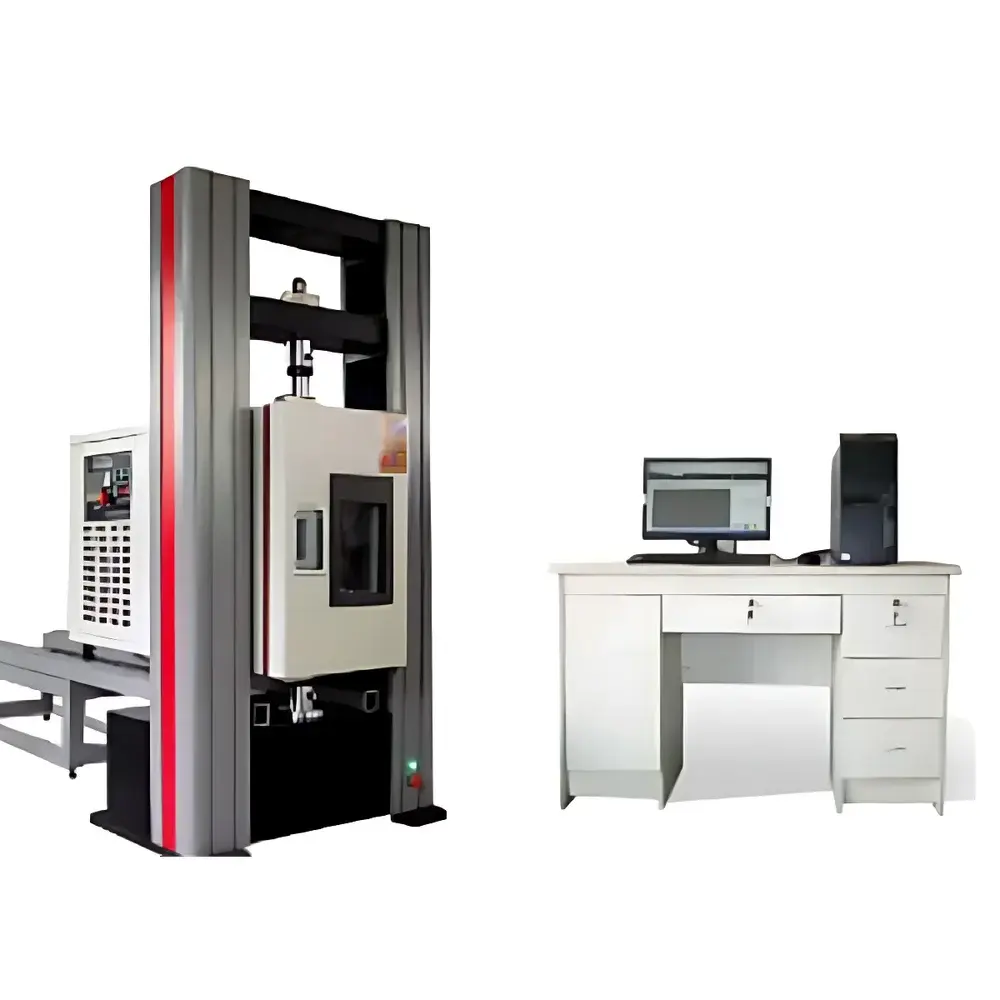
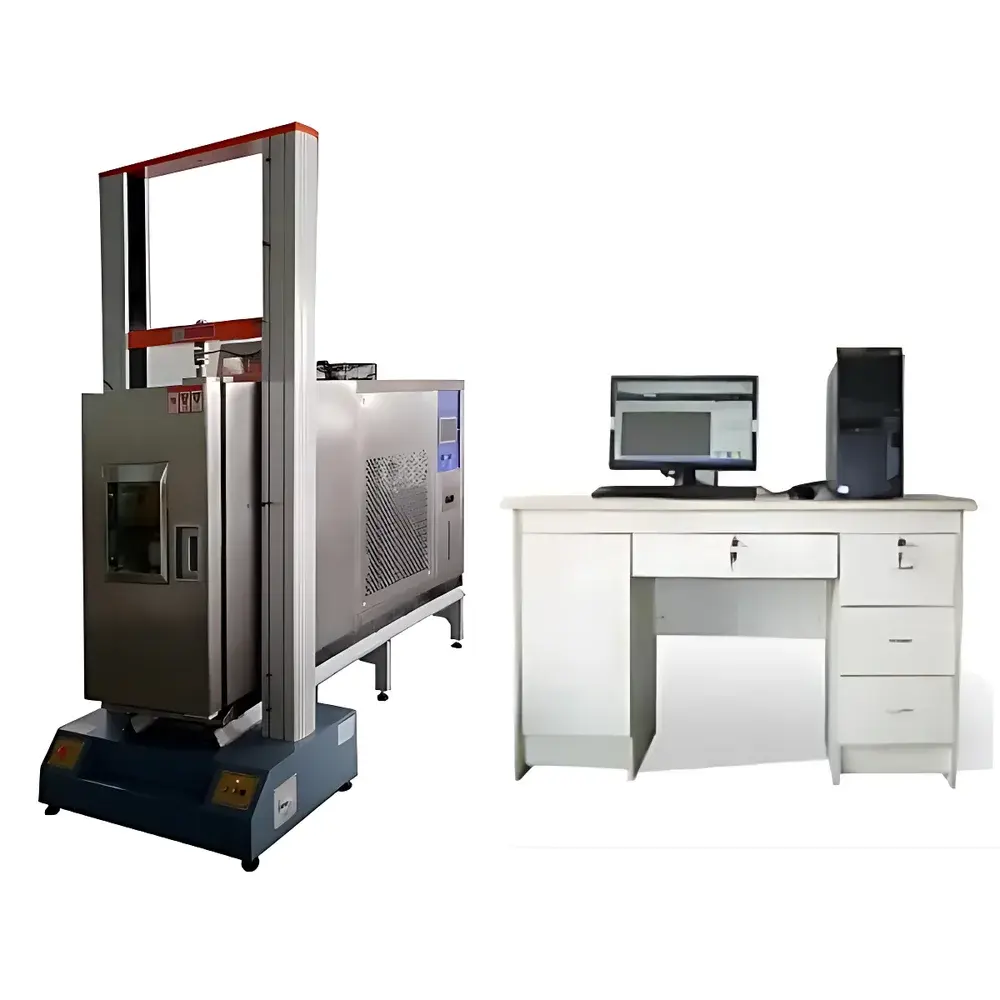
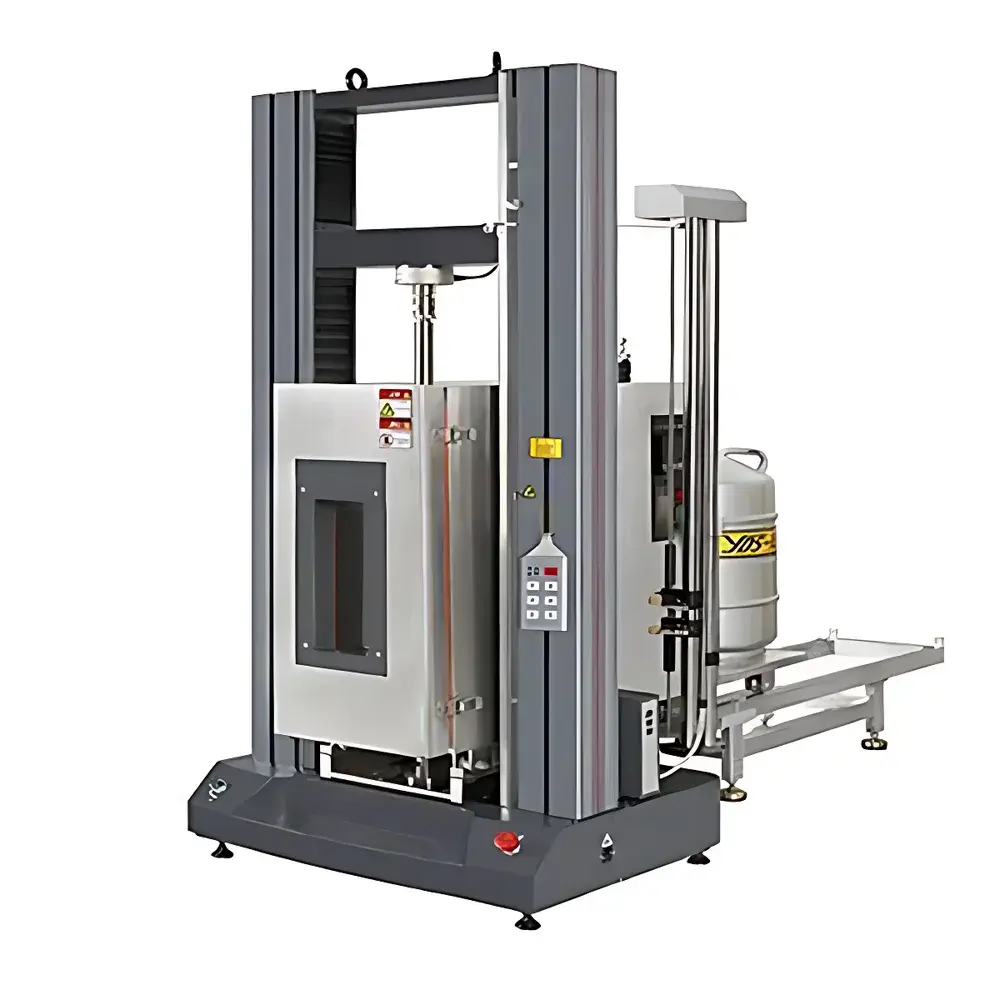
High-Temperature Electronic Universal Testing Machine Tofun TFW-288
| Key | Brand: Tofun |
|---|---|
| Origin | Shanghai, China |
| Manufacturer Type | Manufacturer |
| Instrument Type | Electromechanical Universal Testing Machine |
| Load Range | 0.01 N to 300 kN |
| Load Accuracy | ±0.5% |
| Accuracy Class | 0.5 |
| Force Resolution | 1/500,000 of Full Scale |
| Deformation Measurement Range | 0.2–100% FS |
| Deformation Accuracy | ±0.5% |
| Displacement Accuracy | ±0.5% |
| Column Spacing | 840 mm |
| Test Space (Vertical) | 1000 mm |
| Host Dimensions | 1250 × 560 × 2400 mm |
| Weight | ~380 kg |
| Power Supply | AC 220 V / 50 Hz, ±10%, 750 W |
| Environmental Operating Range | +5 °C to +35 °C |
| Temperature Chamber Range | –40 °C to +100 °C |
| Chamber Internal Dimensions | 360 × 300 × 500 mm (W×D×H) |
| Heating Power | 1.5 kW |
| Temperature Uniformity (100 mm axial) | ±2 °C |
| Temperature Stabilization Time | ≤5 min |
| Chamber Construction | 304 Stainless Steel Exterior, 316 Mirror-Finish Stainless Interior, Ceramic Fiber Insulation |
| Control System | Programmable PID Controller with Pt100 Sensors |
| Safety Features | Leakage Protection, Overcurrent Circuit Breaker |
Overview
The Tofun TFW-288 High-Temperature Electronic Universal Testing Machine is a precision-engineered electromechanical system designed for static mechanical property evaluation under controlled thermal environments. It integrates a high-rigidity dual-column load frame with a programmable environmental chamber capable of stable operation from –40 °C to +100 °C. The system operates on the principle of servo-controlled displacement actuation, where a high-fidelity ball-screw-driven crosshead applies precisely regulated tensile, compressive, flexural, shear, peel, or tear loads to specimens. Force is measured via a calibrated high-stability load cell; deformation and displacement are captured using optical encoder-based extensometry and crosshead position feedback. This architecture ensures traceable, repeatable measurements compliant with ISO 7500-1 (Class 0.5), ASTM E4, and GB/T 16491—making it suitable for R&D validation, quality assurance, and regulatory submission testing in materials science laboratories.
Key Features
- Full-range force measurement capability from 0.01 N to 300 kN with ±0.5% accuracy across 0.4–100% of full scale, eliminating range-switching artifacts
- Force resolution of 1 part in 500,000 of full scale, maintained continuously without manual range segmentation
- Integrated high-uniformity environmental chamber with ±2 °C axial temperature tolerance over 100 mm specimen zone, validated per ASTM E145 and ISO 11357-2
- Programmable multi-segment thermal profiles enabling ramp-hold-cool cycles synchronized with mechanical loading protocols
- Rigid C-frame construction with 840 mm column spacing and 1000 mm vertical test space optimized for standard and custom high-temperature fixtures
- Real-time closed-loop control of load, displacement, and strain modes—including rate-controlled, hold, and cyclic testing sequences
- Compliance with electromagnetic compatibility (EMC) standards IEC 61326-1 and safety requirements IEC 61010-1
Sample Compatibility & Compliance
The TFW-288 accommodates standardized specimens per ASTM D638 (tensile), ASTM D790 (flexure), ASTM D695 (compression), ASTM D1876 (peel), and ISO 527, ISO 178, ISO 604, as well as custom geometries up to 360 mm wide and 500 mm tall within the chamber. Specimen mounting utilizes interchangeable grips—including pneumatic, wedge, and high-temperature ceramic-faced options—with thermal isolation design to minimize heat conduction into the load train. All mechanical and thermal subsystems conform to GLP audit requirements, supporting 21 CFR Part 11-compliant data integrity when paired with optional electronic signature and audit trail modules. Calibration certificates are traceable to NIM (National Institute of Metrology, China) and internationally recognized NMIs via mutual recognition arrangements (CIPM MRA).
Software & Data Management
Control and analysis are executed via Windows-based TofunTest v5.x software—a modular platform supporting both real-time test execution and post-processing. The software implements ISO 17025-aligned data handling: raw sensor values (force, displacement, temperature, strain) are recorded at ≥1 kHz with embedded time stamps and hardware-generated checksums. All test parameters, calibration metadata, operator ID, and environmental logs are stored in encrypted SQLite databases with immutable append-only write policies. Reporting templates comply with ISO/IEC 17025 clause 7.8.2 and include configurable pass/fail criteria, statistical summaries (mean, SD, CV%), and export to PDF, CSV, or XML formats. Optional FDA 21 CFR Part 11 compliance packages provide role-based access control, electronic signatures, and full audit trails—including user actions, parameter changes, and data exports.
Applications
- Thermo-mechanical characterization of aerospace alloys (e.g., Ti-6Al-4V, Inconel 718) across service temperature ranges
- Creep and stress-relaxation behavior of polymer composites and thermoplastic elastomers under elevated temperature
- Interfacial adhesion strength of ceramic-metal brazed joints at operational temperatures
- Compression yield and modulus evolution in battery electrode coatings during thermal cycling
- Validation of ASTM D5229/D5229M (low-velocity impact after hot/wet exposure) pre-conditioning protocols
- Qualification testing of sealing materials (e.g., fluoroelastomers, graphite gaskets) per API RP 14E and ISO 23936
FAQ
What temperature uniformity can be expected inside the test zone during a 100 °C hold?
Temperature deviation remains within ±2 °C over a 100 mm axial segment centered on the gauge length, verified per ISO 11357-2 Annex B.
Is the system compatible with third-party extensometers?
Yes—the controller provides analog ±10 V and digital TTL interfaces for integration with clip-on, video, or laser extensometers meeting ASTM E83 Class B-1 or better specifications.
Can test sequences be scheduled for unattended overnight operation?
Yes. The software supports queued multi-step tests—including automatic chamber preconditioning, specimen loading simulation, and sequential thermal-mechanical cycles—with hardware interlocks preventing unsafe transitions.
How is force calibration maintained across temperature extremes?
Load cells are selected for low thermal drift (<0.02%/°C), and system-level thermal compensation algorithms apply real-time corrections based on chamber ambient and load cell body temperature readings from integrated Pt100 sensors.
Does the system support GMP-compliant documentation workflows?
With the optional Validation Package, users receive IQ/OQ documentation templates, URS mapping, and a complete 3Q protocol aligned with EU Annex 11 and PIC/S TR-14 guidelines.



