
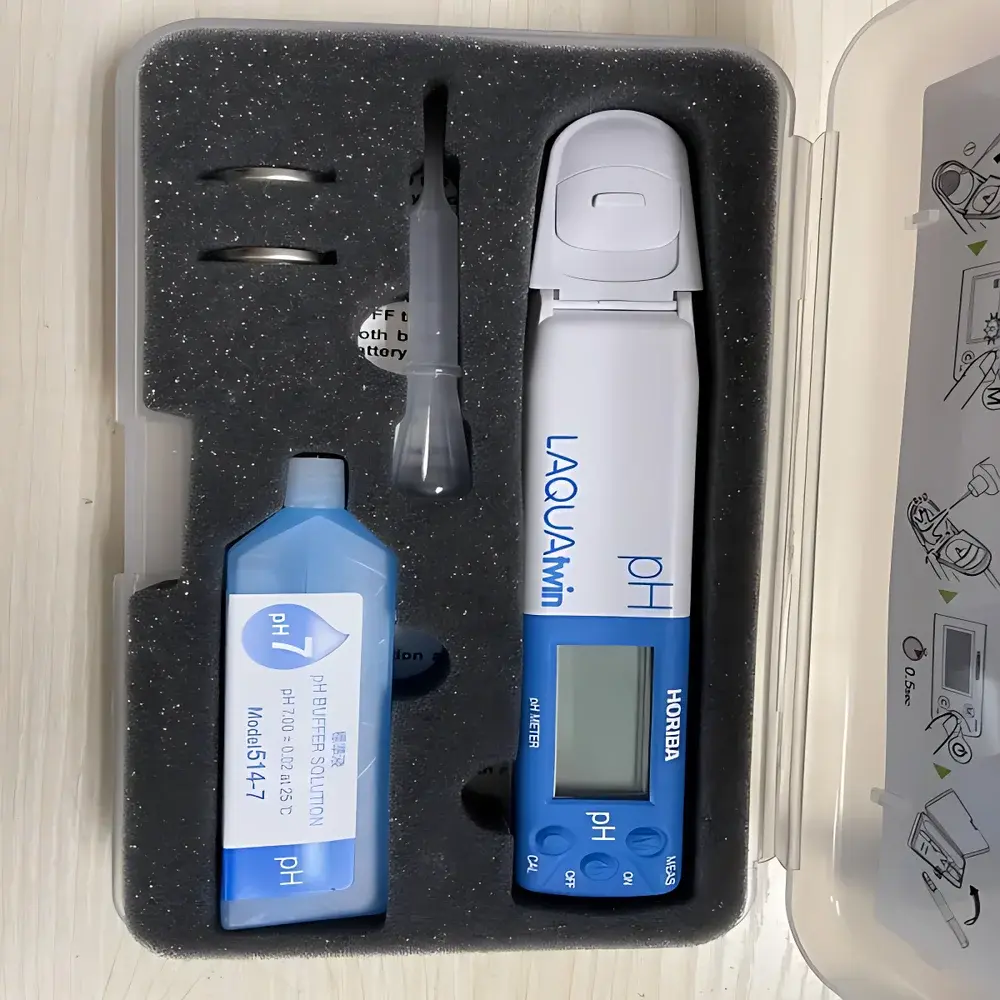
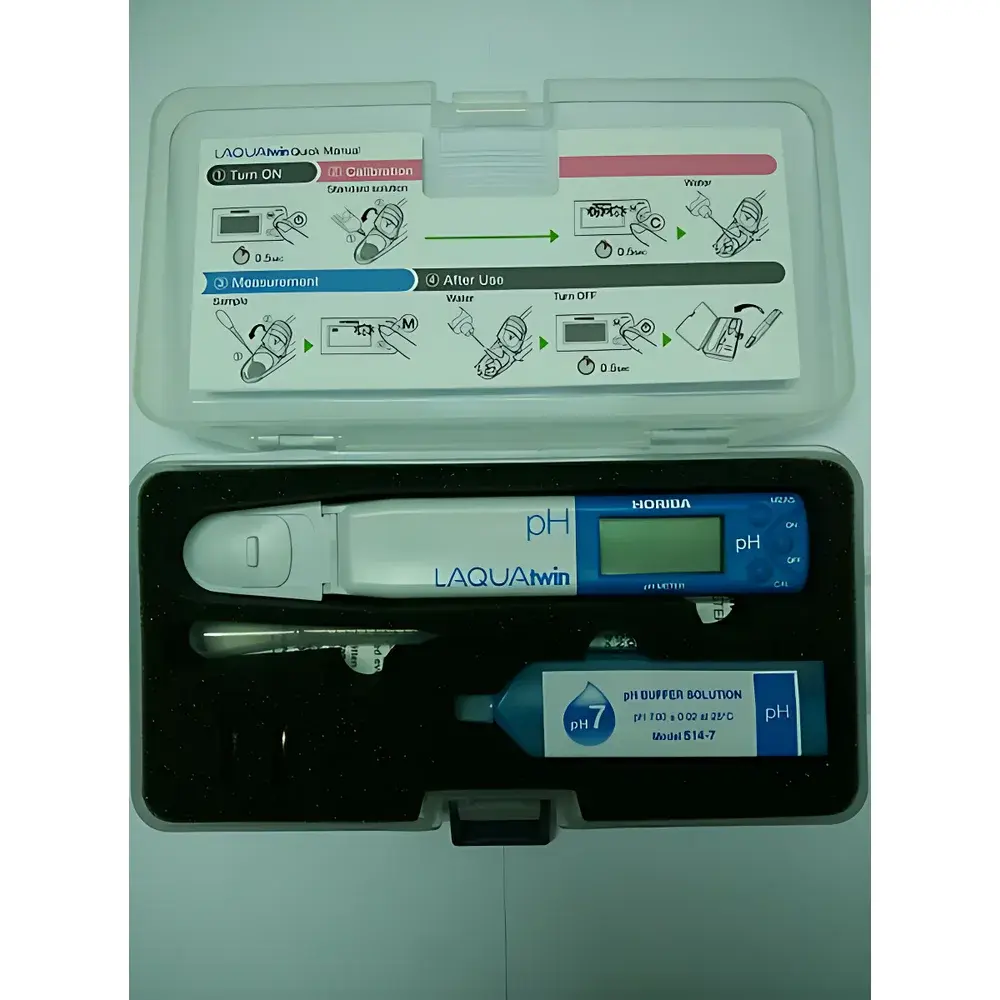
HORIBA PH-11 Portable Flat-Surface pH Meter
| Brand | HORIBA |
|---|---|
| Origin | Japan |
| Model | PH-11 |
| Instrument Type | Pen-Style pH Meter |
| Parameter Type | Single-Parameter (pH) |
| Measurement Range | 0–14 pH |
| Resolution | ±0.01 pH |
| Accuracy | ±0.01 pH |
| Calibration Solutions | pH 4.01 and pH 7.00 standard buffers |
| Temperature Compensation | Automatic (ATC) |
| Electrode Type | Integrated flat-surface pH sensor |
| Sample Volume Requirement | As low as 100 µL |
Overview
The HORIBA PH-11 is a compact, pen-style portable pH meter engineered for field-deployable and benchtop electrochemical measurements in resource-constrained or space-limited environments. Designed around a robust integrated flat-surface pH sensing element, the instrument operates on the fundamental principle of potentiometric measurement—detecting the potential difference between a pH-sensitive glass membrane and a stable reference electrode in aqueous solution, per the Nernst equation. Its architecture eliminates conventional liquid-filled reference junctions, reducing clogging risk and enabling direct contact with viscous, particulate-laden, or low-volume samples—including soil slurries, food pastes, and micro-volume water samples down to 100 µL. The built-in automatic temperature compensation (ATC) circuit ensures pH readings are thermally referenced to 25 °C using an embedded thermistor, complying with ISO 3696 and ASTM D1293 requirements for standardized pH reporting.
Key Features
- Integrated flat-surface pH sensor with chemically stable glass membrane and Ag/AgCl reference system—optimized for non-uniform, semi-solid, and low-volume matrices.
- Auto-ranging digital display with 0.01 pH resolution and ±0.01 pH accuracy at 25 °C, traceable to NIST-traceable pH buffer standards.
- Two-point calibration routine (pH 4.01 and pH 7.00) with intuitive LED-guided prompts; calibration status retained in non-volatile memory.
- IP67-rated housing with chemical-resistant ABS casing—suitable for humid, outdoor, or wash-down environments common in aquaculture and agri-food facilities.
- Battery-powered operation (2 × AAA, ~200 hours continuous use); auto-power-off after 10 minutes of inactivity to conserve energy.
- No external probe cable or connector—minimizes mechanical failure points and simplifies cleaning and disinfection protocols.
Sample Compatibility & Compliance
The PH-11 is validated for direct immersion or surface-contact measurement across diverse sample types: freshwater and seawater (including recirculating aquaculture systems), homogenized soil extracts (1:5 w/v in deionized water), fruit/vegetable tissue juices, dairy products, and pharmaceutical excipient suspensions. It meets essential performance criteria outlined in ISO 7888 (water quality—pH determination), USP (pH measurement in pharmaceutical preparations), and JIS K 0102 (Japanese Industrial Standard for chemical analysis). While not designed for GLP/GMP-regulated release testing, its calibration log retention and ATC functionality support audit-ready documentation when used within internal QA/QC workflows.
Software & Data Management
As a standalone handheld device, the PH-11 does not interface with PC-based software or cloud platforms. All operational data—including calibration dates, buffer IDs, and last-measured pH value—are retained in onboard memory. No data export capability is provided; users record measurements manually or via external logging tools. This design prioritizes reliability, electromagnetic immunity, and compliance with environments where wireless connectivity or computer integration is prohibited (e.g., cleanrooms, explosion-hazard zones, or regulated manufacturing floors where IT validation would be required).
Applications
- Aquaculture and environmental monitoring: real-time pH tracking in ponds, hatcheries, and wastewater influent streams.
- Food safety and quality control: rapid pH verification of fermented products (yogurt, kimchi), meat curing brines, and canned goods prior to thermal processing.
- Agricultural extension services: on-site assessment of irrigation water alkalinity, compost maturity (via leachate pH), and fertilizer solution compatibility.
- Educational laboratories: introductory electrochemistry experiments emphasizing Nernstian behavior, calibration theory, and matrix interference effects.
- Field-based regulatory sampling: EPA Method 150.1-compliant screening where portable, rugged instrumentation is mandated.
FAQ
Does the PH-11 require electrode refilling or maintenance beyond calibration?
No—the flat-surface sensor is sealed and maintenance-free. Routine cleaning with deionized water and gentle wiping is sufficient between samples.
Can it measure pH in high-salinity or organic solvent-containing samples?
It is validated for aqueous matrices up to 35 g/L total dissolved solids (TDS). Performance in >10% v/v ethanol or methanol solutions is not specified and not recommended.
Is the device compliant with FDA 21 CFR Part 11?
No—PH-11 lacks electronic audit trails, user authentication, or secure data export; it is intended for non-GxP preliminary screening only.
What is the operating temperature range?
5–40 °C ambient; sensor response time increases above 35 °C due to electrolyte viscosity changes.
How often should calibration be performed?
Before each measurement session, or every 2 hours during continuous use—especially when measuring samples differing by >2 pH units.




