
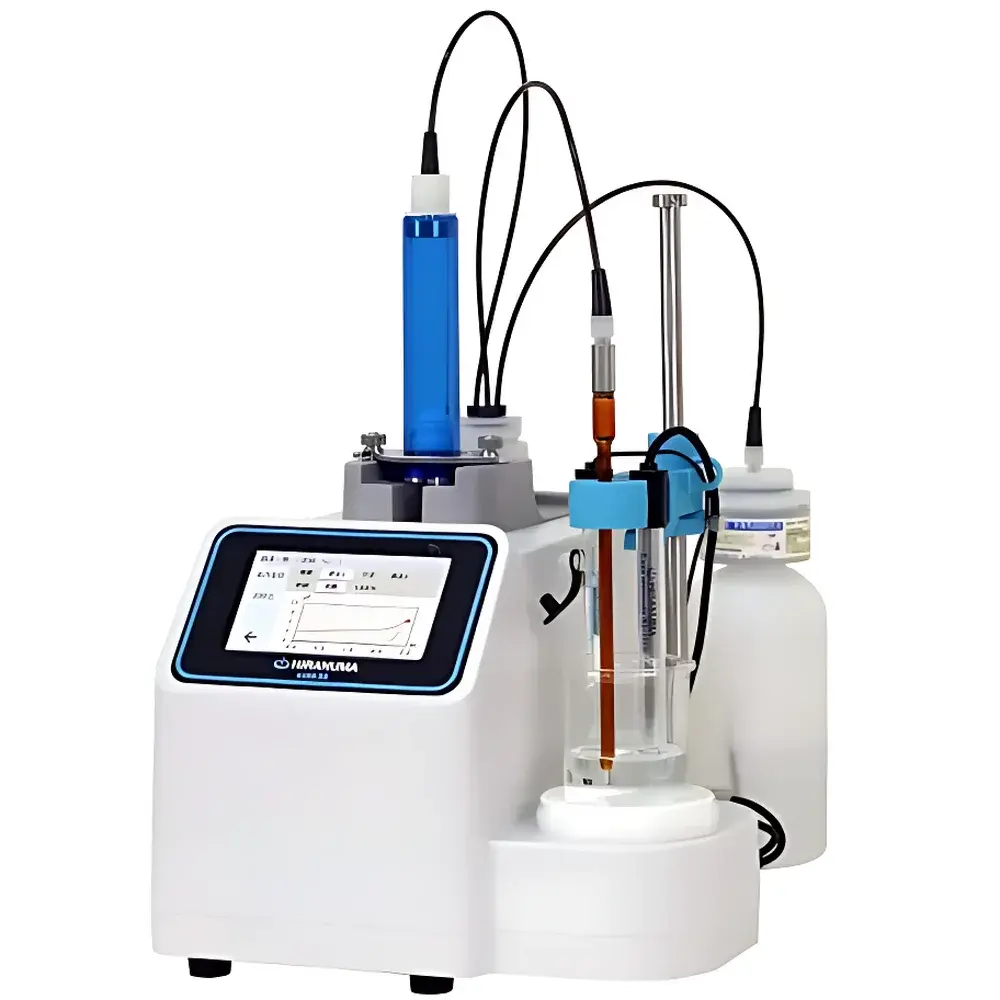
Hiranuma COM-28/28S Automatic Potentiometric Titrator
| Brand | Hiranuma |
|---|---|
| Origin | Japan |
| Model | COM-28/28S |
| Measurement Range | −200 mV to +2000 mV |
| Potential Resolution | 0.1 mV |
| Display | 4.3-inch TFT LCD touchscreen (Chinese UI) |
| Data Storage | 50 internal records + up to ~9,900 via USB flash drive |
| Dimensions | 255 mm (W) × 290 mm (D) × 420 mm (H) |
| Optional accessories | C-1712 autosampler (12-position), photometric titration unit, dual external burettes |
Overview
The Hiranuma COM-28/28S Automatic Potentiometric Titrator is a compact, benchtop electrochemical analyzer engineered for precision potentiometric endpoint detection in routine and regulated laboratory environments. It operates on the fundamental principle of measuring potential difference (in millivolts) between a reference electrode and an indicator electrode immersed in the analyte solution, enabling quantitative determination of acid–base, redox, precipitation, and complexometric reactions. Designed with ISO/IEC 17025-aligned operational logic and compatibility with GLP-compliant data handling workflows, the system supports traceable, repeatable titrations across pharmaceutical QC, polymer chemistry, food safety testing, and industrial raw material verification. Its integrated architecture—combining motorized burette, magnetic stirrer, and real-time potential monitoring—eliminates external component dependencies while maintaining full compliance with ASTM E2087 (Standard Practice for Potentiometric Titration) and USP (Titrimetry).
Key Features
- 4.3-inch high-contrast TFT LCD touchscreen with intuitive Chinese-language interface—optimized for rapid method setup and visual endpoint interpretation
- Real-time titration curve display with dynamic scaling, facilitating immediate identification of inflection points and anomalous response behavior
- Dual burette configuration support (COM-28S): one built-in 20 mL syringe pump + two optional external burettes (50 mL capacity each), enabling multi-reagent sequential titration without manual intervention
- Economy rinse function: automated solvent exchange between titrations using the same 20 mL syringe, minimizing reagent consumption and cross-contamination risk
- Smooth function algorithm (COM-28S): digital signal filtering applied during titration to reduce noise-induced ambiguity in low-slope or overlapping endpoints—particularly valuable for weak acid–weak base systems or NCO (isocyanate) assays
- Compact footprint (255 × 290 mm) with vertical integration of stirrer, burette, and electrode holder—designed for space-constrained QC labs and mobile analytical stations
Sample Compatibility & Compliance
The COM-28/28S accommodates standard 100–250 mL titration vessels and supports common electrode types including Ag/AgCl, calomel, platinum, and ion-selective electrodes (e.g., fluoride, silver). It meets functional requirements for pharmacopeial methods under USP , EP 2.2.20, and JP 2.05. While not certified as 21 CFR Part 11 compliant out-of-the-box, its USB-based data export (CSV/TXT), timestamped records, and editable audit trail via optional PC software (TITRA-LINK™) enable implementation within FDA-auditable environments when deployed with documented SOPs and access controls. All firmware and calibration logs are stored with immutable timestamps.
Software & Data Management
Internal memory retains up to 50 complete titration reports—including raw mV vs. volume data, derivative curves, calculated concentrations, and user annotations. A USB 2.0 port permits bulk export of historical datasets (~9,900 records) for offline review. The optional TITRA-LINK™ PC application enables reprocessing of raw potential curves using alternative endpoint algorithms (first/second derivative, fixed increment, Gran plot), statistical summary generation (RSD%, recovery %), and PDF report templating aligned with ISO 17025 documentation standards. Data files include embedded metadata: operator ID, method name, date/time stamp, electrode serial number, and environmental temperature (if external probe connected).
Applications
- Pharmaceutical excipient assay (e.g., chloride content in lactose, residual acetate in cellulose derivatives)
- Polymer characterization: isocyanate (NCO) value determination per ASTM D2572, acid number in resins (ASTM D974), saponification number in oils
- Food & beverage: total acidity in wines and fruit juices (AOAC 942.15), salt content via argentometric titration, sulfur dioxide quantification
- Water treatment: alkalinity profiling (HCO₃⁻/CO₃²⁻/OH⁻ speciation), chloride and bromide ion analysis in effluent streams
- Electroplating bath control: metal ion concentration (Ni²⁺, Cu²⁺) via complexometric EDTA titration with photometric endpoint detection (when equipped with optional photometric module)
FAQ
Does the COM-28S support GLP-compliant electronic signatures?
No—the instrument does not embed biometric or cryptographic signature functionality. However, exported CSV/PDF reports generated via TITRA-LINK™ can be archived in a validated LIMS or ELN with controlled user authentication.
Can the smooth function be disabled for raw data integrity?
Yes—smoothing is applied only during real-time display; all original mV and volume data points are recorded unaltered in internal memory and USB exports.
Is the C-1712 autosampler compatible with non-aqueous titrations?
Yes—provided solvents are chemically inert toward PTFE tubing and syringe seals (e.g., acetonitrile, toluene, DMF); vapor-tight sample vial caps are recommended for volatile media.
What electrode calibration protocols are supported?
Manual two-point calibration using standard buffer solutions (e.g., pH 4.01/7.00 for combination electrodes) or redox standards (e.g., quinhydrone, Fe²⁺/Fe³⁺); no automatic calibration sequence is built-in.
How is method transfer ensured between COM-28 and COM-28S units?
Method parameters (dosing increments, endpoint criteria, stirring speed) are saved as portable .TMD files and retain full interoperability across both models when loaded via USB.





