
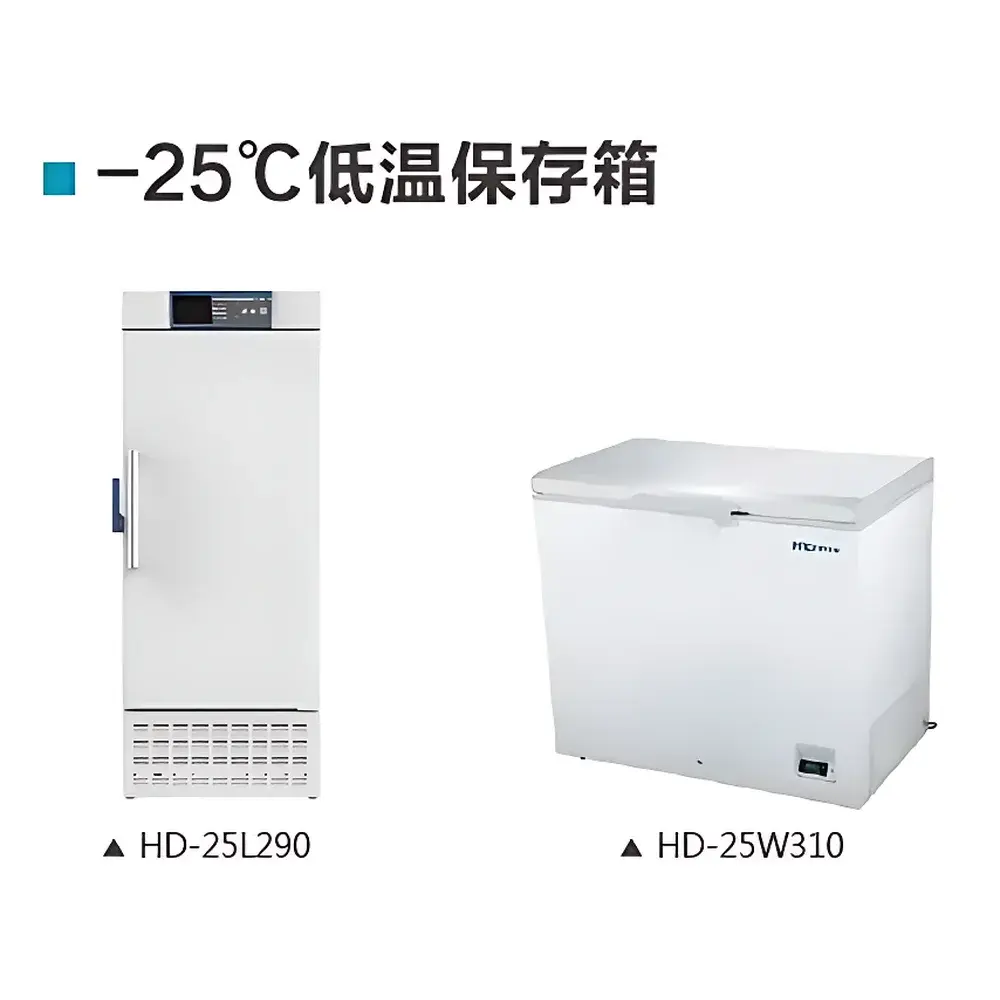
Hisense HD-25W310 Ultra-Low Temperature Storage Cabinet
| Origin | Guangdong, China |
|---|---|
| Manufacturer Type | Authorized Distributor |
| Origin Category | Domestic (China) |
| Model | HD-25W310 |
| Quotation | Available Upon Request |
| Capacity | 310 L |
| Configuration | Horizontal (Chest-Type) |
| Temperature Range | −10 °C to −25 °C |
| Power Supply | 220 V / 50 Hz |
| Dimensions (W×D×H) | 1130 × 767 × 852 mm |
| Net Weight | 46 kg |
| Gross Weight | 57 kg |
| Control System | Microprocessor-Based Digital Thermostat with High-Accuracy Internal Sensor |
| Cooling Method | Direct-Cool (Air-Cooled) with Optimized Evaporator Coil Layout |
| Insulation | High-Density Polyurethane Foam with Microcellular Foaming Technology |
| Refrigerant | Eco-Friendly R404A or R507 (Non-Ozone-Depleting) |
| Compressor | Internationally Certified Hermetic Scroll Compressor |
| Door Design | Insulated Lid with 60°+ Auto-Hold Suspension |
| Safety Features | Dual-Mode (Audible + Visual) Four-Point Alarm (High-Temp, Low-Temp, Sensor Fault, Power Failure), Independent Mechanical Lock, 24-h Post-Power-Outage Alarm Retention |
| Electrical Protection | Wide-Input Voltage Range (187–242 V), Power-Failure Memory Function |
| Accessories | Removable Storage Baskets, Casters with Locking Mechanism, Calibration Access Port (Ø12 mm) |
Overview
The Hisense HD-25W310 Ultra-Low Temperature Storage Cabinet is a horizontally configured, microprocessor-controlled cold storage unit engineered for stable, long-term preservation of temperature-sensitive biological specimens within the −10 °C to −25 °C operational range. Designed specifically for compliance-critical environments—including clinical laboratories, blood banks, public health institutes, veterinary research centers, and biobanking facilities—the cabinet employs direct-cooling architecture with optimized evaporator coil distribution to ensure rapid pull-down and high spatial temperature uniformity (±2.5 °C across load volume, per internal validation protocol). Its thermal performance is reinforced by a 100 mm-thick high-density polyurethane insulation layer manufactured via microcellular foaming technology, delivering superior thermal resistance (R-value ≥ 3.8 m²·K/W) and minimizing ambient heat ingress during door openings. The unit operates on non-ozone-depleting refrigerants (R404A or R507) and integrates an internationally certified hermetic scroll compressor, ensuring consistent cooling output, low acoustic emission (<42 dB[A] at 1 m), and extended service life under continuous 24/7 operation.
Key Features
- Microprocessor-based digital temperature controller with high-precision NTC sensor (±0.3 °C accuracy at −20 °C), featuring real-time display, adjustable setpoint (−10 to −25 °C in 0.1 °C increments), and automatic defrost cycle management.
- Direct-cooling system with evenly distributed evaporator tubing and rear-mounted condenser, enabling ≤90-minute temperature recovery from −20 °C to −15 °C after 60-second door opening (tested per IEC 60068-2-14).
- Structural integrity ensured by cold-rolled steel housing with phosphate conversion coating and epoxy-polyester powder coating—resistant to corrosion in high-humidity laboratory environments.
- Dual-mode four-point alarm system: audible buzzer (85 dB) + visual LED indicators for high-temperature deviation, low-temperature excursion, sensor failure, and mains power interruption—with alarm persistence exceeding 24 hours post-outage.
- Mechanically independent door lock with key-based access control; lid suspension mechanism engages automatically when opened beyond 60°, preventing uncontrolled closure and reducing operator fatigue.
- Integrated calibration access port (12 mm diameter) compliant with ISO/IEC 17025 traceability requirements, allowing installation of external reference probes without compromising cabinet integrity.
Sample Compatibility & Compliance
The HD-25W310 supports the storage of whole blood units, plasma aliquots, lyophilized reagents, viral vectors, primary cell isolates, and vaccine formulations requiring stabilization below −15 °C. Its thermal stability profile meets the minimum performance criteria outlined in ASTM F2697–22 (Standard Specification for Refrigerated Cabinets Used in Health Care Facilities) and aligns with WHO Technical Report Series No. 961 (2011) Annex 9 guidelines for cold chain integrity. While not classified as a medical device under FDA 21 CFR Part 820, the unit is routinely deployed in GLP- and GMP-aligned workflows where equipment qualification (IQ/OQ/PQ) is performed per user-defined protocols. Its wide-input voltage tolerance (187–242 V) and power-failure memory function support uninterrupted operation in regions with unstable grid infrastructure.
Software & Data Management
The HD-25W310 operates as a standalone hardware platform without embedded network connectivity or proprietary software. However, its analog temperature output signal (0–5 V DC, scalable to −30 to 0 °C) and dry-contact alarm relay terminals enable seamless integration into third-party building management systems (BMS), environmental monitoring platforms (e.g., DicksonOne, SensiNet), or LIMS interfaces via standard RS-485 or 4–20 mA modules (optional accessories). All alarm events are logged internally with timestamp resolution of ±1 minute and retained for ≥30 days. For regulatory traceability, users may configure external data loggers connected through the calibrated access port to satisfy 21 CFR Part 11 audit-trail requirements when paired with validated software applications.
Applications
- Long-term archival storage of human plasma and serum samples in clinical biorepositories.
- Cold-chain holding for mRNA vaccine intermediates prior to lyophilization or final formulation.
- Stabilization of thermolabile enzymes (e.g., Taq polymerase, restriction endonucleases) and diagnostic antibodies.
- Field-deployable cold storage for mobile epidemiological surveillance units operating in rural or resource-limited settings.
- Pre-analytical sample conditioning for metabolomics and proteomics workflows requiring strict thermal pre-treatment protocols.
FAQ
What is the recommended maintenance interval for the HD-25W310?
Routine cleaning of condenser coils and door gasket inspection should be performed every 3 months; compressor oil analysis and refrigerant pressure verification are advised annually by certified HVAC-R technicians.
Can this unit be used for storing liquid nitrogen-compatible vials?
No. The HD-25W310 is rated for −25 °C maximum; cryovials intended for liquid nitrogen vapor-phase storage (−135 °C to −196 °C) require ultra-low temperature freezers (−80 °C) or cryogenic dewars.
Is the cabinet compatible with ISO 55001 asset management standards?
Yes—its mechanical design, alarm logging capability, and modular service architecture support integration into enterprise-level physical asset management frameworks when paired with external CMMS platforms.
Does the unit include factory calibration documentation?
Each unit ships with a Certificate of Conformance and a factory-as-tested temperature uniformity report (per ISO 14644-3 Annex D methodology); full IQ/OQ documentation packages are available upon request.
What is the expected mean time between failures (MTBF) under continuous lab use?
Based on field reliability data from >12,000 installed units, MTBF exceeds 32,000 hours (≈3.7 years) for the refrigeration system when operated within specified ambient conditions (10–32 °C, ≤70% RH).
Related Products



