
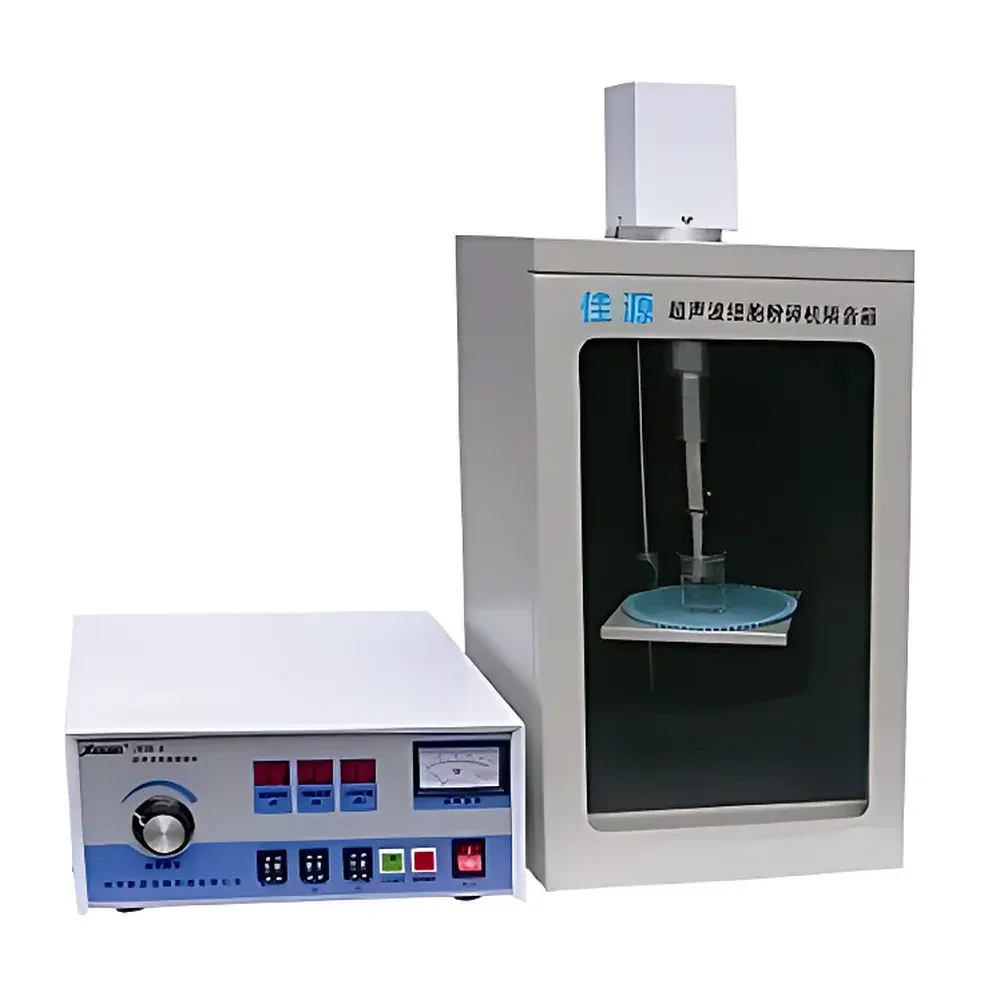
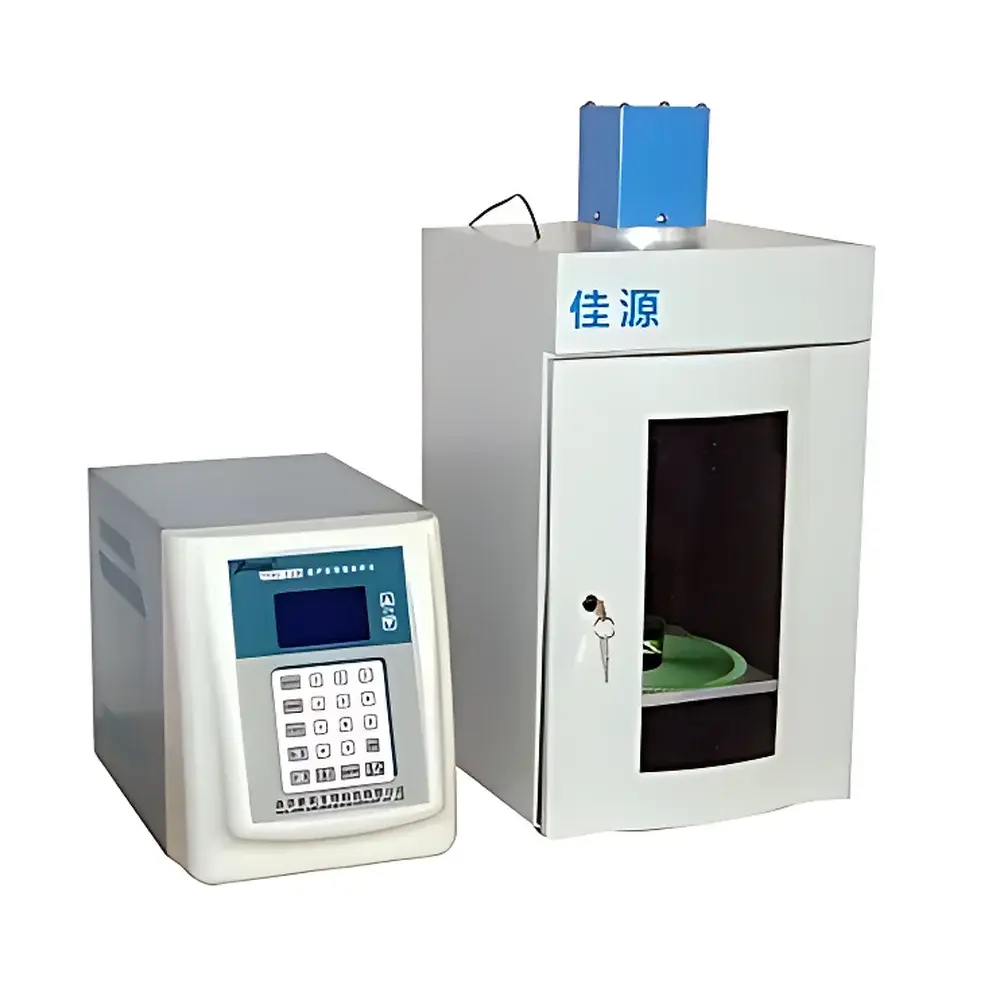
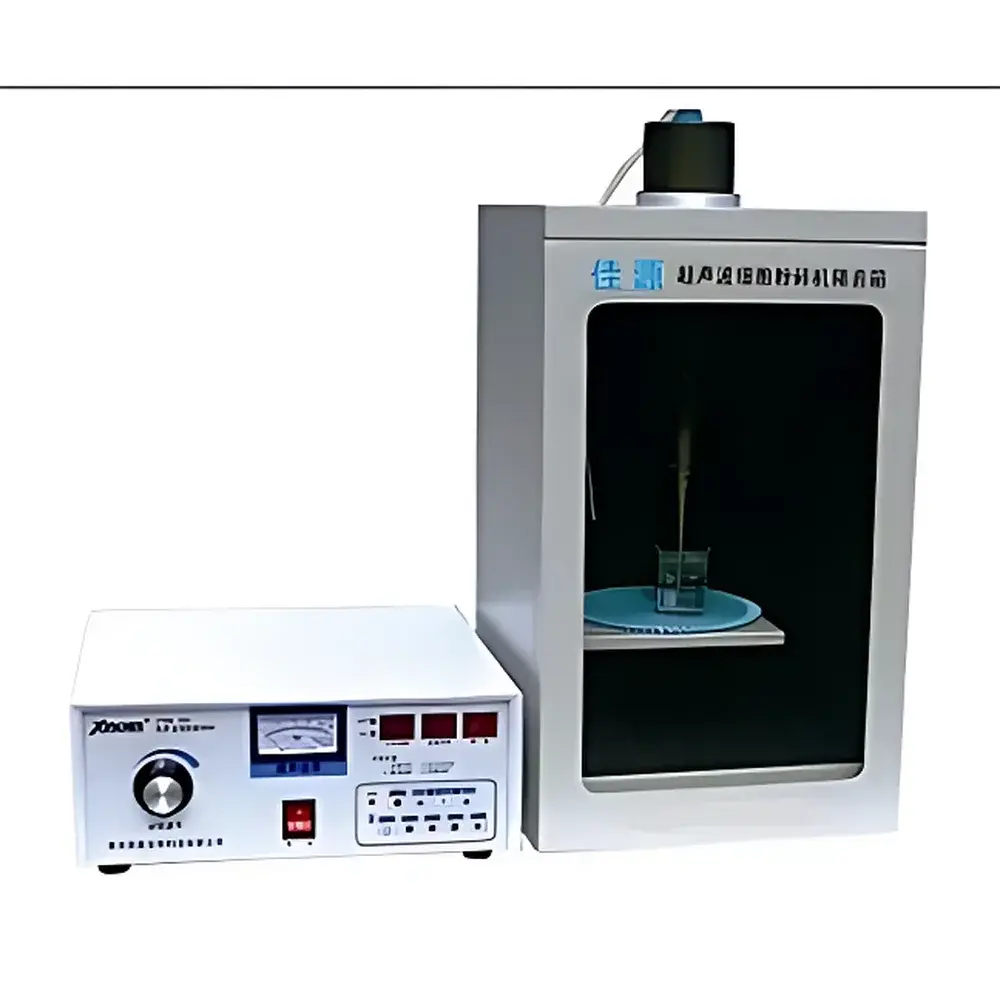
Jiayuan JY98-III Ultrasonic Cell Disruptor
| Brand | Jiayuan |
|---|---|
| Origin | Beijing, China |
| Model | JY98-III |
| Ultrasonic Frequency | 20–25 kHz with Automatic Frequency Tracking |
| Output Power | 1200 W |
| Pulse Mode | Adjustable On-Time (1–99 s) and Off-Time (1–99 s) |
| Cycle Count | 1–99 cycles |
| Standard Probe Diameter | Φ20 mm |
| Optional Probe Diameters | Φ15, Φ22, Φ25 mm |
| Sample Volume Capacity | 50–1000 mL |
| Duty Cycle | 1–99% |
| Input Voltage | 220 V / 110 V, 50 Hz / 60 Hz |
Overview
The Jiayuan JY98-III Ultrasonic Cell Disruptor is a high-power benchtop sonicator engineered for controlled, reproducible cell lysis, tissue homogenization, and nano-scale dispersion in life science laboratories. It operates on the principle of acoustic cavitation—where high-intensity ultrasonic waves generate transient microbubbles in liquid media that collapse violently, producing localized shear forces, microstreaming, and shockwaves sufficient to disrupt cellular membranes, organelles, and extracellular matrices. Unlike rotor-stator or bead-beating methods, this instrument delivers non-thermal mechanical energy with minimal sample heating when operated in pulsed mode—making it suitable for heat-sensitive biomolecules including proteins, nucleic acids, and membrane receptors. Its 1200 W nominal output power, coupled with automatic frequency tracking (20–25 kHz), ensures stable resonance across varying sample viscosities and volumes, supporting consistent energy delivery during extended processing sessions.
Key Features
- High-output 1200 W piezoelectric transducer with real-time frequency auto-tracking for optimal acoustic coupling and energy transfer efficiency
- Programmable pulse control: independent adjustment of sonication duration (1–99 s), rest interval (1–99 s), and total cycle count (1–99), enabling precise thermal management and protocol standardization
- Duty cycle modulation from 1% to 99%, allowing fine-tuned control over average power density and minimizing thermal denaturation risks
- Robust titanium alloy probe (standard Φ20 mm) designed for high-amplitude transmission and corrosion resistance in aqueous and mildly aggressive buffers
- Interchangeable probe options (Φ15, Φ22, Φ25 mm) to match sample volume, viscosity, and target disruption intensity—ensuring scalability from small-volume lysates to bulk emulsions
- Dual-voltage compatibility (220 V / 110 V, 50 Hz / 60 Hz) with built-in overload protection and temperature-sensing circuitry for operational safety
Sample Compatibility & Compliance
The JY98-III accommodates a broad range of biological and chemical samples—including mammalian and bacterial cells, yeast, plant tissues, viral suspensions, subcellular fractions, and synthetic nanomaterial dispersions. Its open-bath configuration supports direct immersion into centrifuge tubes, beakers, or jacketed vessels (with external cooling). While not certified to IEC 61000-4 or ISO/IEC 17025 as a standalone metrological instrument, the device conforms to general electrical safety standards (GB 4793.1–2007, equivalent to IEC 61010-1) and is routinely employed in workflows aligned with GLP-compliant research practices. Users performing regulated assays (e.g., protein extraction for QC release testing) are advised to validate sonication parameters per internal SOPs and document probe calibration history, especially when operating under FDA 21 CFR Part 11–aligned data governance frameworks.
Software & Data Management
The JY98-III operates via an integrated digital control panel with LED display—supporting manual parameter entry and repeat-run memory for up to 10 user-defined protocols. It does not include PC connectivity or proprietary software; however, its deterministic timing architecture enables full traceability when paired with external lab information management systems (LIMS) or electronic lab notebooks (ELN). For audit-ready environments, operators may log settings (power level, duty cycle, pulse sequence, probe type, and batch ID) manually or via barcode-scanned worksheets. Optional external temperature probes (e.g., PT100) can be used in conjunction with chilled circulating baths to maintain sample temperatures below 4 °C during prolonged runs—a common requirement in chromatin immunoprecipitation (ChIP) and RNA integrity preservation protocols.
Applications
- Cell lysis for intracellular protein, DNA, and RNA isolation in molecular biology and biopharmaceutical development
- Preparation of antigen extracts and subunit vaccines requiring native conformational epitopes
- Nanoparticle synthesis and stabilization—including liposomes, polymeric micelles, and metal-organic frameworks (MOFs)
- Emulsification of oil-in-water and water-in-oil systems for food science and cosmetic formulation R&D
- Disaggregation of amyloid fibrils and protein aggregates in neurodegenerative disease research
- Enhancement of enzymatic reaction kinetics via substrate de-agglomeration and interfacial area expansion
FAQ
What is the maximum recommended continuous operating time per cycle?
For thermal stability and transducer longevity, continuous operation beyond 5 minutes is not advised. Use pulsed mode (e.g., 5 s on / 5 s off) for sessions exceeding 3 minutes.
Can the JY98-III be used with corrosive solvents such as chloroform or DMSO?
Titanium probes resist mild aqueous buffers but degrade in halogenated organics and strong acids/bases. Use only with chemically compatible media; consult probe material SDS before exposure.
Is probe calibration required before each use?
No routine recalibration is specified by the manufacturer; however, users should verify amplitude consistency using a calibrated hydrophone or calorimetric assay during method validation and after probe replacement.
Does the unit support external temperature feedback control?
No built-in PID loop exists, but analog voltage outputs (0–5 V) are available on select OEM versions for integration with third-party chillers or temperature controllers.
How does the JY98-III compare to high-throughput microplate sonicators?
It is optimized for single-sample, high-energy applications—not parallel processing. For multi-well formats, consider dedicated microplate horns or bath sonicators with rack adapters.




