
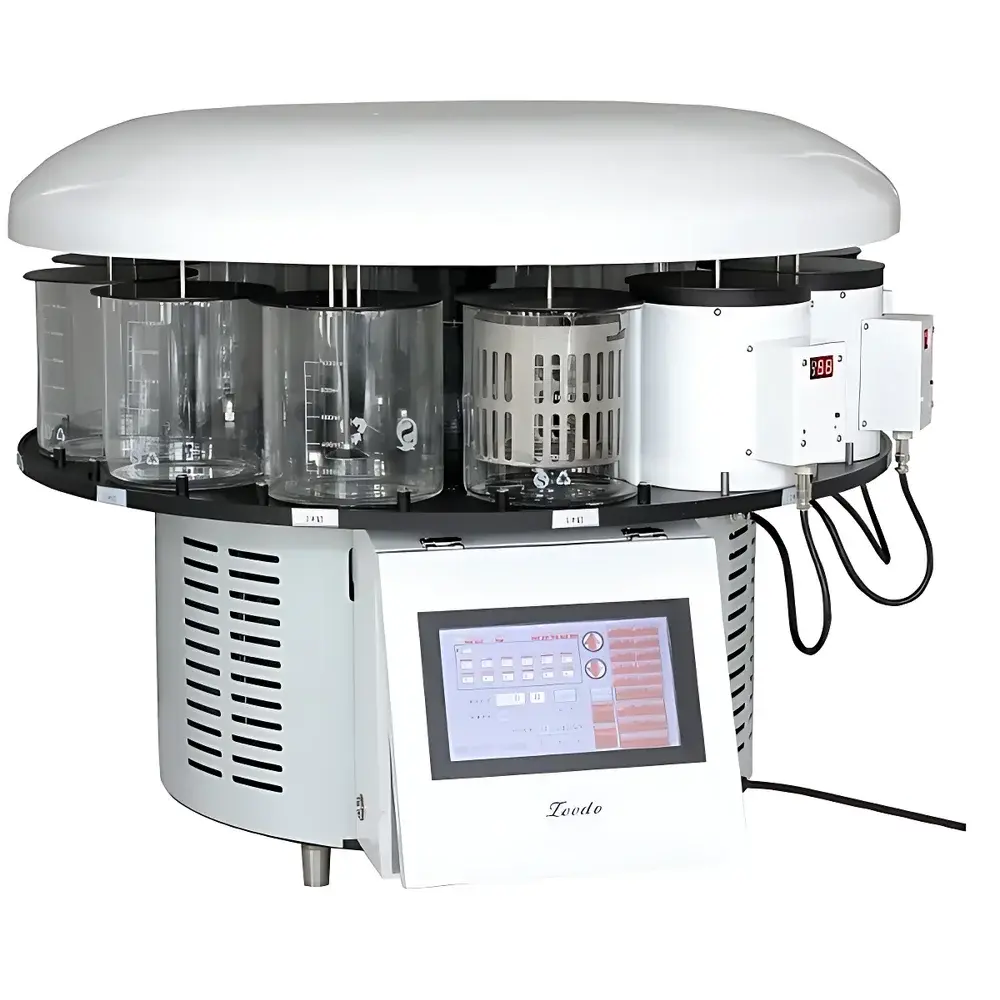
ZEEDO HS-366 Circular Tissue Dehydrator
| Origin | Zhejiang, China |
|---|---|
| Manufacturer Type | Authorized Distributor |
| Origin Category | Domestic (PRC) |
| Model | HS-366 |
| Price Range | USD 7,000 – 14,000 |
| Tissue Processing Stages | 12 |
| Solvent Stations | 9 × 1.2 L |
| Paraffin Stations | 3 × 1.0 L |
| Temperature Control Range | 45–85 °C (±3 °C) |
| Per-Station Timer | 0–59 h 59 min |
| Delay Start | 0–59 h 59 min |
| Basket Agitation Frequency | 3 cycles/min |
| Basket Dimensions | Φ95 × 80 mm (single-tier) / Φ95 × 80 mm × 5 layers (stacked) |
| Net Weight | ~60 kg |
| External Dimensions | 660 × 550 × 680 mm |
| Rated Voltage | AC 220 V, 50 Hz |
| Power Consumption | 500 W |
| Operating Environment | +5 to 40 °C ambient |
| Display Language | Switchable Chinese/English LCD |
| Stored Protocols | 10 user-programmable methods |
| Minimum Time Increment | 1 minute |
| Maximum Delay Duration | 30 days |
| Paraffin Bath Temperature Stability | High-precision PID control with TEFLON-coated interior surfaces |
| Safety Features | Power-failure alarm, cylinder-position retention logic, mechanical obstruction detection, optional UPS integration (4–16 h runtime) |
Overview
The ZEEDO HS-366 Circular Tissue Dehydrator is an automated, microprocessor-controlled tissue processing system engineered for reproducible, high-integrity histological specimen preparation in clinical pathology laboratories, academic research facilities, and pharmaceutical preclinical units. It operates on the principle of sequential solvent exchange—replacing water in fixed biological tissues with graded alcohols (e.g., ethanol or isopropanol), followed by xylene or xylene substitutes, and finally molten paraffin wax—to enable subsequent embedding, sectioning, and microscopic analysis. Its circular carousel architecture enables precise, programmable positioning of tissue cassettes across 12 discrete processing stages, including up to nine solvent stations and three paraffin infiltration baths. Designed for compliance with routine histopathology workflows, the HS-366 supports standardized protocols aligned with CAP (College of American Pathologists) checklist requirements and ISO 15189–2022 recommendations for preanalytical phase control.
Key Features
- 12-stage programmable processing cycle with independent timer control per station (0–59 h 59 min), enabling full customization of dehydration, clearing, and infiltration durations.
- Circular carousel configuration with nine 1.2 L borosilicate glass solvent cylinders—optically transparent for real-time visual monitoring of tissue morphology and reagent clarity—plus three 1.0 L paraffin baths equipped with PID-regulated heating and TEFLON-coated interiors to prevent cross-contamination and residue buildup.
- Motor-driven basket agitation at 3 cycles per minute ensures uniform reagent penetration and minimizes tissue stratification or edge artifacts during prolonged processing.
- Intuitive bilingual (English/Chinese) backlit LCD interface with 10 pre-stored protocol slots; time resolution down to 1 minute; maximum delay start up to 30 days for overnight or weekend scheduling.
- Comprehensive safety architecture: automatic power-loss response (retains current station position and initiates alarm), mechanical obstruction detection, temperature deviation alert, and optional uninterruptible power supply (UPS) integration supporting 4–16 hours of continuous operation during grid failure.
- Ergonomic design with front-access service panel, low-noise operation (<55 dB(A)), and CE-compliant electrical isolation meeting IEC 61010-1 safety standards for laboratory equipment.
Sample Compatibility & Compliance
The HS-366 accommodates standard histology cassettes (e.g., Leica, Sakura, or generic 30 × 25 mm formats) within its Φ95 × 80 mm single-tier or five-layer stacked baskets. It processes human, rodent, avian, and botanical specimens—including dense tissues (e.g., bone, cartilage, fibrotic liver) and delicate structures (e.g., embryonic tissue, neural explants)—without structural distortion when paired with validated gradient protocols. The system supports GLP/GMP-aligned documentation practices through timestamped event logging (power-on, stage transitions, alarms) and optional external data export via RS-232 or USB. While not FDA 21 CFR Part 11–certified out-of-the-box, its audit trail functionality and protocol locking capability facilitate internal validation for regulated environments requiring traceability per ISO/IEC 17025 or CLIA guidelines.
Software & Data Management
The embedded firmware provides non-volatile memory storage for all user-defined protocols and operational logs. No proprietary PC software is required for basic operation; however, optional serial communication allows integration with laboratory information systems (LIS) or electronic lab notebooks (ELN) for automated workflow logging. Event timestamps include date, time, active station number, temperature setpoint, and error codes—enabling retrospective root-cause analysis during QA investigations. All display prompts and error messages are fully translatable between English and Chinese without firmware update, ensuring accessibility across multinational research consortia and contract research organizations (CROs).
Applications
- Routine diagnostic histopathology in hospital labs: high-throughput processing of surgical resections, biopsies, and cytology specimens prior to paraffin embedding.
- Academic and translational research: standardized dehydration of murine tumor xenografts, zebrafish embryos, or plant vascular tissues for comparative morphometric studies.
- Pharmaceutical toxicology: batch-consistent processing of multi-dose animal study tissues under SOP-controlled conditions to support ICH S5(R3)-aligned histopathology review.
- Veterinary diagnostics: adaptable staging for species-specific fixation and processing times (e.g., equine tendon, porcine lung) using custom protocol libraries.
- Core facility deployment: centralized tissue processing with remote status monitoring via integrated LED indicators and audible alerts for stage completion or fault conditions.
FAQ
What types of tissue cassettes are compatible with the HS-366?
Standard 30 × 25 mm plastic or metal cassettes fit securely in both single-tier and five-layer baskets; oversized cassettes require custom basket adaptation.
Does the HS-366 support xylene-free processing protocols?
Yes—the solvent stations accept aqueous alcohol substitutes (e.g., Clear-Rite 3, Histo-Clear II) and low-toxicity clearing agents, provided viscosity and boiling point fall within operational parameters (≤120 °C max bath temp).
Can processing parameters be locked to prevent accidental modification?
Protocol editing requires password access; once saved, active methods execute without user intervention unless manually overridden.
Is validation documentation available for regulatory submissions?
Factory calibration certificates and IQ/OQ templates are supplied; PQ execution must be performed onsite per institutional SOPs and ASTM E2500–13 guidance.
What maintenance intervals are recommended for long-term reliability?
Daily visual inspection of glass cylinders and seals; monthly cleaning of paraffin bath heaters and agitation mechanism; annual verification of temperature accuracy using NIST-traceable probe.





