

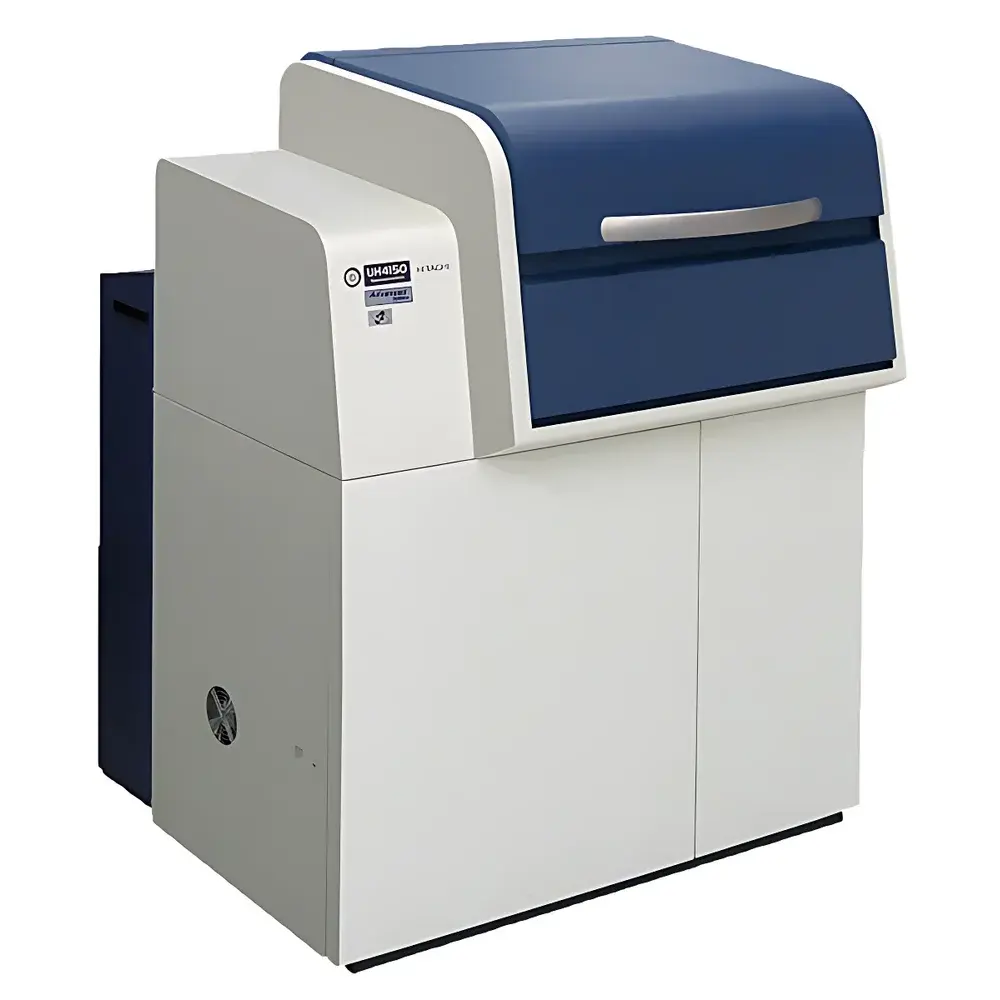
Hitachi UH4150AD+ Advanced UV-Vis-NIR Spectrophotometer
| Brand | Hitachi |
|---|---|
| Origin | Imported |
| Manufacturer Type | Manufacturer |
| Model | UH4150AD+ |
| Optical Design | Double-beam |
| Detector | Photomultiplier Tube (PMT) for UV-Vis |
| Wavelength Range | 175–2000 nm |
| Wavelength Accuracy | ±0.2 nm (UV-Vis), ±1.0 nm (NIR) |
| Wavelength Repeatability | ±0.1 nm (UV-Vis) |
| Spectral Bandwidth | UV-Vis: auto-adjustable up to 14.4 nm, manually selectable from 0.01–8 nm |
| NIR | auto-adjustable up to 36 nm, manually selectable from 0.1–20 nm |
| Stray Light | ≤0.00005% at 220 nm (NaI), ≤0.00004% at 370 nm (NaNO₂) |
| Photometric Range | 8 Abs (UV-Vis), 7 Abs (NIR) |
| Data Mode | Optical Density (O.D.) |
| Multi-scan Capability | Wavelength-range-dependent scan speed & neutral density filter selection |
| Resolution Modes | Four-step high-resolution processing (High/Medium/Standard/Low) |
| ND Filter Wheel | Automatic insertion of five calibrated neutral density filters |
| Detector Calibration | Full 0%T baseline acquisition across measurement range |
| High-Absorbance Calibration | Dual-mode correction (negative transmittance compensation & offset adjustment) |
Overview
The Hitachi UH4150AD+ Advanced UV-Vis-NIR Spectrophotometer is a double-beam optical instrument engineered for high-fidelity spectral characterization across an extended wavelength range of 175–2000 nm. It employs a parallel-beam optical architecture—distinct from conventional focused-beam systems—to ensure consistent incident angle during reflectance measurements, thereby eliminating angular dependence in thin-film and multilayer optical component analysis. This design enables traceable, reproducible quantification of transmittance, reflectance, and absorbance for both homogeneous and heterogeneous samples, including coated lenses, interference filters, dichroic mirrors, and low-transmittance optical glasses. The system integrates dual-detector technology: a high-gain photomultiplier tube (PMT) optimized for the ultraviolet and visible regions (175–900 nm), and a thermoelectrically stabilized InGaAs photodiode with integrated low-noise amplification for the near-infrared region (900–2000 nm). Its photometric dynamic range extends to 8 Abs in the UV-Vis and 7 Abs in the NIR—critical for evaluating high-optical-density filters, laser-grade absorbers, and deep-UV coatings.
Key Features
- Parallel-beam optical path ensures invariant incidence angle across sample types—essential for accurate normal-incidence reflectance of dielectric stacks and prism coatings.
- Dual-detector configuration with automatic switchover: PMT for UV-Vis (175–900 nm) and InGaAs for NIR (900–2000 nm), each independently optimized for signal-to-noise ratio and linearity.
- Four-tier resolution processing (High/Medium/Standard/Low) supports application-specific trade-offs between spectral fidelity and acquisition speed.
- Multi-scan functionality enables independent optimization of scan velocity, slit width, and neutral density filter selection per wavelength sub-range—reducing total measurement time by >55% versus legacy single-scan protocols.
- Five-position automated neutral density (ND) filter wheel permits precise attenuation control without manual intervention, maintaining photometric integrity under high-intensity illumination.
- Comprehensive calibration suite: full 0%T baseline acquisition, high-absorbance correction (negative T compensation and DC offset adjustment), and detector-specific gain normalization.
Sample Compatibility & Compliance
The UH4150AD+ accommodates solid, liquid, and thin-film samples via interchangeable accessories—including micro-sample holders for <1 mm² optics, integrating spheres for diffuse transmittance/haze evaluation, and variable-angle reflectance stages. Its parallel-beam geometry satisfies ISO 9050 (optical properties of glazing), ASTM E1331 (reflectance measurement), and JIS R3106 (spectral transmittance of optical glass) requirements. Data acquisition and processing comply with GLP/GMP documentation standards, supporting audit trails, user authentication, and electronic signature capability when operated with compliant software modules. While not inherently 21 CFR Part 11–certified, the system’s data export formats (ASCII, CSV, JCAMP-DX) are compatible with validated LIMS and ELN platforms used in regulated pharmaceutical and materials development environments.
Software & Data Management
Control and analysis are performed via Hitachi’s SpectraManager II software, which provides real-time O.D. (Optical Density) display, multi-curve overlay, derivative spectroscopy, and band-deconvolution tools. All raw spectra are stored with metadata including instrument configuration, calibration timestamps, detector status, and environmental sensor readings (optional). Export functions support vendor-neutral formats for third-party spectral libraries (e.g., KnowItAll, GRAMS) and statistical process control (SPC) integration. Baseline correction algorithms incorporate polynomial fitting and rubber-band methods, while high-absorbance data undergo iterative nonlinearity compensation based on empirical detector response curves. Software logs all parameter changes, operator IDs, and calibration events—enabling full traceability per ISO/IEC 17025 clause 7.7.
Applications
- Quantitative evaluation of anti-reflective and high-reflection coatings on precision optics and semiconductor lithography masks.
- Spectral transmittance mapping of camera lens assemblies, micro-optics, and AR/VR waveguide substrates.
- Characterization of NIR-absorbing dyes, quantum dot films, and thermochromic smart windows (900–2000 nm).
- High-dynamic-range absorbance profiling of laser safety filters, solar cell encapsulants, and UV-blocking polymers.
- Haze and diffusion analysis using optional integrating sphere attachments—aligned with ASTM D1003 for translucent materials.
- Reference material certification for NIST-traceable optical density standards (e.g., SRM 2065, 2036).
FAQ
What distinguishes the UH4150AD+ from the standard UH4150 model?
The UH4150AD+ introduces enhanced NIR sensitivity via an integrated-amplifier InGaAs detector, expanded photometric range (7 Abs in NIR), multi-scan acceleration, four-stage resolution processing, and refined high-absorbance calibration routines.
Is the instrument suitable for measuring highly scattering or textured surfaces?
Yes—when equipped with an integrating sphere accessory, it supports diffuse transmittance, haze, and total reflectance measurements per ASTM D1003 and ISO 13468.
Can the system be validated for use in GMP-regulated environments?
While the hardware itself does not carry formal 21 CFR Part 11 certification, its data export architecture, audit trail logging, and compatibility with validated third-party software allow integration into compliant quality systems.
How is detector switching managed during a continuous 175–2000 nm scan?
The system automatically transitions between PMT and InGaAs detectors at ~900 nm; transition zones are overlapped and normalized using reference standards to ensure spectral continuity.
Are legacy UH4150 accessories fully compatible with the UH4150AD+?
Yes—all mechanical, optical, and electrical interfaces remain identical; no adapter or firmware update is required for existing sample holders, cuvette changers, or reflectance stages.





