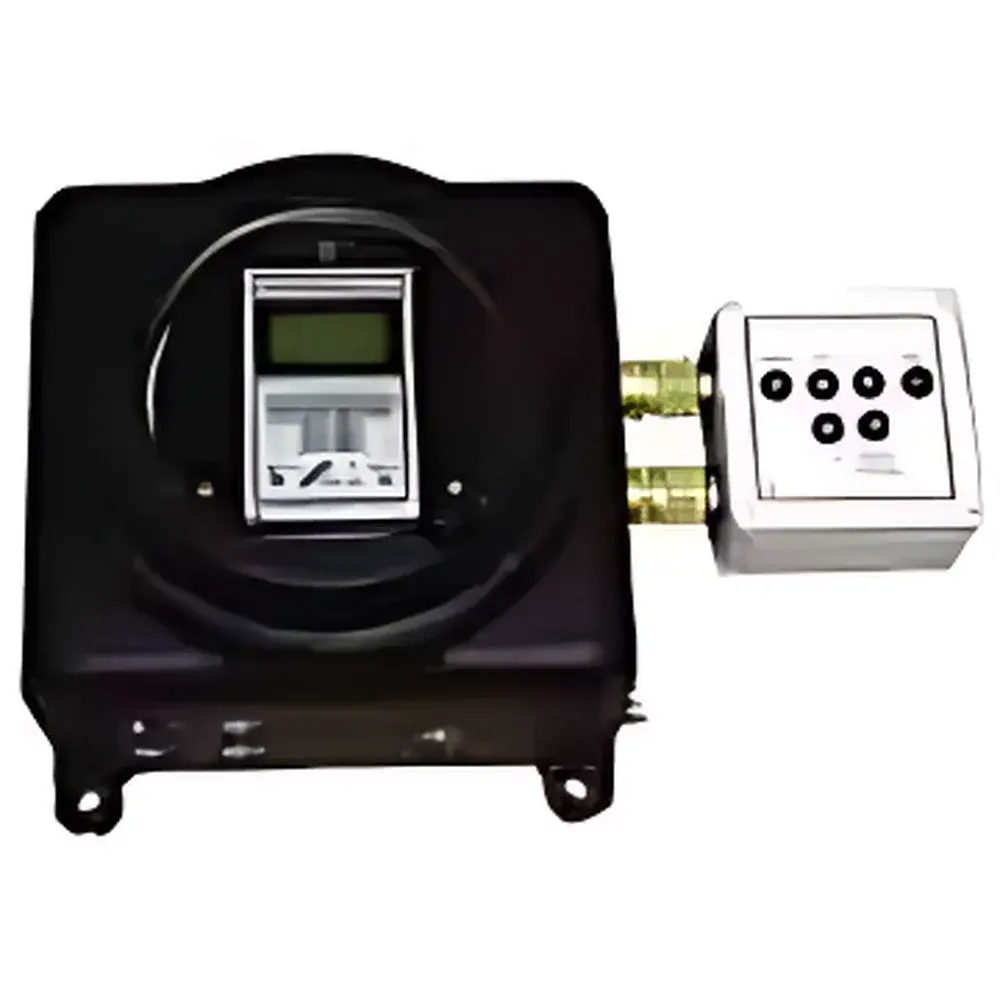
Hitech K1550 Intrinsically Safe Hydrogen Purity Analyzer
| Brand | Hitech |
|---|---|
| Origin | United Kingdom |
| Model | K1550 |
| Detection Principle | Thermal Conductivity (TC) |
| Measurable Gases | H₂, CO₂, Ar, He, N₂, CH₄, Ne, CFCs (e.g., R12, R22) |
| Measurement Range | 0–0.5% to 0–100% vol (H₂/He) |
| Accuracy | ±1% of full scale |
| Stability | Better than ±1% FS/month |
| Response Time (T90) | 20 s |
| Sample Flow Rate | 100–300 mL/min |
| Sample Temperature | –10 °C to +40 °C (non-condensing) |
| Sample Pressure | Ambient-referenced (vented to atmosphere) |
| Display | Dot-matrix LCD (2- or 4-line) |
| Outputs | Two user-programmable 4–20 mA analog outputs |
| Alarms | Two independent relay outputs (0.5 A / 48 V AC/DC), configurable as HIGH/LOW/OFF with adjustable hysteresis |
| Enclosure | DIN 96×144 mm front panel mount |
| Sensor Mounting | Integrated or remote (up to 100 m via intrinsically safe barrier) |
| Certification | ATEX II 1G Ex ia IIC T4 Ga / IECEx ia IIC T4 Ga (Zone 0/1 compatible) |
Overview
The Hitech K1550 Intrinsically Safe Hydrogen Purity Analyzer is a precision thermal conductivity (TC)-based gas analyzer engineered for continuous, real-time monitoring of hydrogen concentration in binary or quasi-binary gas mixtures—where only one component varies while the balance remains stable (e.g., H₂/N₂, H₂/CO₂, H₂/Ar, H₂/CH₄). Its operating principle relies on the differential thermal conductivity between hydrogen (λ ≈ 180 mW/m·K at 25 °C) and common background gases (e.g., N₂: λ ≈ 26 mW/m·K; CO₂: λ ≈ 17 mW/m·K), enabling high-sensitivity detection across wide dynamic ranges—from sub-ppm-equivalent resolution in low-H₂ streams to full 0–100% vol quantification. Designed explicitly for hazardous area deployment, the K1550 complies with ATEX Directive 2014/34/EU and IECEx standards for Zone 0 (gas group IIC, T4 temperature class), making it suitable for hydrogen production, PEM electrolyzer off-gas monitoring, ammonia synthesis purge streams, fuel cell feed validation, and chlor-alkali cell vent analysis. The system integrates a microprocessor-controlled TC sensor with active temperature compensation and digital signal conditioning—eliminating drift associated with ambient fluctuations and ensuring long-term baseline stability without routine recalibration.
Key Features
- Intrinsically safe architecture certified to ATEX II 1G Ex ia IIC T4 Ga and IECEx ia IIC T4 Ga—enabling direct installation in Zone 0, Zone 1, and Zone 2 classified areas.
- High-stability, non-consumptive thermal conductivity sensor with low thermal mass and no catalytic surfaces—zero consumables, zero calibration gas dependency under stable binary conditions.
- Dual independent alarm relays (0.5 A / 48 V AC/DC), each fully configurable for HIGH, LOW, or OFF logic with user-defined hysteresis (0–60 s) and visual LED status indication.
- Two fully programmable 4–20 mA analog outputs: scalable to any measurement range, assignable to primary concentration, alarm status, or diagnostic signals (e.g., sensor health flag).
- Modular mechanical design: transmitter housed in a DIN 96×144 mm panel-mount enclosure (IP40 standard, IP54 optional with lockable door); sensor head mountable either integrally or remotely up to 100 m using MTL or equivalent IS barriers.
- Robust construction using glass-fiber-reinforced Noryl® polymer—resistant to corrosion from HCl, Cl₂, HF, and other aggressive process gases commonly encountered in chemical and refining environments.
Sample Compatibility & Compliance
The K1550 is validated for use with dry, non-corrosive, non-particulate gas streams containing H₂, CO₂, Ar, He, Ne, CH₄, N₂, and halogenated hydrocarbons (e.g., R12, R22, R134a). It is not suitable for wet, acidic, or oxidizing samples without appropriate pre-conditioning (e.g., PTFE-lined sampling lines, particulate filtration, condensate traps). Sample flow must be maintained at 100–300 mL/min via external pump or pressure-driven flow; inlet/outlet ports accept 6 mm OD stainless steel or PTFE tubing via compression fittings. All wetted materials are 316L SS or chemically inert polymers. The analyzer meets EMC Directive 2014/30/EU and Low Voltage Directive 2014/35/EU. Full traceability documentation—including factory calibration certificates, EC-Type Examination Certificates (Notified Body: Sira, Baseefa), and SIL2 verification reports per IEC 61508—supports compliance with ISO 9001, API RP 14C, and OSHA 1910.119 process safety management requirements.
Software & Data Management
While the K1550 operates as a stand-alone, microprocessor-based instrument with no embedded PC or network interface, its configuration and diagnostics are managed via intuitive front-panel navigation using the multi-line LCD display and membrane keypad. All parameters—including span/gain coefficients, alarm thresholds, hysteresis values, output scaling, and unit selection—are stored in non-volatile memory and survive power loss. Audit trails are maintained internally for all configuration changes and alarm events, supporting GLP/GMP-aligned operational discipline. For integration into DCS/SCADA systems, the dual 4–20 mA outputs provide seamless analog interfacing; optional HART-enabled versions (K1550-H) support digital configuration and diagnostics via standard hand-held communicators compliant with HART 7 protocol. Firmware updates are performed offline via USB-to-serial adapter and proprietary configuration utility (Windows-compatible), with version control and change logs retained per FDA 21 CFR Part 11 data integrity guidelines.
Applications
- Hydrogen purity verification in PEM and alkaline electrolyzer outlet streams prior to compression and storage.
- Real-time monitoring of H₂ concentration in ammonia synthesis loop purge gas to optimize purge rate and minimize H₂ loss.
- Safety-critical detection of hydrogen ingress in transformer oil gas analysis (DGA) carrier gas streams.
- Process control of hydrogen blending in natural gas grids (H₂ ≤ 20% v/v) per EN 16726 and ISO 8502 standards.
- Off-gas analysis in chlor-alkali cells to ensure chlorine/hydrogen separation integrity and prevent explosive mixture formation.
- Quality assurance in semiconductor manufacturing ambient purge lines and annealing furnace atmospheres.
FAQ
Can the K1550 measure hydrogen in air?
No. Air contains ~78% N₂ and ~21% O₂—both exhibit similar thermal conductivities (~26 mW/m·K and ~27 mW/m·K respectively), resulting in insufficient differential signal for reliable H₂ quantification. The K1550 requires a stable, known background gas with significantly different λ (e.g., N₂, Ar, CO₂, CH₄).
Is calibration required after installation?
A single zero/span calibration using certified reference gases is recommended at commissioning. Under stable binary conditions and proper sample conditioning, drift remains <±1% FS/month—eliminating routine calibration. Annual verification against traceable standards satisfies ISO/IEC 17025 metrological requirements.
What is the maximum allowable distance between sensor and transmitter?
Up to 100 meters when paired with an approved intrinsically safe barrier (e.g., MTL5042, Pepperl+Fuchs KFD2-STC4). Cable specification: twisted-pair, shielded, 0.5 mm² min cross-section, capacitance <100 nF/km.
Does the K1550 support oxygen measurement?
No. Oxygen has low thermal conductivity (λ ≈ 27 mW/m·K) and cannot be resolved from N₂ or Ar using TC detection. For simultaneous H₂/O₂ analysis, specify the KG1550 dual-sensor variant (see HPS119 datasheet).
Can it operate in high-humidity environments?
The analyzer itself is rated for ambient humidity up to 95% RH non-condensing (–5 °C to +40 °C). However, sample gas must be dew-point controlled below –10 °C to prevent condensation in the sensor chamber, which would impair thermal transfer and cause erroneous readings.
Related Products