
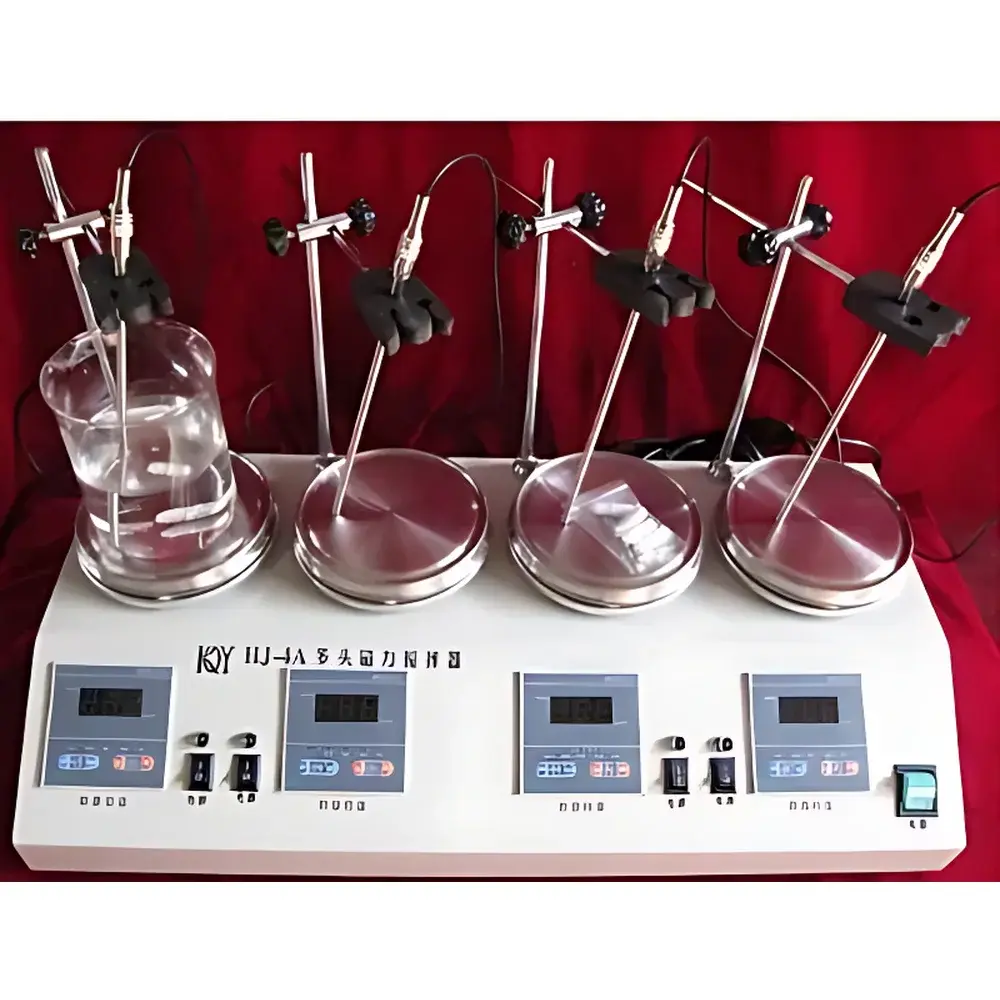
HJ-4A Digital Temperature-Controlled Multi-Position Magnetic Stirrer (4-Station) | HJ-2A (2-Station) & HJ-6A (6-Station) Variants
| Origin | Shanghai, China |
|---|---|
| Manufacturer Type | Authorized Distributor |
| Product Origin | Domestic (PRC) |
| Models | HJ-4A / HJ-2A / HJ-6A |
| Price | USD 320 (FOB Shanghai) |
| Power Supply | 220 V AC, 50 Hz |
| Motor Speed Range | 0–2400 rpm (infinitely adjustable, no gear shifting) |
| Motor Output | 4 × 25 W (HJ-4A) |
| Heating Power | 4 × 200 W (HJ-4A) |
| Temperature Control Range | Ambient to 300 °C (digital LED display, ±1.5 °C accuracy at steady state) |
| Heater Plate Material | Stainless Steel 304 |
| Housing Material | Cold-Rolled Steel with High-Temperature Epoxy Powder Coating |
| Max Continuous Operation | 8 h at medium speed (1200 rpm), 4 h at max speed (2400 rpm) |
| Safety | Grounded chassis, overtemperature cut-off (320 °C auto-shutdown), splash-resistant control panel |
Overview
The HJ-4A Digital Temperature-Controlled Multi-Position Magnetic Stirrer is an engineered solution for parallel sample preparation in analytical, quality control, and research laboratories. Designed on the principle of rotating magnetic field coupling—where a microprocessor-synchronized stator coil generates a precisely modulated rotating magnetic field to drive PTFE-coated magnetic stir bars—the instrument delivers consistent torque transfer across multiple vessels without mechanical contact. Unlike belt-driven or gear-coupled systems, this contactless actuation eliminates wear-related drift, ensures silent operation (<45 dB(A) at 1 m), and enables stable agitation under viscous or heterogeneous conditions. The integrated heating module employs resistive stainless steel (SS304) plates with PID-regulated thermal feedback, supporting precise isothermal reaction maintenance, solvent evaporation control, and dissolution testing per USP and ASTM D1298 protocols. Available in 2-, 4-, and 6-station configurations (HJ-2A, HJ-4A, HJ-6A), the platform accommodates standard laboratory glassware (50–1000 mL beakers, Erlenmeyer flasks) and supports GLP-compliant documentation when paired with external data loggers.
Key Features
- Four independent stirring channels (HJ-4A) with individual speed control (0–2400 rpm, infinitely variable via rotary encoder)
- Digital LED temperature display with ±1.5 °C accuracy (ambient to 300 °C), calibrated against NIST-traceable reference thermometers
- Stainless steel 304 heating plate resistant to corrosion from acids, alkalis, and organic solvents
- Cold-rolled steel housing with high-temp epoxy powder coating (200 °C rated) for long-term chemical resistance and mechanical durability
- Brushless DC motor architecture rated for >10,000 hours MTBF under continuous duty; no carbon dust accumulation or commutator degradation
- Integrated thermal safety cutoff at 320 °C prevents heater runaway; ground-fault protected power input meets IEC 61010-1 Class I requirements
- Low-vibration design (<0.05 mm peak-to-peak displacement at 2400 rpm) minimizes sample splashing and improves reproducibility in titration or precipitation workflows
Sample Compatibility & Compliance
The HJ-4A accommodates borosilicate glass, polypropylene, and PTFE-lined containers up to 1000 mL volume per station. Stir bar compatibility includes standard cylindrical (15–40 mm) and cross-shaped (for high-viscosity media) PTFE-coated magnets (included: four 30 mm × 8 mm rods). The unit conforms to electromagnetic compatibility standards EN 61326-1 (industrial environment) and electrical safety standard EN 61010-1:2010. While not intrinsically safe for explosive atmospheres, it is routinely deployed in ISO/IEC 17025-accredited labs for sample homogenization prior to ICP-OES, HPLC, and gravimetric analysis. Temperature stability profiles meet ASTM E220 calibration verification criteria when operated within ±10 V of nominal 220 V supply.
Software & Data Management
This analog-digital hybrid instrument operates without embedded firmware or network connectivity—intentionally designed for reliability in regulated environments where software validation burdens exceed operational benefits. All setpoints (speed, temperature) are manually adjusted and retained via non-volatile digital potentiometers. For audit-ready workflows, users integrate external USB data loggers (e.g., Omega OM-DAQPRO-5300) connected to the rear-panel analog output (0–5 V proportional to actual plate temperature). The system supports 21 CFR Part 11 compliance when used with validated third-party logging software featuring electronic signatures, audit trails, and role-based access control—commonly implemented in pharmaceutical QC labs conducting dissolution uniformity testing (USP ) or buffer preparation SOPs.
Applications
- Parallel digestion of environmental water samples (EPA Method 200.7) requiring simultaneous pH adjustment and mixing
- Preparation of calibration standards for atomic absorption spectroscopy (AAS) and inductively coupled plasma mass spectrometry (ICP-MS)
- Controlled heating and agitation during Karl Fischer titration solvent conditioning
- Homogenization of polymer solutions prior to rheological characterization (Brookfield DVNext)
- Accelerated stability studies (ICH Q1A) involving temperature-cycled dissolution of active pharmaceutical ingredients (APIs)
- Cell culture media pre-warming and buffering in biosafety cabinets (BSC Class II A2)
FAQ
What is the maximum viscosity this stirrer can handle effectively?
At 2400 rpm and 25 °C, the HJ-4A maintains stable rotation of standard 30 mm stir bars in aqueous glycerol solutions up to 1500 mPa·s. For higher viscosities (>3000 mPa·s), use cross-type stir bars and reduce speed to ≤1200 rpm.
Can the unit be used with corrosive reagents such as concentrated HNO₃ or HF?
The SS304 heating plate resists dilute acids but is not suitable for hydrofluoric acid or hot fuming nitric acid. Use PTFE-coated stir bars and place vessels on inert ceramic pads to prevent direct contact with aggressive vapors.
Is temperature calibration traceable to national standards?
The factory calibration uses NIST-traceable dry-block calibrators (Fluke 9142). End users may perform in-house verification using a certified RTD probe inserted into a stirred water bath at 25 °C, 50 °C, and 100 °C.
Does the instrument support programmable ramp-soak temperature profiles?
No—this is a manually operated analog-digital controller. For multi-step thermal protocols, pair with an external programmable temperature controller (e.g., Watlow F4T) interfaced via 0–5 V analog input.
What maintenance is required to ensure long-term performance?
Wipe the heating surface with isopropyl alcohol after each use; inspect stir bars for PTFE chipping quarterly; verify grounding continuity annually per IEC 62353. No lubrication or internal servicing is required.



