
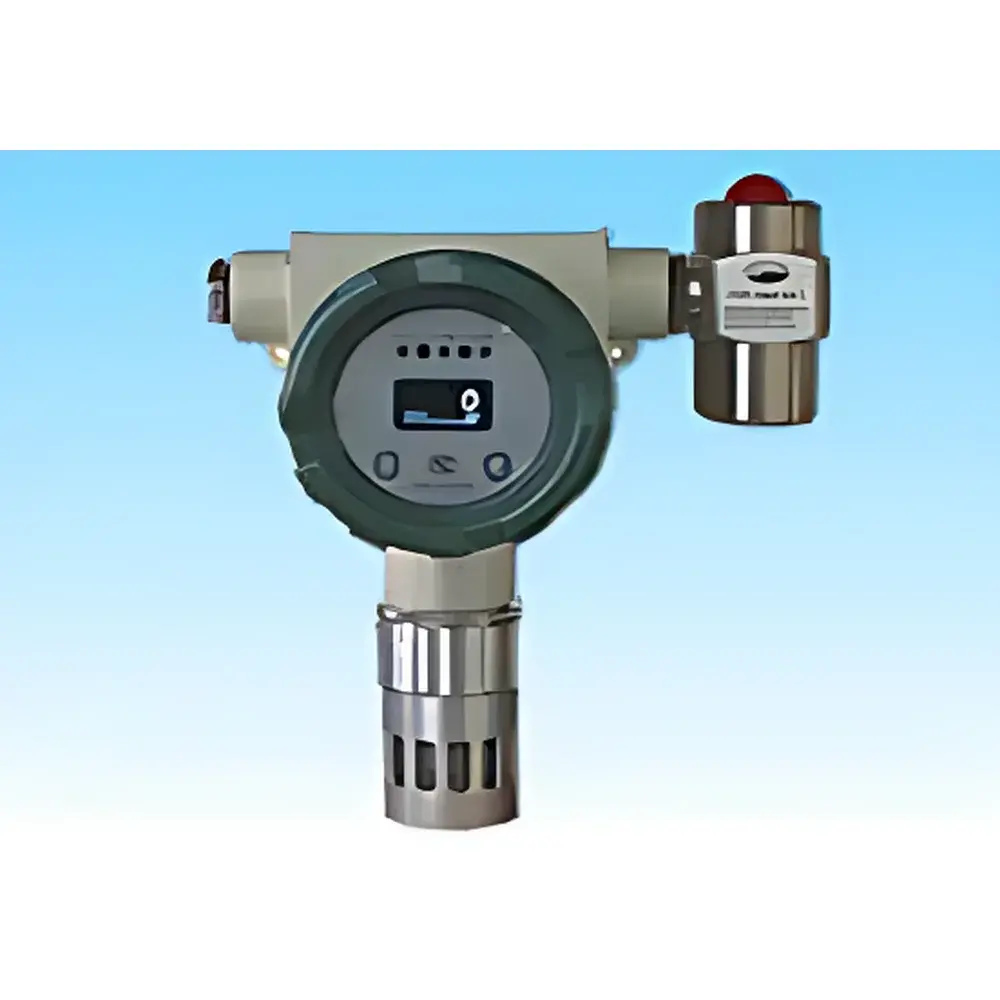
HK-7100A / HK-7200A Infrared Point Gas Detector Series (Huakeyi)
| Origin | Beijing |
|---|---|
| Manufacturer Type | Authorized Distributor |
| Origin Category | Domestic (PRC) |
| Detection Principle | Non-Dispersive Infrared (NDIR) |
| Pricing | Available Upon Request |
Overview
The HK-7100A (for combustible gases) and HK-7200A (for toxic gases) are industrial-grade, point-type gas detectors engineered for continuous, real-time monitoring of hydrocarbon (HC) vapors, carbon dioxide (CO₂), carbon monoxide (CO), and other NDIR-compatible gases in hazardous and non-hazardous environments. These detectors employ non-dispersive infrared (NDIR) spectroscopy — a mature, interference-resistant optical absorption technique that measures target gas concentration by quantifying attenuation of specific mid-infrared wavelengths (e.g., ~3.4 µm for HC, ~4.26 µm for CO₂). Unlike electrochemical or catalytic bead sensors, NDIR technology offers inherent immunity to sensor poisoning, zero oxygen dependency, long-term baseline stability, and no consumable components — making it ideal for demanding applications in power plants, boiler rooms, chemical storage facilities, and HVAC air quality control. The devices comply with China’s mandatory safety standards GB 15322.1–2003 (combustible gas detectors) and GB 12358–2006 (multi-gas detectors), and are certified for use in Zone 1 explosive atmospheres under Ex d IIC T6 Gb protection.
Key Features
- 32-bit embedded microcontroller architecture enabling high-speed signal processing, low-latency alarm response, and robust digital filtering.
- Dual power configuration support: bus-powered operation via centralized controller (18–30 VDC) or independent regional supply — simplifying system integration in distributed monitoring networks.
- High-contrast, wide-temperature OLED display (–40 °C to +70 °C operating range) with bilingual Chinese/English menu navigation and intuitive status indicators (normal, Level 1 alarm, Level 2 alarm, fault).
- Tool-free operator interface: magnetic stylus for local configuration and bidirectional infrared remote control (optional) for safe, contactless setup in confined or high-risk zones.
- Universal detector housing with hot-swappable, auto-identifying NDIR sensor modules — supporting over 200 gas-specific configurations across five measurement principles (NDIR, electrochemical, PID, catalytic, semiconductor), all mechanically and electrically interoperable.
- Advanced SMT manufacturing process ensures compact footprint (≤120 mm × 90 mm × 65 mm), enhanced thermal management, and improved MTBF (>50,000 hours).
- Integrated self-diagnostic firmware continuously monitors sensor health, optical path integrity, and signal-to-noise ratio — triggering automatic fault alerts and logging diagnostic codes for predictive maintenance.
Sample Compatibility & Compliance
The HK-7100A/HK-7200A series is validated for diffusion-sampling detection of gases including but not limited to methane (CH₄), propane (C₃H₈), butane (C₄H₁₀), CO₂, and CO. Sensor modules are calibrated per gas-specific absorption spectra and certified traceable to national metrological standards. Device-level compliance includes IP66 ingress protection (dust-tight and resistant to powerful water jets), Ex d IIC T6 explosion-proof rating (surface temperature ≤85 °C), and electromagnetic compatibility per GB/T 18268.1–2010 (IEC 61326-1). While not FDA 21 CFR Part 11 or ISO 17025 accredited out-of-box, the platform supports audit-ready data logging when integrated with compliant SCADA or DCS systems meeting GLP/GMP environmental monitoring requirements.
Software & Data Management
Configuration and calibration are performed via local IR remote or magnetic stylus — no PC required. Analog output (4–20 mA, two-wire or three-wire) enables direct connection to PLCs, DCS, or analog input modules with HART compatibility optional. Digital communication options include CAN bus (up to 10 km line length, multi-drop topology) and RS485 Modbus RTU (up to 1.2 km, 32-node capacity), facilitating scalable network deployment. All alarm events — including time-stamped Level 1/2 thresholds, fault codes, and sensor swap logs — are stored in non-volatile memory and retrievable via serial query. Optional external sounder/strobe units provide local audible/visual alerting synchronized with relay outputs (SPDT, 250 VAC/30 VDC, 5 A).
Applications
- Continuous leak detection in natural gas distribution stations and LNG terminals.
- CO₂ concentration monitoring in indoor air quality (IAQ) systems, greenhouses, and fermentation chambers.
- Combustible gas surveillance in coal-fired boiler rooms, turbine enclosures, and hydrogen production cells.
- Toxic gas warning in battery charging rooms (CO), refrigeration plant machinery spaces (CO₂), and solvent storage areas (HC vapors).
- Integration into fire and gas safety systems (FGS) compliant with IEC 61511 functional safety requirements (SIL 2 capable with proper system architecture).
FAQ
What gases can be detected using the NDIR sensor module?
NDIR modules are factory-configured for CO₂, CH₄, C₃H₈, C₄H₁₀, and other hydrocarbons with strong mid-IR absorption bands; CO detection requires an electrochemical module (compatible but not NDIR-based).
Is field calibration possible without specialized equipment?
Yes — zero calibration is supported via ambient air exposure; span calibration requires certified gas standard and IR remote access; full procedure documented in EN 62066-compliant manual.
Can multiple detectors share one CAN bus segment?
Yes — up to 32 nodes with unique address assignment; termination resistors required at both ends of the bus.
Does the device support Modbus TCP over Ethernet?
No — native protocols are 4–20 mA, CAN bus, and RS485 Modbus RTU; Ethernet gateway integration is achievable via third-party protocol converters.
What is the expected service life of the NDIR optical source?
The dual-beam infrared emitter (typically MEMS-based micro-hotplate or LED) is rated for ≥10 years under continuous operation at 25 °C ambient, with gradual intensity drift compensated via reference channel normalization.
Related Products







