
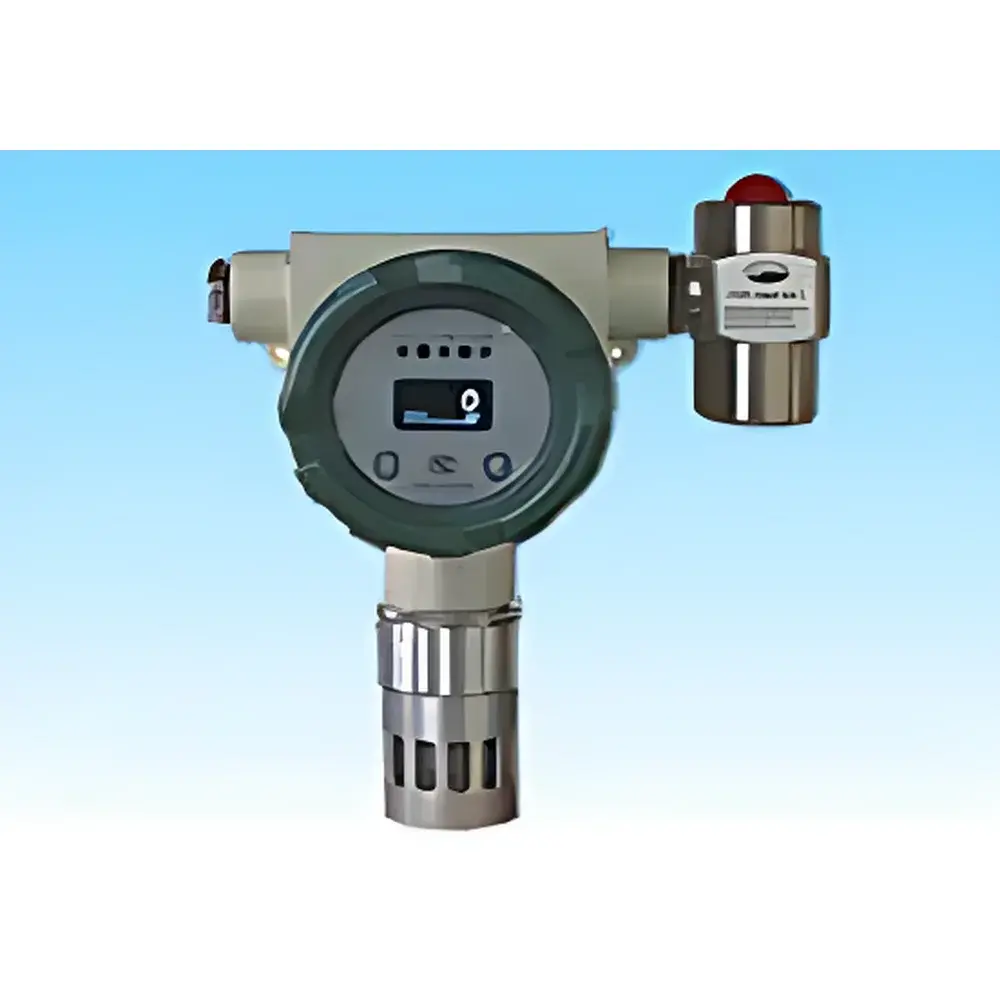
HK-7200A Electrochemical Toxic Gas Detector
| Origin | Beijing |
|---|---|
| Manufacturer Type | Authorized Distributor |
| Origin Category | Domestic (PRC) |
| Model | Digital Multi-Principle Gas Detector Platform (5 Sensing Technologies) |
| Pricing | Upon Request |
Overview
The HK-7200A Electrochemical Toxic Gas Detector is a field-deployable, intrinsically robust fixed gas monitoring instrument engineered for continuous, real-time detection of electrochemically active toxic gases—including CO, H₂S, Cl₂, SO₂, NO₂, NH₃, PH₃, and O₂ deficiency—in industrial, municipal, and environmental applications. It operates on the principle of amperometric electrochemical sensing: target gas molecules diffuse through a selective membrane into an aqueous electrolyte cell, where they undergo oxidation or reduction at a working electrode, generating a current linearly proportional to gas concentration. This analog signal is digitized and processed by a 32-bit embedded microcontroller, ensuring high reproducibility, low drift, and stable baseline performance across extended operational cycles. Designed for integration into Automatic Air Quality Monitoring Systems (AAQMS), the HK-7200A supports both centralized bus-powered architectures and decentralized zone-specific power schemes—making it suitable for hazardous area deployment in oil & gas facilities, wastewater treatment plants, chemical storage zones, and underground utility tunnels.
Key Features
- Modular sensor architecture: One universal host platform fully compatible with over 200 electrochemical, infrared, catalytic bead, PID, and metal oxide semiconductor (MOS) sensors—enabling seamless interchangeability without hardware or firmware modification.
- Hot-swap capable sensor modules with built-in self-diagnostic routines: automatic detection of sensor aging, electrolyte depletion, electrode poisoning, and open/short circuit faults—reported via status codes and visual indicators.
- High-contrast, wide-temperature OLED display (–40 °C to +55 °C operating range) with bilingual (English/Chinese) menu navigation and intuitive icon-based interface.
- Dual-mode local operation: magnetic stylus interaction (no physical buttons, ideal for gloved use and sealed enclosures) and bidirectional infrared remote control (up to 10 m line-of-sight).
- Industrial-grade construction: flameproof enclosure rated Ex d II CT6 (IEC 60079-1 compliant), IP66 ingress protection, and surface-mount technology (SMT) PCB assembly for enhanced thermal stability and long-term reliability.
- Flexible signal output options: isolated 4–20 mA analog output (≤1000 m over 2.5 mm² cable), CAN bus (≤10 km), and RS485 Modbus RTU (≤1.2 km)—all configurable via onboard DIP switches or software tool.
Sample Compatibility & Compliance
The HK-7200A is calibrated and validated for detection of Class II toxic gases per GB 12358–2006 (“General Requirements for Electrical Apparatus for Detecting Combustible and Toxic Gases”). Its electrochemical sensor variants meet ISO 16000-23 (indoor air quality), EN 45544-1 (electrochemical sensor performance), and IEC 61000-6-2/-4 (EMC immunity). While not certified to UL 2075 or ATEX Directive 2014/34/EU out-of-the-box, units configured with Ex-certified sensors and installed per IEC 60079-14 may be incorporated into SIL 2-capable safety loops when integrated with appropriate logic solvers. All sensor modules comply with RoHS 2011/65/EU and REACH Annex XVII restrictions.
Software & Data Management
The detector supports configuration and diagnostics via HK-ConfigTool (Windows-based PC utility) using USB-to-RS485 adapter or IR link. Firmware updates are performed over CAN or RS485 without sensor removal. Data logging (optional external SD card module) records timestamped concentration values, alarm events, sensor health flags, and calibration history—exportable as CSV for traceability. When deployed in networked AAQMS environments, the HK-7200A transmits structured telemetry via Modbus TCP gateways or MQTT brokers, enabling ingestion into SCADA, PI System, or cloud-based environmental dashboards compliant with ISO 50001 energy management frameworks.
Applications
- Continuous monitoring of confined space entry points for H₂S, CO, and O₂ deficiency in petrochemical refineries and pipeline maintenance sites.
- Real-time leak detection in chlorine dosing rooms at drinking water treatment plants and wastewater disinfection facilities.
- Fixed-point surveillance of ammonia refrigeration systems in cold storage warehouses and food processing lines.
- Integration into urban air quality networks for localized monitoring of traffic-related NO₂ and SO₂ near sensitive receptors (schools, hospitals).
- Backup verification channel for optical gas imaging (OGI) surveys—providing quantitative, time-stamped concentration data to support regulatory reporting under China’s Ambient Air Quality Standards (GB 3095–2012).
FAQ
What gases can the HK-7200A detect?
It detects electrochemically active toxic gases including carbon monoxide (CO), hydrogen sulfide (H₂S), chlorine (Cl₂), sulfur dioxide (SO₂), nitrogen dioxide (NO₂), ammonia (NH₃), phosphine (PH₃), and oxygen (O₂) deficiency—subject to sensor module selection.
Is the device certified for hazardous areas?
Yes—the housing carries Ex d II CT6 certification per GB 3836.1–2010 and GB 3836.2–2010, permitting installation in Zone 1/2 classified locations where flammable gas atmospheres may occur.
Can multiple sensor types be used with the same base unit?
Yes—its universal interface accepts all five sensor principle families (electrochemical, infrared, catalytic, PID, MOS) without mechanical or electrical adaptation; firmware auto-identifies connected modules.
Does it support regulatory audit trails?
While native logging lacks FDA 21 CFR Part 11 electronic signature capability, third-party middleware solutions can enforce user authentication, change tracking, and tamper-evident archiving when interfacing via Modbus or CAN.
What is the typical T90 response time?
Response time varies by sensor chemistry and diffusion path: electrochemical sensors typically achieve T90 ≤ 30 s for CO and H₂S; Cl₂ and NH₃ may require up to 60 s depending on ambient humidity and temperature.







