
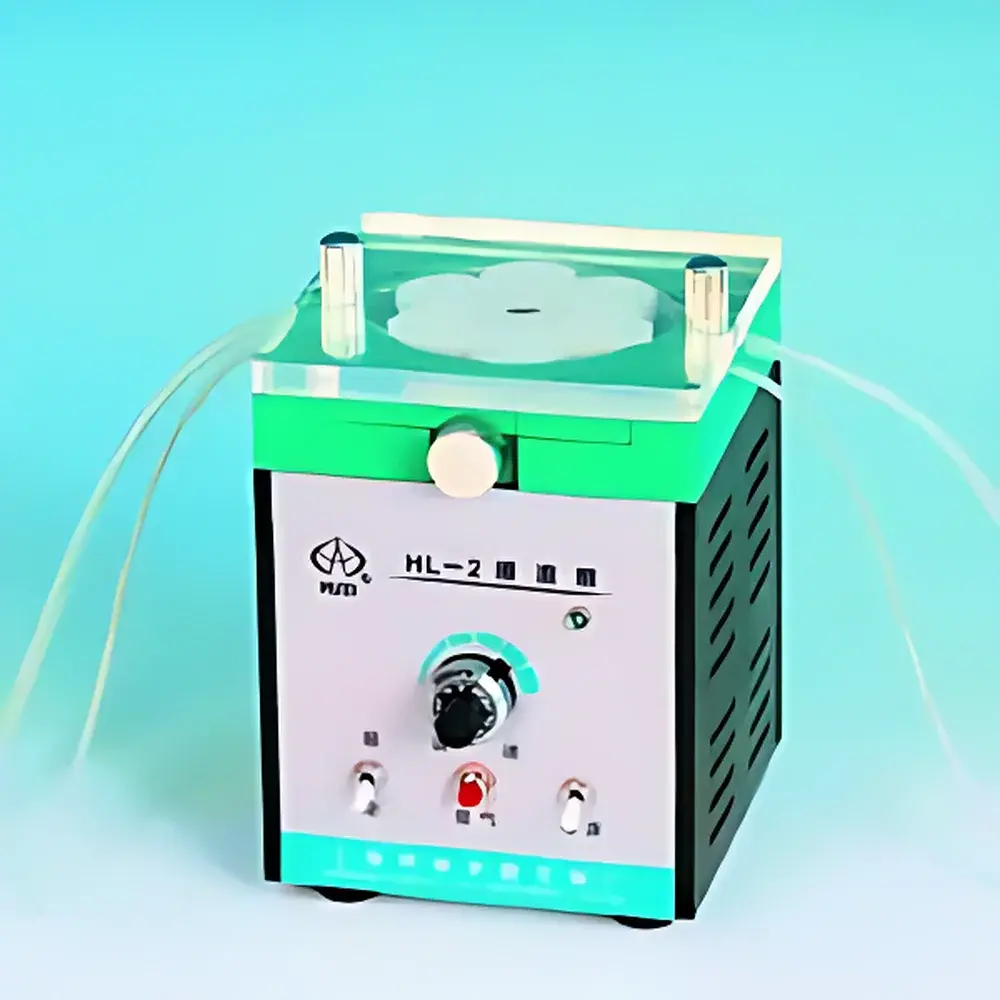
HL-2B Constant-Flow Peristaltic Pump / HL-2S PTFE-Head Peristaltic Pump
| Origin | Shanghai, China |
|---|---|
| Manufacturer Type | Authorized Distributor |
| Regional Origin | Domestic (China) |
| Model Variants | HL-2 / HL-2S / HL-2D |
| Flow Rate Range | 0.5–900 mL/h per channel |
| Speed Range | 0–65 rpm (digital display, stepless adjustment) |
| Pressure Rating | 3 kg/cm² (≈294 kPa) |
| Channel Configuration | Dual-channel (HL-2D/HL-2B) |
| Timer Range | 1–20 hours |
| Power Supply | AC 220 V, 50 Hz |
| Pump Head Material Options | Silicone tubing (standard), PTFE-lined tubing (HL-2S variant) |
| Compliance | Designed for general laboratory use under ISO/IEC 17025-aligned operational conditions |
Overview
The HL-2B Constant-Flow Peristaltic Pump and HL-2S PTFE-Head Peristaltic Pump are dual-channel, digitally controlled laboratory peristaltic pumps engineered for precise, pulse-free fluid delivery in low-to-medium pressure applications. Based on the principle of peristalsis—where rollers compress flexible tubing to displace fluid—the system delivers accurate volumetric flow without contact between pump components and the fluid stream. This design eliminates contamination risk, prevents sample degradation from shear-sensitive media, and supports solvent compatibility across a broad chemical spectrum. The HL-2B variant employs standard silicone tubing with digital speed control and dual-channel independent operation; the HL-2S integrates a chemically inert PTFE-lined pump head assembly, enhancing resistance to aggressive solvents, strong acids, and bases. Both models operate within a calibrated speed range of 0–65 rpm, translating to a verified flow rate range of 0.5–900 mL/h per channel under standardized tubing (ID 1.6 mm, wall thickness 0.8 mm), with pressure capability up to 294 kPa (3 kg/cm²). These instruments are intended for continuous or timed intermittent operation in ambient laboratory environments (10–40 °C, <80% RH non-condensing).
Key Features
- Dual-channel architecture enables simultaneous, independent fluid delivery—ideal for gradient mixing, parallel sample processing, or feed-and-collect configurations.
- Digital LED display with real-time rpm readout and stepless speed adjustment ensures repeatable flow calibration without mechanical gear shifting.
- Programmable timer function (1–20 hours per channel) supports unattended operation for extended assays, dialysis, or column elution protocols.
- Modular pump head design allows rapid tubing replacement and accommodates multiple inner diameters (1.6 mm, 2.4 mm, 3.2 mm) to scale flow output while maintaining laminar delivery characteristics.
- HL-2S variant features a fully PTFE-wetted pump head—including rotor housing, roller surfaces, and compression plate—validated for compatibility with HCl (37%), HNO₃ (65%), NaOH (50%), acetone, THF, and chlorinated solvents.
- Robust aluminum alloy chassis and EMI-shielded motor drive ensure stable performance during long-duration runs and co-location with sensitive analytical instrumentation.
Sample Compatibility & Compliance
The HL-2B and HL-2S are compatible with aqueous buffers, cell culture media, polymer solutions, organic solvents (dependent on tubing selection), and mild reagents. Tubing must be selected per application: platinum-cured silicone (HL-2B), PTFE-reinforced silicone (HL-2S), or fluoropolymer alternatives for extreme pH or UV exposure. While not certified to IEC 61000-6-2/6-4 or UL 61010-1 out-of-the-box, the units meet functional safety expectations for Class II laboratory equipment when operated within specified environmental and electrical parameters. Documentation supports traceability for GLP-compliant workflows, including batch-specific tubing lot records and speed calibration logs. No FDA 21 CFR Part 11 electronic signature capability is embedded; however, external data logging via RS-232 (optional interface module) permits integration into validated LIMS or ELN systems with appropriate audit trail configuration.
Software & Data Management
These pumps operate as standalone hardware devices with no proprietary software dependency. All parameter settings—including rpm, run time, and channel enable/disable—are retained in non-volatile memory after power cycling. Optional RS-232 communication (available via accessory module) enables remote speed control and status polling using ASCII command protocol (e.g., “SPD=42rn”, “STA?rn”). Integration with LabVIEW, Python (pySerial), or MATLAB is documented in the technical supplement. Calibration certificates (traceable to NIM, China) are provided with each unit, specifying speed accuracy (±0.5% of setpoint at 25 °C) and flow reproducibility (RSD <1.2% over 60 min at constant rpm and temperature).
Applications
- Continuous feeding in chromatography systems (HPLC fraction collection, SEC buffer delivery)
- Controlled infusion in dialysis, ultrafiltration, and membrane bioreactor studies
- Reagent dosing for automated titration, colorimetric assays, and enzymatic kinetics
- Cell perfusion in 3D bioreactors and microfluidic organ-on-chip platforms
- Environmental water sampling and on-site nutrient injection in mesocosm experiments
- Pharmaceutical dissolution testing per USP , where pulse-free flow minimizes particle disturbance
FAQ
What tubing sizes are supported, and how do they affect flow rate?
Standard configurations support inner diameters of 1.6 mm, 2.4 mm, and 3.2 mm. Flow rate scales approximately with the square of ID; switching from 1.6 mm to 2.4 mm tubing increases maximum flow by ~2.25× at identical rpm.
Is the HL-2S suitable for pumping hydrofluoric acid (HF)?
No. Although the PTFE head resists many corrosives, HF attacks PTFE at elevated concentrations and temperatures. Use only with HF concentrations ≤0.1% and at room temperature, with strict adherence to material safety data sheets.
Can both channels run at different speeds simultaneously?
Yes. Each channel has independent speed and timer controls, enabling asynchronous operation without cross-interference.
Does the pump include overload protection?
Yes. Integrated thermal cutoff interrupts motor power if coil temperature exceeds 90 °C, resetting automatically upon cooling.
How often should tubing be replaced during continuous operation?
Under typical use (24/7 at 30 rpm with 1.6 mm silicone tubing), replace every 150–200 hours. PTFE-reinforced tubing extends service life to ≥400 hours under equivalent conditions.



