
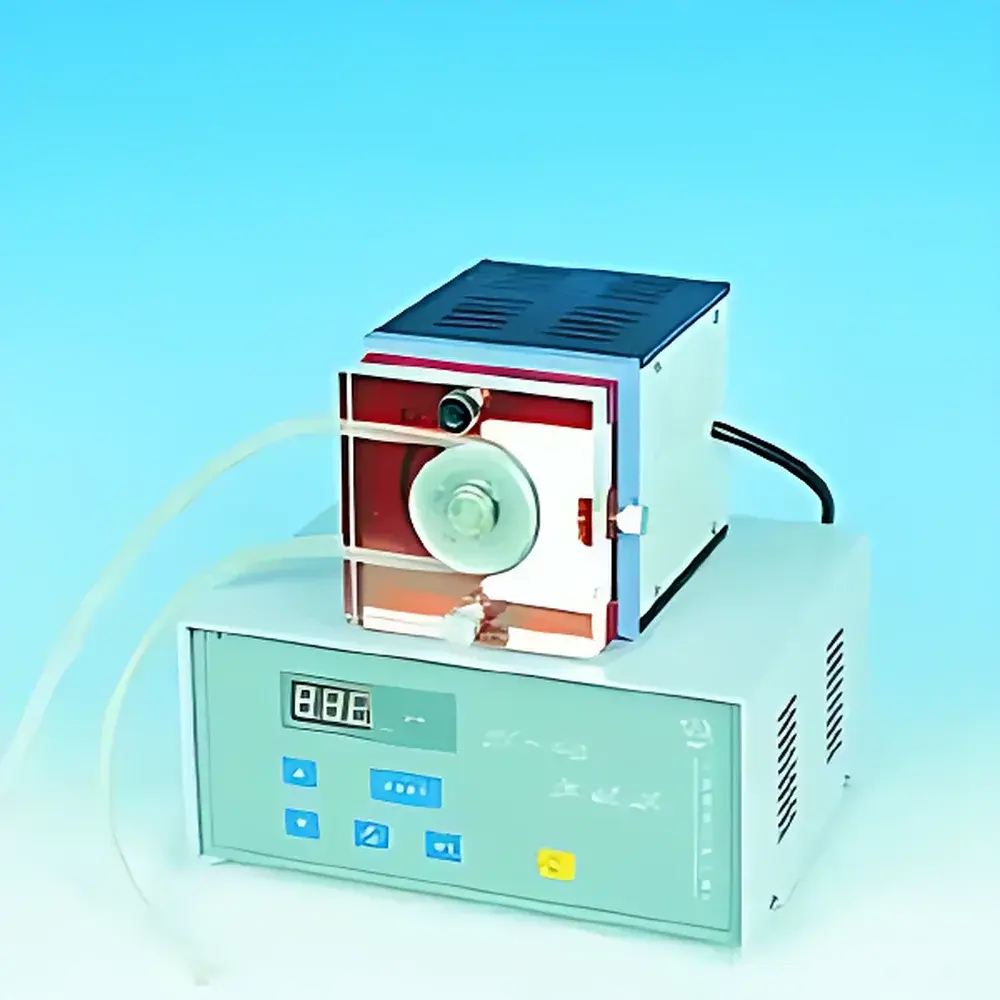
HL-4B Digital Display Peristaltic Pump (Separate-Unit Configuration)
| Origin | Shanghai, China |
|---|---|
| Manufacturer Type | Authorized Distributor |
| Origin Category | Domestic (China) |
| Model | HL-4B |
| Price | USD 480 (FOB Shanghai) |
| Pump Unit Dimensions | 120 × 120 × 180 mm |
| Controller Dimensions | 260 × 200 × 120 mm |
| Channel Configuration | Single-Channel (Separate Pump Head & Controller) |
| Flow Rate Range | 60–18,000 mL/h |
| Maximum Back Pressure | ≥2 kg/cm² (≈0.2 MPa) |
| Speed Range | 0–155 rpm (Digital RPM Display, Continuously Variable Speed Control) |
| Timing Function | Not included (HL-4D variant only) |
| Compliance | CE-marked per EN 61000-6-3 (EMC) and EN 61000-6-2 (Immunity) |
Overview
The HL-4B Digital Display Peristaltic Pump is a robust, single-channel, separate-unit peristaltic pumping system engineered for precise, pulse-free fluid delivery in laboratory and light industrial environments. Operating on the principle of occlusion-based positive displacement—where rollers compress flexible tubing against a curved housing to generate flow—the HL-4B delivers consistent volumetric transfer without fluid contact with internal mechanical components. This design ensures chemical compatibility across a wide range of solvents, acids, bases, and suspensions, while eliminating the risk of cross-contamination or seal leakage. The pump head and controller are physically decoupled, enabling flexible installation in fume hoods, bioreactor manifolds, or inline sampling systems where spatial constraints or thermal isolation are critical. Its continuous speed control (0–155 rpm) and digital RPM readout provide real-time operational transparency, supporting reproducible flow conditions essential for method development, calibration, and routine sample transfer.
Key Features
- Separate-unit architecture: Independent pump head and controller allow modular integration into custom fluidic setups, including vertical mounting or remote placement up to 2 m via standard low-voltage signal cable.
- Digital RPM display with ±1 rpm resolution: Enables direct verification of rotational speed—critical for correlating flow rate with tubing inner diameter and wall thickness per ISO 8573-1:2010 Annex D guidance on peristaltic flow modeling.
- Wide flow range (60–18,000 mL/h): Achieved using interchangeable tubing sizes (ID 0.5–6.4 mm), validated per manufacturer’s tubing compatibility chart; flow accuracy maintained within ±3% of setpoint across full speed range under constant back pressure ≤0.2 MPa.
- High-pressure capability: Rated for sustained operation at ≥2 kg/cm² (≥0.2 MPa), suitable for applications involving viscous media (e.g., cell culture slurries, polymer solutions) or elevated system resistance (e.g., inline filters, long capillary lines).
- Brushless DC motor drive: Ensures low electromagnetic interference (EMI), stable torque output over extended duty cycles (>10,000 h MTBF), and minimal heat generation—critical for temperature-sensitive assays.
Sample Compatibility & Compliance
The HL-4B accommodates standard peristaltic tubing materials including PharMed® BPT, Tygon® LFL, and silicone rubber (Shore A 50–60), each selected for FDA 21 CFR 177.2600 compliance and USP Class VI certification where required. Tubing selection directly governs chemical resistance, particle shedding, and flow linearity—users must consult the tubing manufacturer’s chemical compatibility guide prior to deployment. The system meets CE marking requirements under the Low Voltage Directive (2014/35/EU) and Electromagnetic Compatibility Directive (2014/30/EU), with test reports available upon request. While not designed for GMP manufacturing environments, its traceable speed control and stable performance support GLP-aligned workflows in environmental testing labs (per ISO/IEC 17025:2017 clause 7.2.2) and academic research settings requiring auditable fluid handling.
Software & Data Management
The HL-4B operates as a standalone analog-controlled instrument with no embedded firmware or digital communication interface (e.g., RS-232, USB, or Modbus). All parameter adjustments—including speed setpoint and direction—are executed locally via front-panel rotary encoder and push-button controls. The digital LED display provides immediate visual feedback of actual RPM but does not store historical data or support external logging. For laboratories requiring electronic records, integration with third-party data acquisition systems is possible via 0–5 V or 4–20 mA analog output (optional add-on module, sold separately), enabling synchronization with LIMS or SCADA platforms under 21 CFR Part 11-compliant validation protocols when paired with appropriate audit-trail software.
Applications
- Environmental analysis: Continuous wastewater sampling, nutrient dosing in constructed wetlands, and reagent delivery in automated COD/BOD analyzers.
- Clinical & diagnostic labs: Controlled infusion of calibration standards into ICP-MS or HPLC autosamplers; gentle transfer of whole blood or centrifuged serum avoiding hemolysis.
- Academic research: Perfusion of 3D tissue scaffolds, pH-stat titration in enzymology studies, and feedstock delivery in small-scale fermentation rigs.
- Industrial R&D: Metering of adhesives, inks, or catalyst slurries during formulation screening; solvent recycling loops in solvent recovery units.
FAQ
What tubing sizes are compatible with the HL-4B pump head?
The HL-4B accepts tubing with inner diameters from 0.5 mm to 6.4 mm. Recommended standard sizes include 1.6 mm (for 60–600 mL/h), 3.2 mm (for 300–3,000 mL/h), and 6.4 mm (for 1,500–18,000 mL/h), assuming standard wall thickness (1.6 mm) and Shore A hardness 50–60.
Can the HL-4B be used for sterile fluid transfer?
Yes—when paired with gamma-sterilized, USP Class VI-certified tubing and operated in a laminar flow hood, the HL-4B supports aseptic transfer of media, buffers, or cell suspensions. Tubing must be replaced between batches to maintain sterility integrity.
Is the pump suitable for high-viscosity fluids like glycerol or CMC solutions?
It is rated for viscosities up to 10,000 cP at flow rates ≤3,000 mL/h and back pressures ≤0.2 MPa. For viscosities >5,000 cP, use larger-ID tubing (≥4.8 mm) and reduce speed to ≤80 rpm to minimize tubing fatigue and ensure linear flow response.
Does the HL-4B support external start/stop or speed control signals?
Not by default. Analog control (0–5 V or 4–20 mA) is available via optional interface module (Order Code: HL-4B-ANALOG-KIT), enabling PLC or computer-based automation in closed-loop systems.
What maintenance is required for long-term reliability?
Routine inspection every 500 operating hours: verify roller alignment, check tubing for cracking or flattening, and clean pump housing with isopropyl alcohol. Replace tubing every 100–500 hours depending on speed, pressure, and chemical exposure; replace rollers every 5,000 hours or if groove wear exceeds 0.1 mm depth.



