
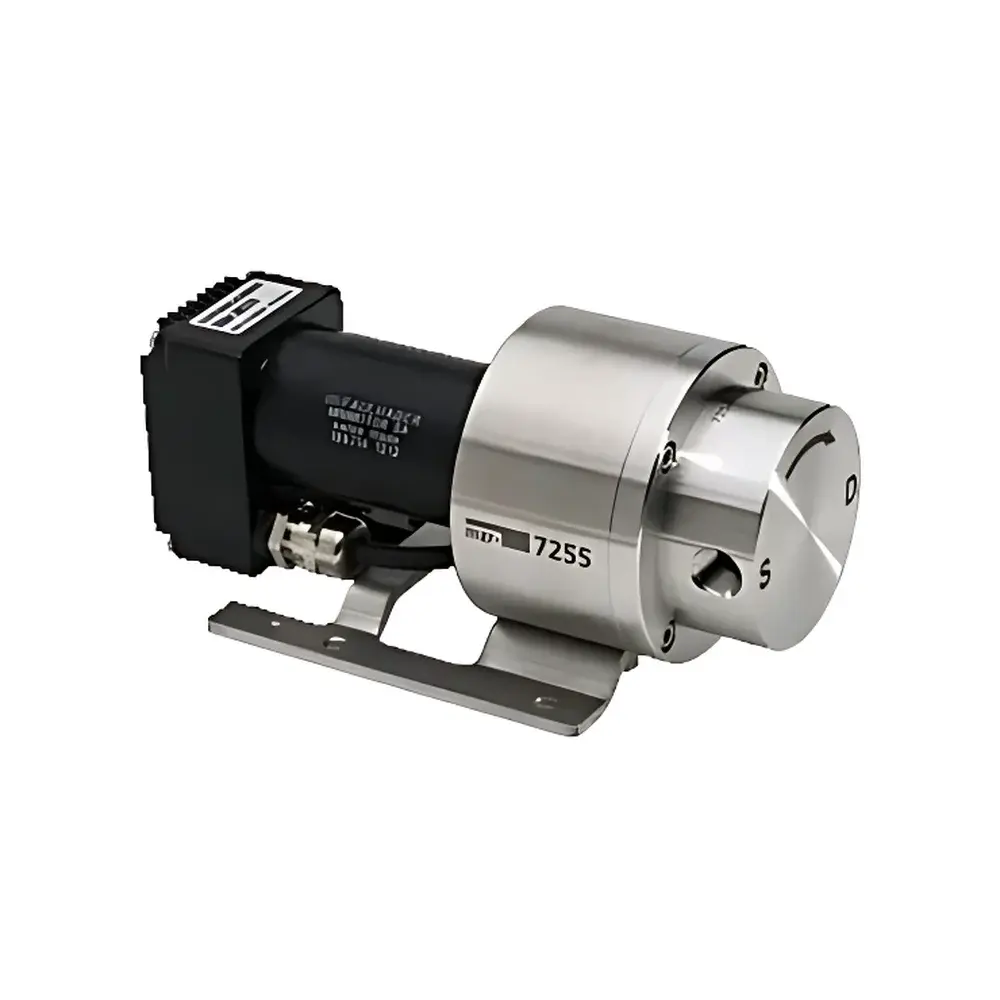
HNPM MZR-7255 Corrosion-Resistant Micro Annular Gear Pump
| Brand | HNPM |
|---|---|
| Origin | Germany |
| Model | MZR-7255 |
| Flow Rate | 0.048–288 mL/min |
| Viscosity Range | 0.3–1,000 mPa·s |
| Precision | CV < 1% |
| Speed Range | 1–6,000 rpm |
| Max Pressure | 80 bar |
| Displacement | 48 µL |
| Minimum Dose | 30 µL |
| Wetted Materials | Alloy C22 (2.4602), SSiC, Al₂O₃, ZrO₂, FFKM (Kalrez® Spectrum™ 6375) |
| Motor | 24 V DC, 44 W DC Servo with Encoder & Microcontroller |
| Interface | 0–10 V, 0(4)–20 mA, RS-232, 1x Digital I/O, Optional CAN Bus |
| Dimensions (L×W×H) | 146 × 70 × 72 mm |
| Weight | ~1,650 g |
| Operating Temp | −5 to +60 °C (−20 to +100 °C with optional thermal control) |
Overview
The HNPM MZR-7255 Corrosion-Resistant Micro Annular Gear Pump is an engineered solution for precise, pulse-free fluid handling of aggressive chemical media in demanding laboratory and pilot-scale process environments. Based on the principle of positive displacement via a micro annular gear mechanism—where two interlocking ceramic gears rotate within a precisely machined housing—the pump delivers continuous, non-pulsating flow without check valves or reciprocating components. Its design eliminates dead volume, minimizes shear stress, and ensures high volumetric efficiency across a wide viscosity range (0.3–1,000 mPa·s). The MZR-7255 is particularly suited for applications requiring long-term stability under corrosive, oxidizing, or reducing conditions—such as continuous-flow synthesis, microreactor integration, analytical sample introduction, and reagent dosing in corrosion-resistant process lines.
Key Features
- Chemically inert wetted path constructed from Alloy C22 (DIN 2.4602), sintered silicon carbide (SSiC) shafts and bearings, alumina (Al₂O₃) functional ceramics, and stabilized zirconia (ZrO₂) rotors—ensuring compatibility with strong acids (e.g., HNO₃, H₂SO₄), alkalis (e.g., NaOH), halogenated solvents, and oxidizers (e.g., H₂O₂, ClO₃⁻).
- Hermetically sealed magnetic coupling using 8-pole NdFeB (neodymium-iron-boron) magnets, eliminating mechanical seals and preventing leakage—even at elevated pressures up to 80 bar (1160 psi) total system pressure (inlet + differential).
- High-precision DC servo motor (24 V, 44 W) with integrated encoder and microcontroller, enabling closed-loop speed and dose control with repeatability better than CV < 1% across the full operational range (1–6,000 rpm).
- Compact footprint (146 × 70 × 72 mm) and low mass (~1.65 kg) facilitate integration into automated platforms, glovebox systems, and modular reactor skids without structural reinforcement.
- Multi-protocol interface support: analog (0–10 V / 0[4]–20 mA), digital (RS-232), discrete I/O, and optional CAN bus—enabling seamless interoperability with PLCs, SCADA systems, and LabVIEW- or Python-based control architectures.
Sample Compatibility & Compliance
The MZR-7255 meets material compatibility requirements defined in ASTM G152 (standard practice for evaluating resistance of metals to corrosion) and aligns with ISO 15190:2020 for laboratory safety in chemical handling. Its wetted materials comply with USP Class VI biocompatibility testing when configured with FFKM (Kalrez® Spectrum™ 6375) seals—making it suitable for pharmaceutical intermediate transfer where extractables and leachables must be minimized. The pump’s construction supports GLP and GMP-aligned workflows through traceable calibration records, configurable audit trails (via external controller logging), and deterministic dose delivery—critical for method validation per ICH Q2(R2) and FDA 21 CFR Part 11 compliant data acquisition systems.
Software & Data Management
While the MZR-7255 operates autonomously via analog/digital inputs, its embedded microcontroller enables firmware-upgradable functionality—including programmable ramp profiles, dose-volume triggering, and real-time error diagnostics (e.g., stall detection, overtemperature, or flow deviation alerts). When integrated with third-party control software (e.g., NI LabVIEW, MATLAB, or custom Python scripts via PySerial), users can implement dynamic flow rate modulation synchronized with reaction parameters (e.g., temperature, pH, or spectroscopic feedback). All operational parameters—including speed setpoint, actual RPM, cumulative volume dispensed, and runtime—are accessible via ASCII command protocol over RS-232, supporting automated report generation and electronic lab notebook (ELN) integration.
Applications
- Continuous-flow synthesis of fine chemicals and active pharmaceutical ingredients (APIs) in microreactors and mesoscale reactors.
- Precise reagent metering in automated titration, electrochemical cell feeding, and catalyst screening platforms.
- Stable carrier solvent delivery in LC-MS and IC-MS interfaces where pulsation-induced signal noise must be avoided.
- Corrosion-resistant dosing in flue gas desulfurization (FGD) simulation rigs, nuclear fuel cycle research, and spent electrolyte recycling loops.
- Low-volume calibration standard delivery in metrology labs performing gravimetric flow verification per ISO 4064-2.
FAQ
What is the maximum allowable differential pressure at 100 mPa·s viscosity?
At viscosities above 16 mPa·s, the pump supports up to 40 bar differential pressure; operation at 80 bar total system pressure requires inlet pressure compensation and is validated only for viscosities ≤100 mPa·s with appropriate thermal management.
Can the MZR-7255 be used with hydrofluoric acid (HF)?
No. While Alloy C22 and ZrO₂ exhibit broad resistance to mineral acids, HF attacks both zirconia and silicon carbide. Alternative wetted material configurations (e.g., Hastelloy B-3 with PTFE-lined internals) require factory customization and are subject to separate qualification.
Is firmware update capability available in-field?
Yes—firmware updates are performed via RS-232 using HNPM-provided utilities and require no hardware modification. Version history and checksum validation ensure traceability per ISO/IEC 17025 Clause 5.9.2.
Does the pump meet ATEX or IECEx requirements for hazardous areas?
The standard MZR-7255 is not certified for Zone 1/21 use. Explosion-proof variants with intrinsically safe motor drivers and encapsulated electronics are available upon request and require project-specific certification documentation.
What maintenance intervals are recommended for continuous 24/7 operation?
Under nominal load (≤40 bar ΔP, 25 °C, non-abrasive media), the ceramic bearing and rotor assembly is rated for ≥15,000 operating hours. Annual verification of magnetic coupling torque retention and encoder linearity is advised for GMP-critical deployments.



