
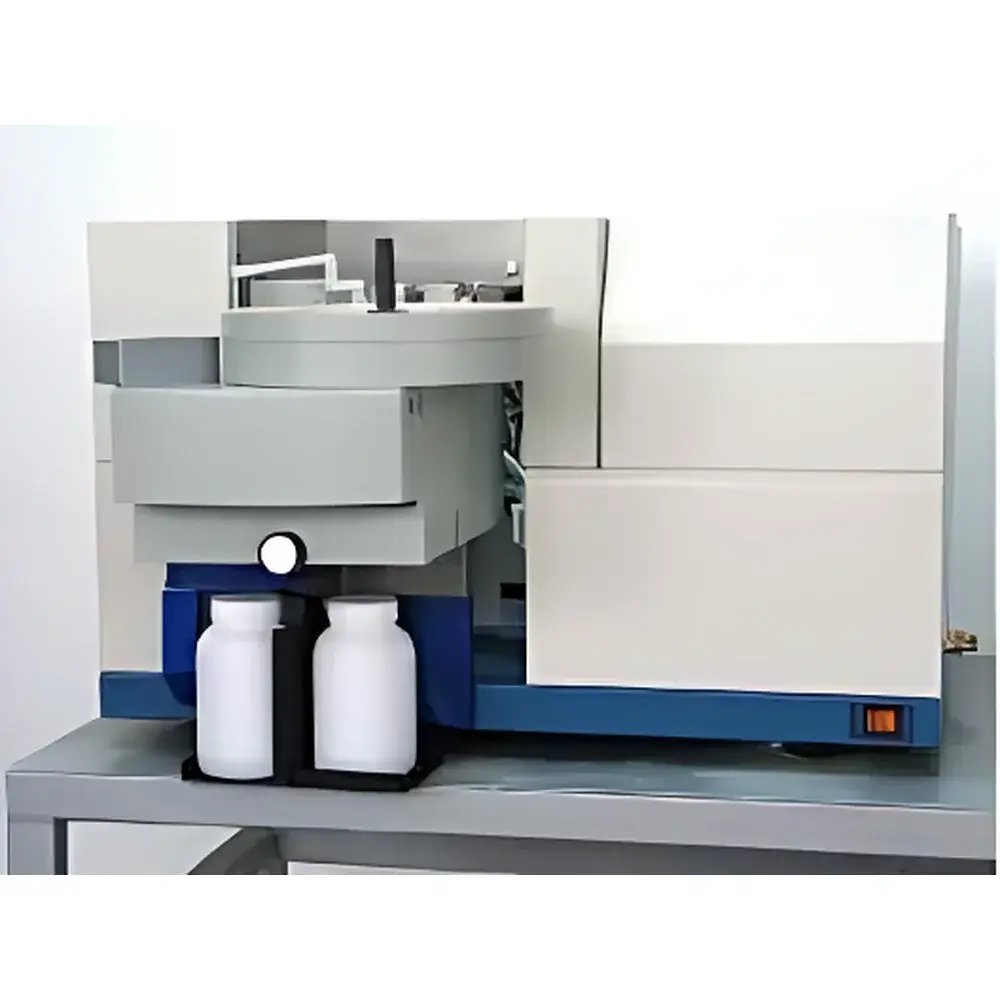
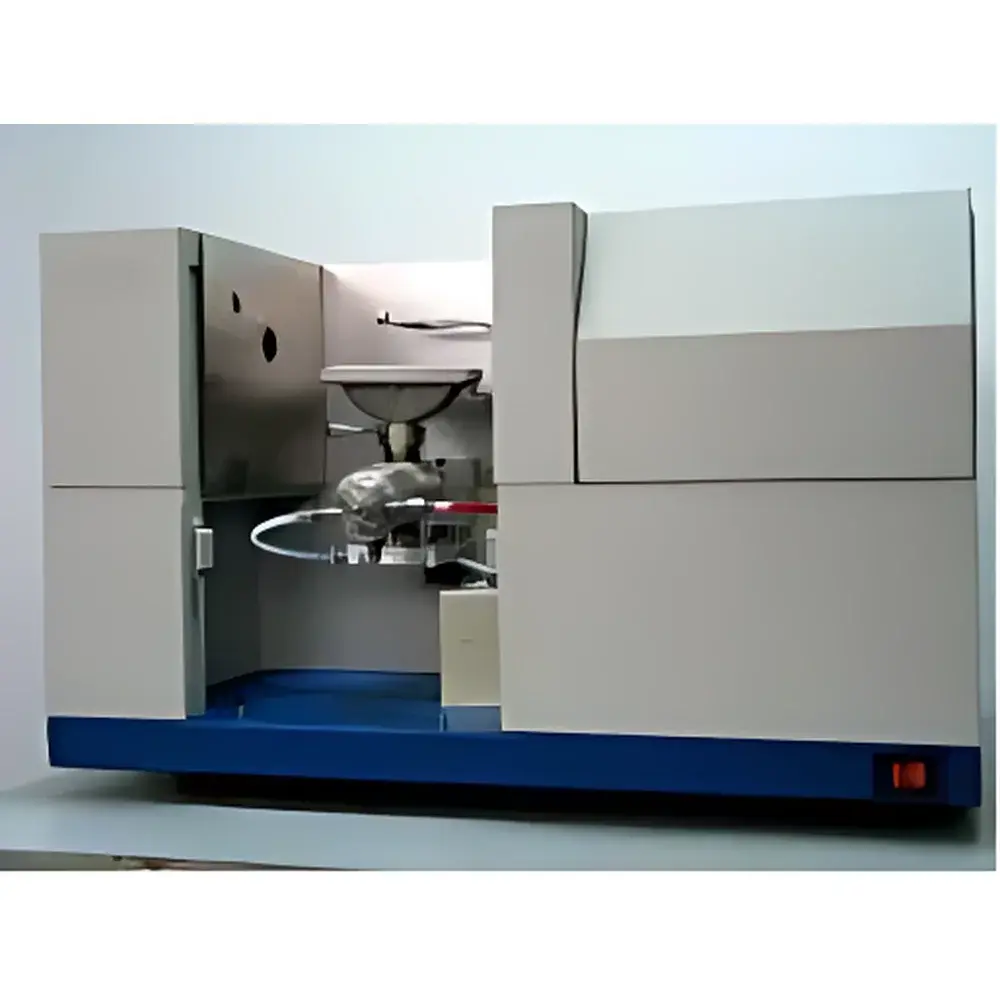
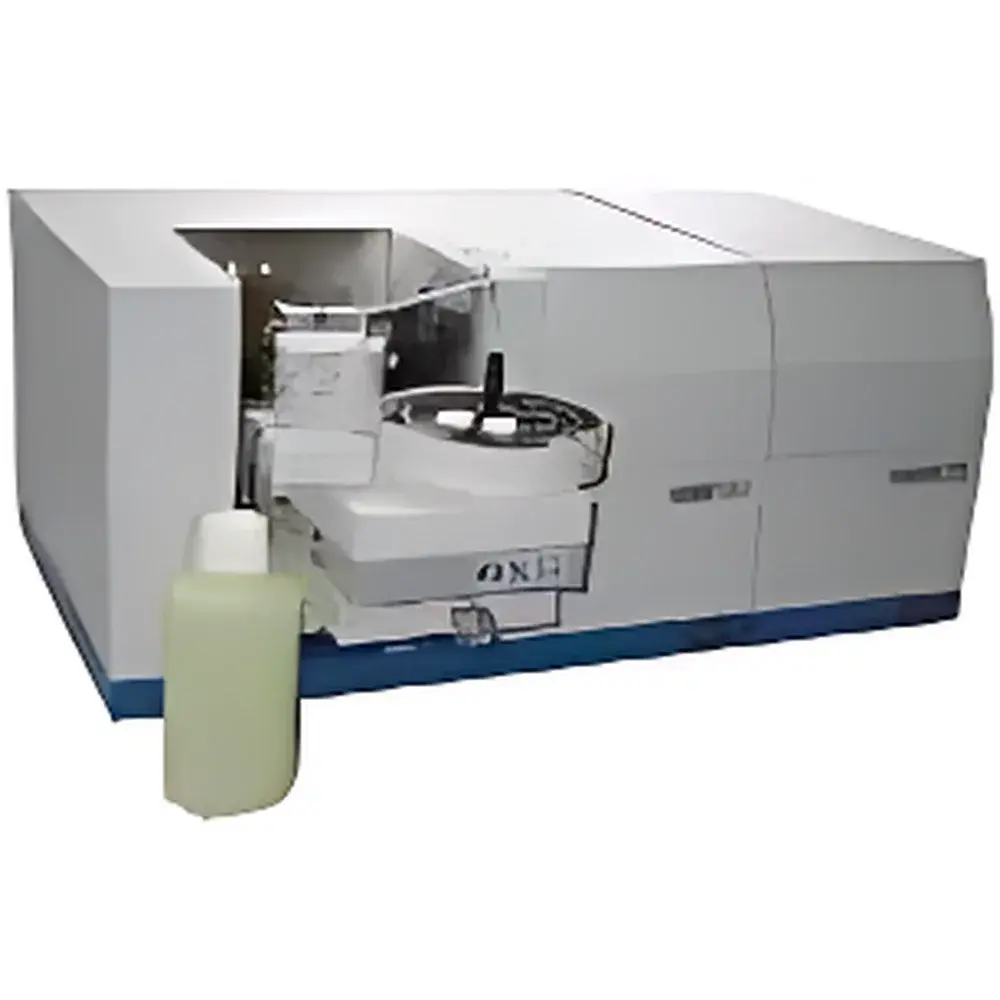
HOGON AA9800 Flame and Graphite Furnace Atomic Absorption Spectrometer
| Brand | HOGON |
|---|---|
| Origin | Shanghai, China |
| Manufacturer Type | Direct Manufacturer |
| Instrument Type | Flame–Graphite Furnace Hybrid AAS |
| Monochromator | Fixed-grating with selectable slits |
| Optical System | Double-beam |
| Detector | Solid-state CCD array |
| Background Correction | Simultaneous D₂-lamp and Self-reversal (SR) correction |
| Spectral Bandwidth | 0.1, 0.2, 0.4, 0.7, 1.0, 2.0 nm (auto-switching) |
| Wavelength Range | 190–900 nm |
| Wavelength Accuracy | ±0.2 nm |
| Wavelength Repeatability | 0.1 nm |
| Resolution | 0.2 nm |
| Cu Detection Limit (Flame) | ≤0.004 µg/mL |
| Cu Characteristic Concentration (Flame) | ≤0.025 µg/mL per 1% absorption |
| Precision (RSD, Cu, A > 0.8) | ≤0.5% |
| Baseline Drift | ≤0.002 A / 30 min |
| Graphite Furnace Max Ramp Rate | ≥3000 °C/s |
| Graphite Furnace Temp Range | Ambient to 3000 °C |
| Cd Characteristic Mass | ≤1 pg |
| Cu Characteristic Mass | ≤10 pg |
| Graphite Furnace Precision (RSD) | ≤3% (Cd, Cu) |
| Lamp Turret | 6-position automatic |
| Auto-sampler Options | 45- or 85-position |
| Gas Control | Dual-path (in-tube / out-tube) inert gas regulation |
| Safety Systems | Real-time flame status monitoring, gas pressure sensors (air, acetylene, N₂O), auto-shutdown on flame failure/flashback, power-interruption cutoff, overtemperature/coolant-flow interlock |
| Dimensions | 700 × 550 × 440 mm |
| Weight | 80 kg |
| Power Requirement | 220 V AC, 6000 W nominal, transient peak up to 8 kW |
Overview
The HOGON AA9800 is a dual-mode atomic absorption spectrometer engineered for high-precision elemental quantification across flame and graphite furnace atomization pathways—operating simultaneously without mechanical mode switching. Based on the fundamental principle of atomic absorption spectroscopy, the instrument measures ground-state atomic vapor absorption of element-specific hollow cathode lamp (HCL) radiation at characteristic wavelengths (190–900 nm). Its double-beam optical architecture—featuring a suspended anti-vibration optical platform—minimizes thermal drift and mechanical perturbation, ensuring long-term wavelength stability and photometric reproducibility. The system complies with core metrological standards including JJG 694 (China National Verification Regulation for AAS), GB/T 15337 (General Technical Requirements for AAS), and JB/T 6780 (Performance Specifications for Flame AAS), and supports traceability in GLP- and GMP-aligned laboratories through full audit trail capability in its software environment.
Key Features
- Dual-atomization capability: Independent, concurrent flame and graphite furnace operation—eliminating downtime during method transition.
- 6-lamp automatic turret with simultaneous pre-heating: Enables rapid multi-element analysis and seamless lamp alignment calibration.
- High-fidelity background correction: Integrated deuterium lamp (D₂) and self-reversal (SR) techniques provide accurate correction across broad absorbance ranges (up to 2.5 A), essential for complex matrices in environmental and biological samples.
- Advanced graphite furnace control: PID-based temperature regulation ensures immunity to line voltage fluctuations; ramp rates exceed 3000 °C/s with precise dwell control from ambient to 3000 °C.
- Dual-path gas management: Separate inner- and outer-tube inert gas flow control optimizes atomization efficiency while extending graphite tube lifetime—critical for low-volume, high-sensitivity analyses.
- Real-time multimedia monitoring: Integrated digital camera system visualizes graphite tube interior during drying, ashing, and atomization stages—supporting method development, operator training, and positional optimization of autosampler probe insertion.
- Comprehensive hardware safety architecture: Includes flame presence sensors, burner-head interlocks, real-time gas pressure monitoring (air, acetylene, nitrous oxide), automatic fuel cutoff on flashback or flameout, and thermal/coolant-flow interlocks.
Sample Compatibility & Compliance
The AA9800 accommodates aqueous solutions, digested solids (e.g., EPA Method 3050B/3052), and organic extracts following appropriate matrix modifiers. It meets regulatory requirements for elemental testing in food (AOAC 999.10, ISO 11885), environmental water (EPA 7000B), pharmaceuticals (USP , ICH Q2(R2)), and cosmetics (ISO 17294-2). Its software supports 21 CFR Part 11-compliant electronic signatures, audit trails, and user-access controls—validated for use in FDA-registered and ISO/IEC 17025-accredited laboratories. All safety mechanisms conform to IEC 61010-1 (Electrical Safety for Laboratory Equipment) and EN 61010-2-051 (Particular Requirements for Analytical Instruments).
Software & Data Management
The proprietary HOGON AAS Workstation provides full instrument control via Windows-based GUI, supporting method creation, sequence programming, kinetic curve acquisition, and integrated calibration (linear, quadratic, standard addition). Data handling includes automatic peak integration, multi-point background subtraction, QC flagging (e.g., drift, outlier detection), and export to CSV, XML, or LIMS-compatible formats. Audit trail logs capture all parameter changes, calibration events, and user actions with timestamps and operator IDs. Remote diagnostics and firmware updates are supported over secure LAN/WAN connections—enabling centralized fleet management for multi-site laboratories.
Applications
The AA9800 delivers validated performance in routine and regulated workflows: quantification of Ca, Mg, Fe, Zn in fortified foods and dietary supplements; Pb, Cd, As in soil and wastewater per ISO 17294-2; Na, K in clinical serum; Cr, Ni in electroplating baths; and ultra-trace Cd (<1 pg) and Cu (60 samples/hour), while graphite furnace enables sub-ppt detection in geological digests and single-cell metalomics studies. The optional online dilution module reduces manual sample preparation errors and extends linear dynamic range by up to 100×.
FAQ
Does the AA9800 require external cooling water for graphite furnace operation?
Yes—continuous deionized water flow (≥1.5 L/min, 10–30 °C) is mandatory for graphite furnace heat dissipation; the system halts heating if flow falls below threshold.
Can the software generate compliance-ready reports for ISO/IEC 17025 accreditation?
Yes—the workstation exports fully traceable PDF reports containing raw spectra, calibration curves, uncertainty estimates (k=2), and full audit trail appendices.
Is the 6-lamp turret compatible with third-party hollow cathode lamps?
It accepts standard 1/4-inch pin-base HCLs meeting IUPAC lamp specifications; however, optimal performance and auto-alignment require HOGON-certified lamps.
What is the maximum sample volume capacity for the 85-position autosampler?
Each vial holds up to 2 mL; total rack capacity is 85 × 2 mL, with programmable rinse cycles and cross-contamination mitigation protocols.
How does the dual-path gas control improve analytical sensitivity?
By maintaining outer-tube argon purge during atomization while pausing inner-tube flow, the system minimizes convective losses of analyte atoms—increasing residence time in the optical path and enhancing peak area reproducibility.




