
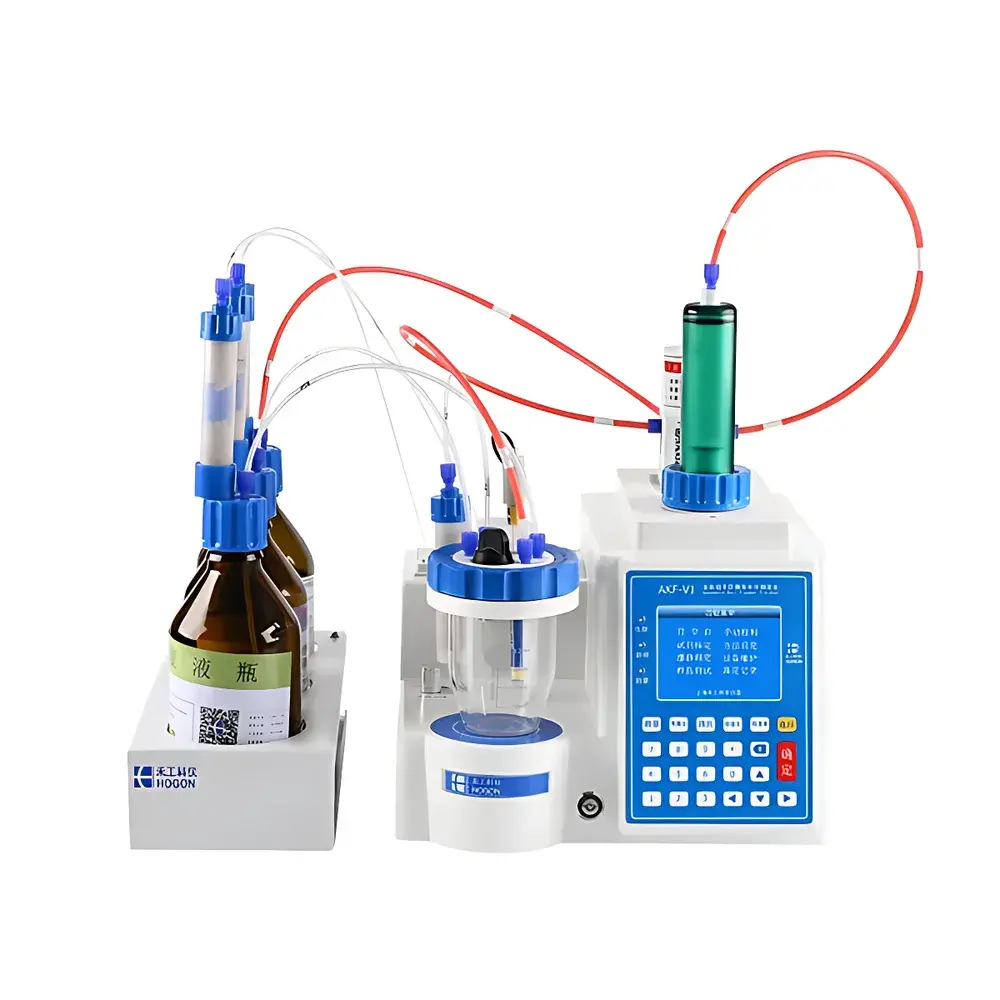
HOGON AKF-V1 Karl Fischer Volumetric Moisture Analyzer for Cyclobutanone
| Brand | HOGON |
|---|---|
| Origin | Shanghai, China |
| Manufacturer Type | Direct Manufacturer |
| Instrument Type | Volumetric Karl Fischer Moisture Analyzer |
| Moisture Range | 0.001–100.00% (10 ppm – 100% w/w) |
| Resolution | 1 ppm |
| Measurement Precision | ±1 mV |
| Minimum Dispensing Volume | 1 µL |
| Repeatability | RSD ≤ 0.5% (at 20 mg H₂O) |
| Linearity (r²) | ≥ 0.998 |
| Polarization Voltage Range | 0–120 mV |
| Burette | 20 mL long-life automatic burette |
| Titration Control Accuracy | 0.001 mL |
| Power Supply | 110–240 VAC, 50–60 Hz |
| Data Storage Capacity | 100 test records |
Overview
The HOGON AKF-V1 Karl Fischer Volumetric Moisture Analyzer is a dedicated benchtop instrument engineered for high-precision, trace-level water quantification in challenging organic solvents—particularly aldehydes and ketones such as cyclobutanone. It operates on the principle of volumetric coulometric-free Karl Fischer titration, where iodine generated *in situ* via stoichiometric reaction with water is replaced by controlled addition of standardized iodine-containing reagent. Unlike coulometric systems, the AKF-V1 employs a dual-platinum electrode pair to monitor the redox potential shift at the endpoint, enabling robust, reproducible detection even in low-conductivity, non-aqueous matrices. Its sealed titration cell architecture minimizes ambient moisture ingress, while the integrated stirring platform ensures homogeneous reagent–sample interaction—critical for accurate quantification in viscous or low-dielectric media like cyclobutanone (dielectric constant ε ≈ 22). Designed for routine QC labs and R&D environments in fine chemical, pharmaceutical, and polymer synthesis, the AKF-V1 meets foundational requirements for method validation under ISO 8533, ASTM E203, and USP .
Key Features
- Optimized for aldehyde/ketone matrices: Compatible with proprietary KF reagents A (titrant, 5.1922 mg/mL I₂ equivalence) and B (solvent), formulated to suppress side reactions with carbonyl groups.
- High-fidelity endpoint detection: Dual-platinum polarizable electrodes with adjustable polarization voltage (0–120 mV) enable stable endpoint recognition across variable sample conductivities.
- Precision fluid handling: 20 mL high-accuracy burette with ±0.001 mL dispensing resolution and 1 µL minimum increment supports trace-level analysis down to 10 ppm.
- Automated blank subtraction: Built-in “blank titration” function removes residual moisture from solvent and cell prior to sample introduction, establishing a true zero baseline.
- Drift compensation algorithm: Real-time background moisture drift correction eliminates environmental humidity influence during extended analyses.
- GLP-ready operation: All measurements log timestamp, operator ID (if configured), sample weight, reagent consumption, endpoint potential, and drift value—fully traceable per FDA 21 CFR Part 11 audit trail requirements when paired with compliant LIMS integration.
Sample Compatibility & Compliance
The AKF-V1 is validated for direct injection analysis of neat cyclobutanone and other reactive carbonyl compounds without derivatization. Its closed-cell design and inert PTFE-coated components resist corrosion from aggressive KF reagents. The system complies with ISO/IEC 17025 documentation standards for calibration and performance verification. Routine verification includes water standard calibration (10 µL certified water, 10.00 ± 0.02 mg/g) with acceptance criteria: linearity r² ≥ 0.998, repeatability RSD ≤ 0.5% (n=5), and recovery 99.5–100.5%. For regulated environments, the instrument supports IQ/OQ protocols aligned with GMP Annex 11 and USP guidelines on moisture analysis.
Software & Data Management
The embedded firmware provides intuitive touchscreen navigation for method setup, calibration, and measurement execution. Each assay stores full metadata—including sample mass, titrant volume consumed, endpoint potential (mV), drift rate (µg/min), and calculated moisture %—in a non-editable binary log. Export options include CSV and PDF reports with digital signature fields. Up to 100 complete test records are retained onboard; external USB export enables long-term archival. Optional PC software (HOGON MoistureLink v3.x) adds statistical process control (SPC) charts, multi-method comparison, and automated report generation compliant with 21 CFR Part 11 electronic signature rules.
Applications
- Quality control of cyclobutanone raw material in API synthesis, where water > 0.2% w/w may catalyze ring-opening or promote aldol condensation side reactions.
- Stability-indicating assays for ketone-based excipients in lyophilized formulations.
- Moisture specification verification in electronic-grade solvents used in semiconductor photoresist manufacturing.
- Batch release testing of catalyst ligands containing cyclic ketone moieties, where trace water deactivates transition metal centers.
- Method transfer support between R&D and production labs due to deterministic endpoint detection and minimal operator dependency.
FAQ
Is the AKF-V1 suitable for moisture analysis in other ketones besides cyclobutanone?
Yes—the instrument is validated for acetone, methyl ethyl ketone (MEK), cyclohexanone, and diisobutyl ketone using the same aldehyde/ketone-specific reagent system.
What maintenance is required for long-term accuracy?
Burette piston lubrication every 6 months, electrode cleaning with ethanol weekly, and annual verification of burette delivery accuracy using certified gravimetric standards.
Can the system be integrated into a laboratory network for centralized data management?
Yes—via optional Ethernet module supporting MODBUS TCP and secure HTTPS API endpoints for LIMS or MES connectivity.
Does the instrument support ASTM D6304 or ISO 15512 compliance?
It fulfills all instrumental requirements of ASTM D6304 (Section 8.2–8.5) and ISO 15512 for volumetric KF titration, including endpoint detection criteria, reagent standardization, and precision reporting.
How is reagent stability monitored during extended use?
The system logs real-time drift values before and after each titration; sustained drift > 5 µg/min triggers an alert recommending reagent replacement or cell drying.



