
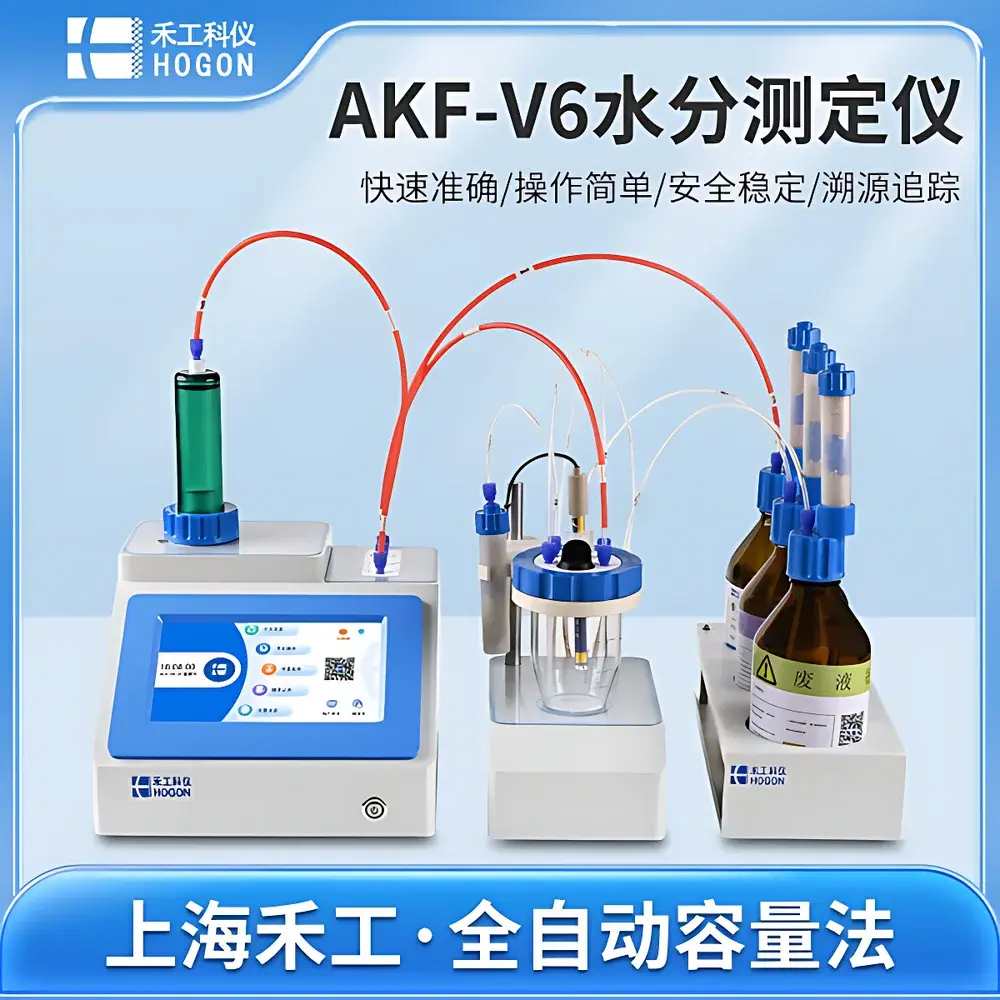
HOGON AKF-V6 Acetic Acid-Specific Volumetric Karl Fischer Moisture Titrator
| Brand | HOGON |
|---|---|
| Origin | Shanghai, China |
| Manufacturer Type | Direct Manufacturer |
| Instrument Type | Volumetric Karl Fischer Titrator (Acetic Acid-Optimized) |
| Titration Mode | Fully Automated |
| Moisture Range | 10 ppm – 100% H₂O (0.001–100 wt%) |
| Resolution | 0.1 ppm |
| Precision | RSD ≤ 0.3% (at 1500 µL reagent consumption) |
| Minimum Dispensing Volume | 0.5 µL (20 mL burette) |
| Burette Accuracy | ±0.5 µL (20 mL burette) |
Overview
The HOGON AKF-V6 Acetic Acid-Specific Volumetric Karl Fischer Moisture Titrator is an engineered solution for high-precision water content determination in acetic acid-rich and highly reactive matrices commonly encountered in pharmaceutical, biotechnology, and fine chemical manufacturing. Based on the classical volumetric Karl Fischer titration principle—where iodine, generated in situ via stoichiometric reaction with sulfur dioxide and a base in methanol-free or low-alcohol solvent systems, quantitatively oxidizes water—the AKF-V6 employs a chemically optimized reagent delivery architecture and adaptive endpoint detection to ensure robust performance in challenging acidic environments. Unlike generic KF titrators, the AKF-V6 integrates proprietary solvent compatibility logic, acid-stable electrode conditioning protocols, and corrosion-resistant fluidic pathways specifically validated for glacial acetic acid (≥99.8%), enabling direct, non-dilution analysis of raw materials, active pharmaceutical ingredients (APIs), excipients, and formulation solvents without sample degradation or endpoint drift.
Key Features
- 7-inch full-color capacitive touchscreen with bilingual (English/Chinese) GUI, real-time titration curve visualization, and simultaneous display of moisture content, titrant consumption, drift, and endpoint stability metrics
- Fully enclosed, chemically inert titration cell assembly constructed from PTFE, borosilicate glass, and Hastelloy C-276 components—designed to withstand prolonged exposure to glacial acetic acid and chlorinated solvents
- HOGON proprietary high-precision burette system with dual-sensor volumetric verification (optical + gravimetric feedback), delivering ≤0.5 µL dispensing accuracy across the full 20 mL range
- Intelligent endpoint recognition algorithm combining dynamic slope monitoring, second-derivative peak detection, and adaptive baseline correction—reducing false endpoints in volatile or low-conductivity samples
- Automated workflow sequence: solvent priming, electrode conditioning, sample injection (via integrated syringe pump or optional headspace sampler), titration, post-titration rinse, and waste evacuation—all programmable and repeatable
- Manual override mode supporting discrete operations including burette filling, electrode de-passivation, quantitative dispensing, waste drainage, and cell cleaning—essential for method development and troubleshooting
Sample Compatibility & Compliance
The AKF-V6 is validated for direct analysis of acetic acid-based formulations and associated pharmaceutical intermediates, including but not limited to glacial acetic acid, acetic anhydride, acetyl chloride, and mixed solvent systems containing ≥70% acetic acid. It accommodates solids (e.g., PVP K30, lactose, starch, magnesium chloride hexahydrate), semi-solids (soft/hard capsule shells, medical adhesives), lyophilized biologics (PLA/PGA/PVA-based scaffolds, protein and serum freeze-dried powders), and liquid formulations (ophthalmic solutions, IV admixtures, diagnostic reagents). Instrument firmware supports user-defined method templates compliant with USP , EP 2.5.12, and ASTM E203. Audit trail functionality meets FDA 21 CFR Part 11 requirements for electronic records and signatures, including time-stamped operator actions, parameter changes, and result modifications—with immutable storage of raw titration data, metadata, and system logs.
Software & Data Management
Embedded Linux-based control software provides role-based access via three-tier user permissions (Administrator, Supervisor, Analyst), each with configurable privileges for method editing, calibration, report generation, and audit log review. All measurement data—including titration curves, raw current/voltage traces, reagent batch IDs, environmental temperature/humidity stamps, and operator credentials—are automatically timestamped and stored in encrypted SQLite databases. Local storage retains ≥1,000 complete test records; external USB export supports CSV, PDF, and XML formats compatible with LIMS integration. Optional network connectivity enables remote diagnostics, centralized instrument fleet monitoring, and secure cloud backup per ISO/IEC 27001-aligned data governance policies.
Applications
The AKF-V6 serves as a reference-grade moisture analyzer in QC/QA laboratories supporting GMP-compliant manufacturing of sterile injectables, ophthalmic preparations, and lyophilized biologics. Typical use cases include release testing of acetic acid used in peptide synthesis, moisture verification of freeze-dried monoclonal antibody formulations, stability-indicating assays for hygroscopic excipients (e.g., polyvinylpyrrolidone, mannitol), and residual solvent quantification in final drug product batches. Its adaptability extends to R&D applications such as kinetic studies of hydrolysis in ester prodrugs, moisture sorption isotherm mapping of polymer matrices, and method transfer validation between compendial and in-house analytical procedures.
FAQ
Is the AKF-V6 compatible with non-acetic acid matrices?
Yes—while optimized for acetic acid, the instrument supports standard KF solvents (e.g., Hydranal–Composite 5, Metrohm Aquastar) and can be reconfigured for general-purpose moisture analysis across liquids, solids, and gases using optional accessories.
Does it support GLP-compliant data integrity requirements?
Yes—full 21 CFR Part 11 compliance is implemented via electronic signatures, audit trail immutability, and permission-controlled data access, satisfying GLP and GMP documentation standards.
Can the system interface with laboratory information management systems (LIMS)?
Yes—CSV and XML export formats, combined with configurable TCP/IP communication protocols, enable seamless bidirectional integration with major LIMS platforms.
What maintenance intervals are recommended for routine operation?
Daily electrode cleaning and solvent replacement; quarterly calibration verification using certified water standards (e.g., Hydranal Water Standard 1.00 mg/g); annual preventive maintenance including burette seal inspection and optical sensor recalibration.
Is method development support available from HOGON application scientists?
Yes—HOGON provides documented application notes, SOP templates, and remote technical consultation for method optimization, validation, and regulatory submission support.




