
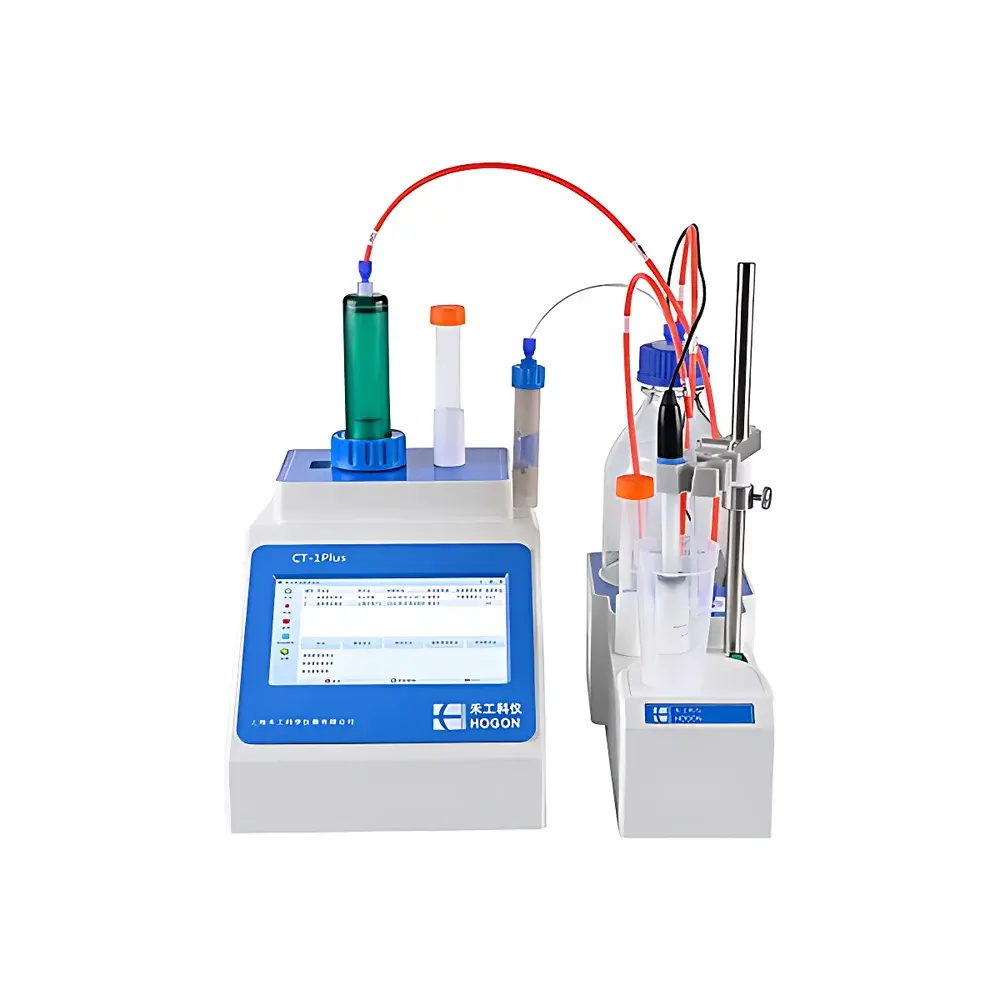
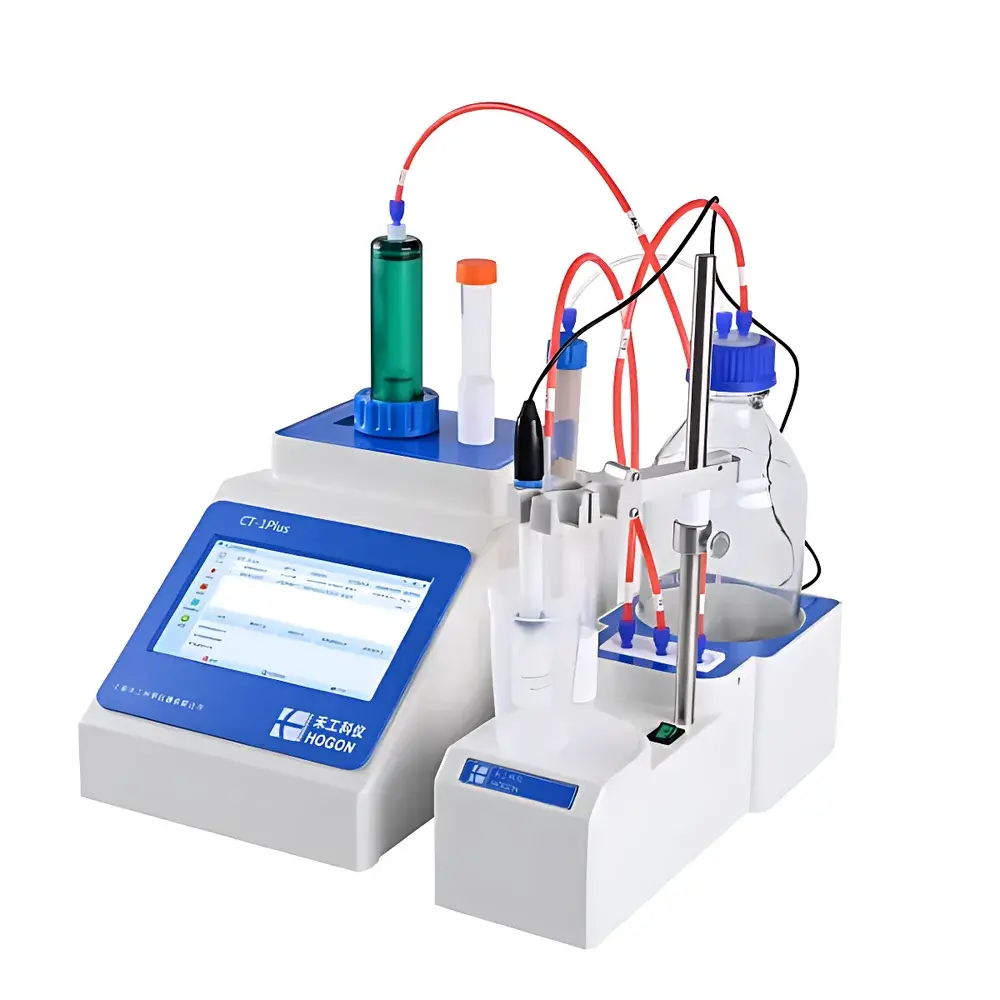
HOGON CT-1Plus Automatic Potentiometric Titrator for Mixed Acid Concentration Analysis in Wet Etching Processes
| Brand | HOGON |
|---|---|
| Origin | Shanghai, China |
| Manufacturer Type | Direct Manufacturer |
| Product Category | Domestic |
| Model | CT-1Plus |
| Instrument Type | General-Purpose Potentiometric Titrator |
| Application Scope | Universal |
| pH Measurement Range | 1–14 |
| Meter Display Accuracy | ±0.2 mV |
| Meter Resolution | 0.1 mV (within ±2000 mV range) |
| Titration Precision | 0.001 mL (20 mL burette, standard) |
| Titration Resolution | 0.0005 mL (10 mL burette, optional) |
Overview
The HOGON CT-1Plus Automatic Potentiometric Titrator is an engineered solution for precise, reproducible quantification of mixed acid concentrations—particularly nitric acid (HNO₃) and hydrofluoric acid (HF)—in semiconductor wet etching processes. Operating on the principle of potentiometric titration, the instrument detects inflection points in electrode potential versus titrant volume to identify stoichiometric endpoints without subjective visual interpretation. This electrochemical measurement approach eliminates human bias inherent in colorimetric or manual titrations and delivers traceable, objective results essential for process-critical environments. Designed specifically for high-ionic-strength, corrosive media common in microfabrication, the CT-1Plus integrates a robust fluidic architecture with chemically resistant components—including HF-compatible electrodes—to ensure long-term stability and metrological integrity under routine production-line use.
Key Features
- High-precision dispensing system featuring a standard 20 mL glass burette with ±0.001 mL volumetric accuracy and 10 µL minimum dispensing increment—enabling fine-grained control over titrant addition during multi-step acid dissociation analysis.
- Advanced differential endpoint detection algorithm with user-adjustable sensitivity (e.g., dE/dV threshold ≥200), allowing reliable resolution of overlapping endpoints in sequential HNO₃/HF titrations where pKa values differ by less than 1 unit.
- Automated workflow execution: sample weighing, electrode immersion, magnetic stirring, titrant delivery, real-time potential monitoring, endpoint recognition, stoichiometric calculation, and report generation—all performed unattended within ~120 seconds per analysis.
- Electrode compatibility with both pH102 composite glass electrodes and antimony (Sb) reference electrodes, both rated for continuous exposure to ≥40% HF solutions and strong mineral acids at ambient temperatures.
- 7-inch capacitive touchscreen interface with intuitive method editor, preloaded SOP templates for common etchant matrices (e.g., HF/HNO₃, HF/HCl, phosphoric acid blends), and GLP-compliant audit trail logging.
Sample Compatibility & Compliance
The CT-1Plus accommodates liquid samples ranging from 0.1 g to 5.0 g, dissolved in deionized water or low-conductivity solvents. It maintains measurement fidelity across total acidities from 0.1 mol/kg to 8.0 mol/kg and supports direct analysis of undiluted etch baths when paired with appropriate dilution protocols. All hardware and firmware comply with IEC 61010-1 (safety requirements for electrical equipment) and meet electromagnetic compatibility standards per EN 61326-1. Data handling conforms to FDA 21 CFR Part 11 requirements through electronic signature support, immutable result archiving, and time-stamped operator logs—facilitating regulatory audits in ISO 9001, ISO/IEC 17025, and GMP-aligned laboratories.
Software & Data Management
Embedded firmware includes HOGON TitraSoft v3.2, a validated application platform supporting method validation per ASTM E2656 and ISO 8655-6. Each analysis generates a structured XML dataset containing raw potential curves, derivative plots, calculated concentrations (with propagated uncertainty), and metadata (operator ID, timestamp, calibration history). Export options include CSV, PDF, and LIMS-ready formats compatible with Thermo Fisher SampleManager, LabVantage, and Waters Empower. Audit trails record all parameter modifications, calibration events, and result overrides—retained for ≥36 months with automatic backup to external USB storage.
Applications
- Semiconductor manufacturing: Quantitative determination of HNO₃ and HF in silicon dioxide etchants, with demonstrated repeatability of ≤0.15% RSD (n=6) for both analytes across concentration ranges of 15–25% w/w HNO₃ and 4–6% w/w HF.
- PCB fabrication: Monitoring CuCl₂ etchant depletion and NH₃ concentration in alkaline stripping baths via back-titration with standardized HCl.
- Electroplating process control: Analysis of sulfuric acid content in copper sulfate plating electrolytes and free cyanide in zinc cyanide baths.
- Environmental compliance testing: Determination of total acidity and fluoride ion activity in industrial wastewater streams per EPA Method 300.0 and ISO 9964-1.
- Pharmaceutical excipient QC: Assay of citric acid monohydrate and tartaric acid purity in oral solid dosage forms per USP .
FAQ
What electrode types are recommended for HF-containing etchants?
Antimony (Sb) electrodes are preferred for direct HF measurement due to their insensitivity to fluoride ion interference; pH102 composite electrodes may be used for HNO₃ quantification when HF concentration is below 1% w/w.
Can the CT-1Plus perform back-titrations for complex matrices?
Yes—the instrument supports up to four independent titration steps per method, including addition of excess reagent, waiting periods, and reverse titration with secondary standard solutions.
Is method validation documentation available?
HOGON provides IQ/OQ/PQ protocols, linearity studies (R² ≥0.9995), and precision reports compliant with ISO/IEC 17025 Annex A.2 upon request.
How is data integrity ensured during power interruption?
All ongoing titrations are automatically saved to non-volatile memory; recovery resumes from last stable measurement point upon reboot without data loss.
Does the system support remote monitoring or integration with MES?
Via optional Ethernet module and OPC UA server, enabling real-time status polling, alarm notification, and bidirectional data exchange with factory-level SCADA and MES platforms.
Related Products





