
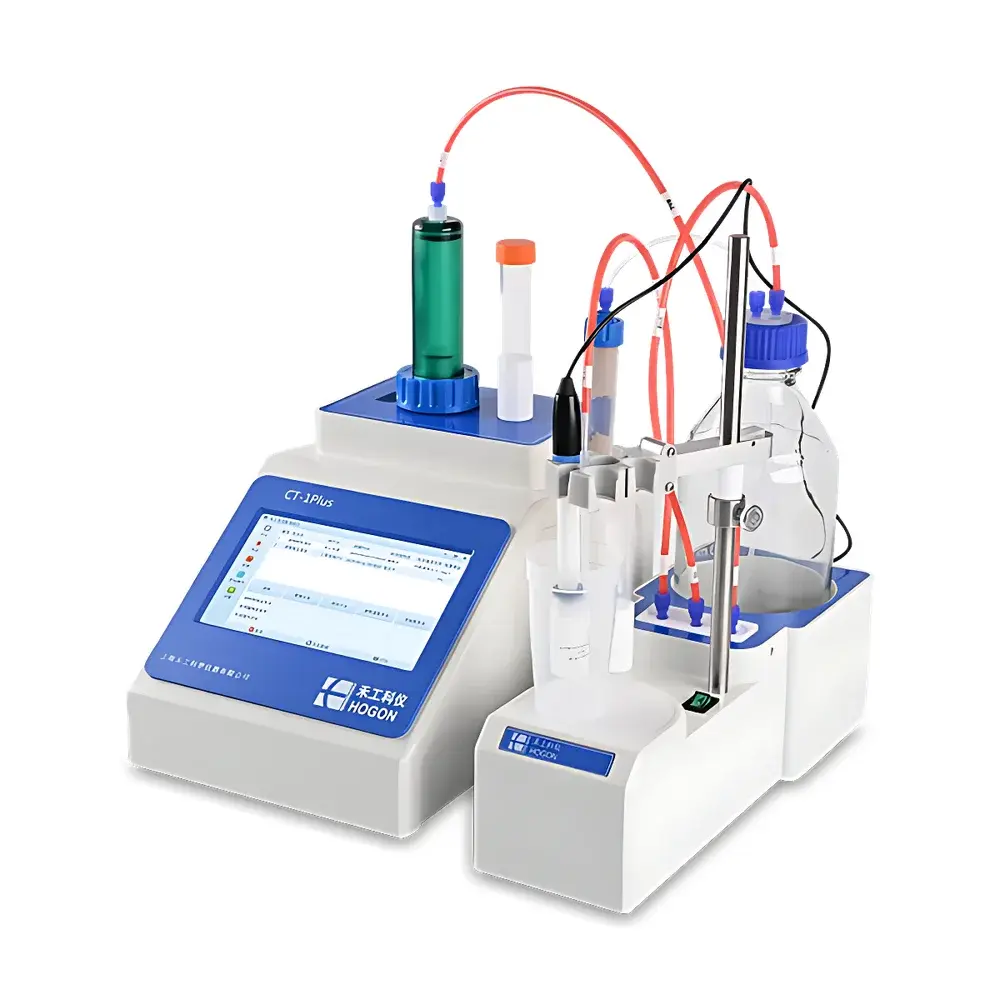
HOGON CT-1Plus Automatic Potentiometric Titrator for Polyethylene Glycol Acid Number Determination
| Brand | HOGON |
|---|---|
| Origin | Shanghai, China |
| Manufacturer Type | Direct Manufacturer |
| Regional Classification | Domestic (China) |
| Model | CT-1Plus for PEG Acid Number |
| Instrument Type | General-Purpose Potentiometric Titrator |
| Application Specificity | Dedicated Application |
| pH Range | 1–14 |
| mV Range | −2000 to +2000 mV |
| Meter Accuracy | ±0.03% of reading + 0.1 mV |
| Meter Resolution | 0.1 mV |
| Burette Precision (20 mL standard) | 0.001 mL |
| Burette Resolution | 1/20000 |
Overview
The HOGON CT-1Plus Automatic Potentiometric Titrator is engineered for precise, reproducible acid number determination in polyethylene glycol (PEG) and related hydrophilic polymers used extensively in pharmaceutical excipients, biodegradable medical devices, and controlled-release formulations. It operates on the fundamental principle of potentiometric titration: monitoring the potential difference between a reference electrode and an indicator electrode (typically a combination pH or non-aqueous acid-base electrode) as a standardized base titrant—commonly potassium hydroxide in isopropanol—is incrementally delivered into the sample solution. The inflection point of the resulting E–V (potential vs. volume) curve is identified as the stoichiometric endpoint, from which acid number (mg KOH/g sample) is calculated per ASTM D974, ISO 3682, and USP . Designed for routine QC laboratories in API manufacturing and polymer R&D, the CT-1Plus integrates metrological traceability, GLP-compliant operation, and application-specific method templates—ensuring regulatory alignment without requiring custom software development.
Key Features
- High-resolution potentiometric measurement system with 0.1 mV resolution and ±0.03% full-scale accuracy, compliant with IEC 61000-4-30 for electrical metrology stability.
- 20 mL precision glass burette with mechanical drive and optical encoder feedback, delivering volumetric precision of ±0.001 mL and resolution of 1 part in 20,000—validated per ISO 8655-3 for piston burettes.
- Micro-dosing capability down to 20 µL increments, enabling accurate titration of low-acid-content PEG samples (e.g., PEG 4000, PEG 6000) without dilution artifacts.
- Dual-mode endpoint detection: first-derivative (dE/dV) algorithm with user-adjustable threshold (e.g., ΔdE/dV ≥ 300 mV/mL) and fixed-pH stop criteria—minimizing false endpoints in viscous or low-conductivity media.
- Integrated magnetic stirrer with closed-loop speed control (100–1200 rpm), ensuring homogeneous mixing during titration while eliminating vortex-induced electrode drift.
- Onboard method storage (≥100 protocols), password-protected user levels (Operator, Supervisor, Administrator), and audit trail logging meeting FDA 21 CFR Part 11 requirements for electronic records.
Sample Compatibility & Compliance
The CT-1Plus accommodates standard 100 mL glass titration beakers and supports direct weighing of solid PEG samples (0.5–5 g) via integrated balance interface (optional RS-232/USB). It is validated for use with non-aqueous titrants (0.1 mol/L KOH in 2-propanol/toluene), ethanol-free solvents, and temperature-stabilized sample compartments (ambient ±2 °C). Method validation data confirm linearity (r² ≥ 0.9998), repeatability (RSD ≤ 0.8% for n = 6), and intermediate precision across operators and days—fully aligned with ICH Q2(R2) guidelines. Regulatory documentation includes factory calibration certificates traceable to NIM (National Institute of Metrology, China) and optional IQ/OQ/PQ protocol packages for GMP environments.
Software & Data Management
The instrument runs embedded firmware with real-time titration curve visualization, automatic baseline correction, and post-run report generation in PDF and CSV formats. All raw data—including timestamped electrode potential, burette position, stirrer speed, and environmental temperature—are stored with immutable metadata. Data export supports LIMS integration via HL7 or ASTM E1384-compliant XML. Audit trails record every parameter change, method execution, and user login/logout event with digital signature verification—enabling full compliance with GLP, ISO/IEC 17025, and pharmaceutical quality systems.
Applications
- Acid number quantification in PEG-based surfactants, hydrogels, and micelle-forming drug carriers per USP and Ph. Eur. 2.5.1.
- Quality control of polymeric excipients in sterile injectables and ophthalmic solutions.
- Stability-indicating assay for hydrolytic degradation monitoring of PEGylated proteins and peptides.
- Batch release testing of synthetic absorbable sutures (e.g., polyglycolic acid copolymers) per ISO 10993-12.
- Method transfer support for compendial assays including ASTM D664 (petroleum acids) and ISO 6618 (fatty acid methyl esters).
FAQ
Is the CT-1Plus compliant with 21 CFR Part 11 for electronic signatures and audit trails?
Yes—the system implements role-based access control, electronic signatures with time-stamped authentication, and tamper-evident audit logs with retention configurable up to 10 years.
Can it be used for acid number analysis of other polymers beyond PEG?
Absolutely—it supports method customization for polylactic acid (PLA), poly(lactic-co-glycolic acid) (PLGA), caprolactone-based polyesters, and fatty acid derivatives using pre-validated solvent/titrant combinations.
What electrode types are recommended for PEG acid number determination?
A non-aqueous combination pH electrode with LiCl in ethanol electrolyte (e.g., HOGON EP-102NA) is standard; optional redox or silver/silver chloride electrodes are supported for specialized applications.
Does the system require external PC software for routine operation?
No—all titration control, data acquisition, and reporting occur onboard; optional PC software (HOGON TitraLink™) is available for advanced statistical analysis and multi-instrument fleet management.
How is calibration verified and maintained?
Built-in calibration verification uses certified buffer standards (pH 4.01, 7.00, 10.01) and mV reference solutions; automated calibration checks can be scheduled daily or per batch, with results logged in the audit trail.





