
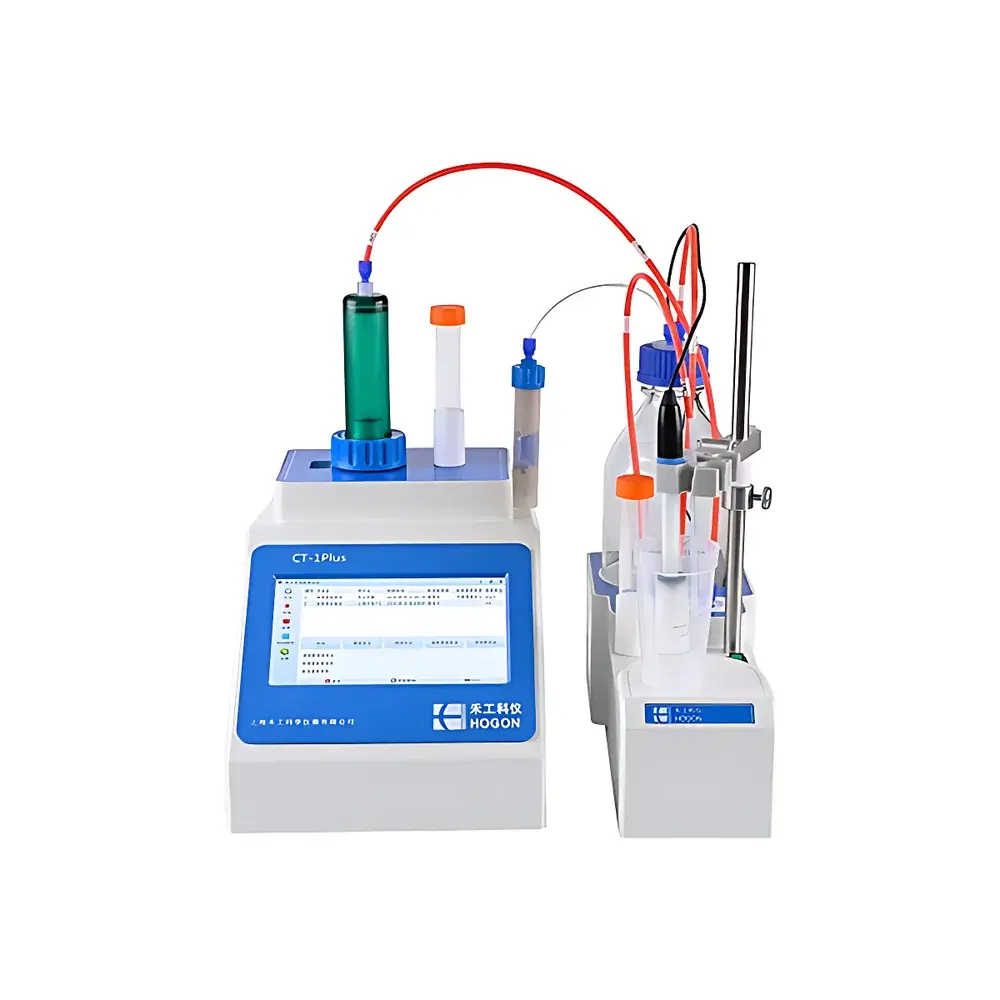
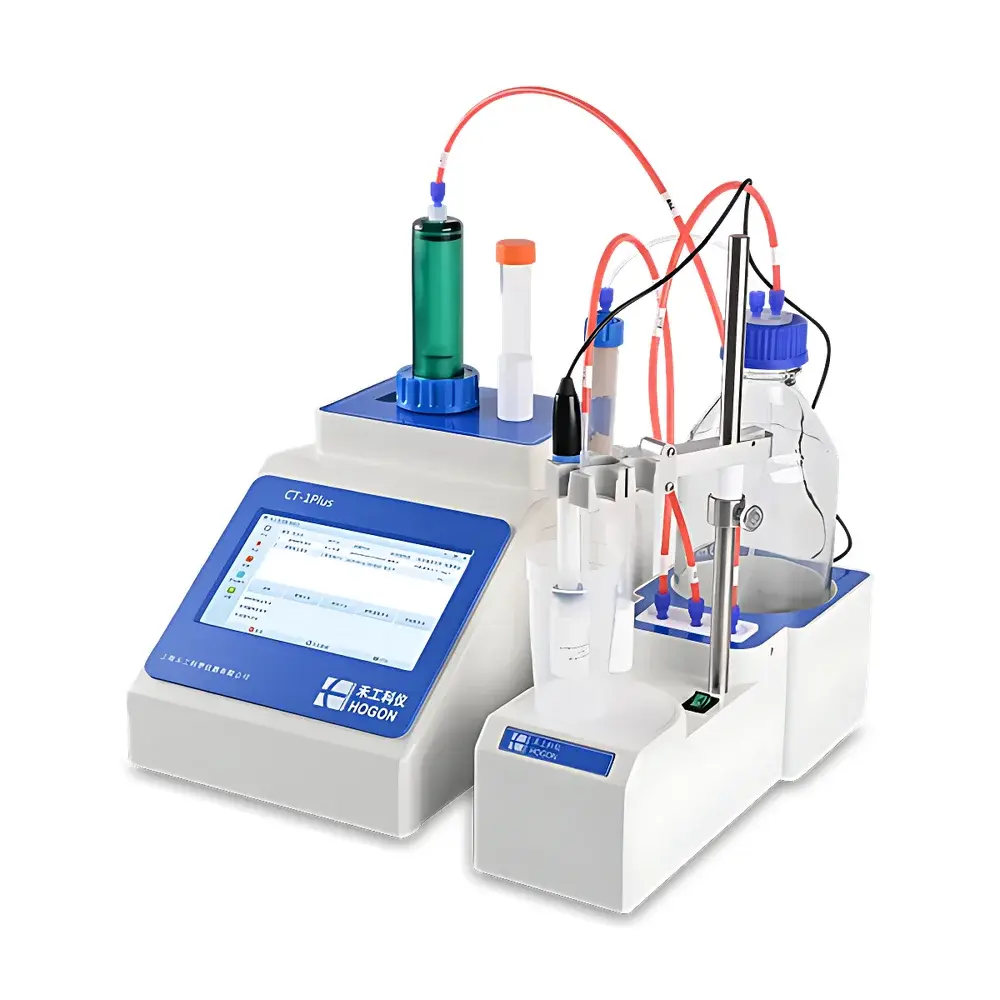
HOGON CT-1Plus Automatic Potentiometric Titrator for Vanadium Ion Quantification in Vanadium Redox Flow Battery Electrolytes
| Brand | HOGON |
|---|---|
| Origin | Shanghai, China |
| Manufacturer Type | Direct Manufacturer |
| Instrument Type | General-purpose Automatic Potentiometric Titrator |
| Application Scope | Universal (with validated method for V²⁺/V³⁺/V⁴⁺/V⁵⁺ speciation) |
| pH Range | 1–14 |
| Potential Resolution | 0.1 mV |
| Potential Measurement Range | ±2000 mV |
| Potential Accuracy | ±0.2 mV |
| Burette Precision (Standard 20 mL) | 0.001 mL |
| Burette Resolution (Optional 10 mL) | 0.0005 mL |
Overview
The HOGON CT-1Plus is an ISO/IEC 17025-aligned automatic potentiometric titrator engineered for high-reproducibility redox titrations in demanding electrochemical quality control and R&D environments. It operates on the principle of potentiometric endpoint detection—measuring the inflection point in solution potential (mV) during a controlled redox reaction between a standardized oxidizing agent and target vanadium species (V²⁺, V³⁺, V⁴⁺, V⁵⁺) in acidic electrolyte matrices. Unlike photometric or coulometric alternatives, this method delivers direct, stoichiometry-based quantification without reliance on calibration curves, making it intrinsically traceable to SI units when paired with certified reference materials (CRMs) and NIST-traceable KMnO₄ standards. The instrument integrates a precision stepper-motor-driven burette system, real-time differential (dE/dV) endpoint algorithm, and a rugged ORP-101C composite electrode optimized for rapid response and low drift in phosphoric acid media—conditions essential for accurate vanadium speciation in VRFB electrolytes per ASTM D8196-22 and IEC 62933-3-1:2021.
Key Features
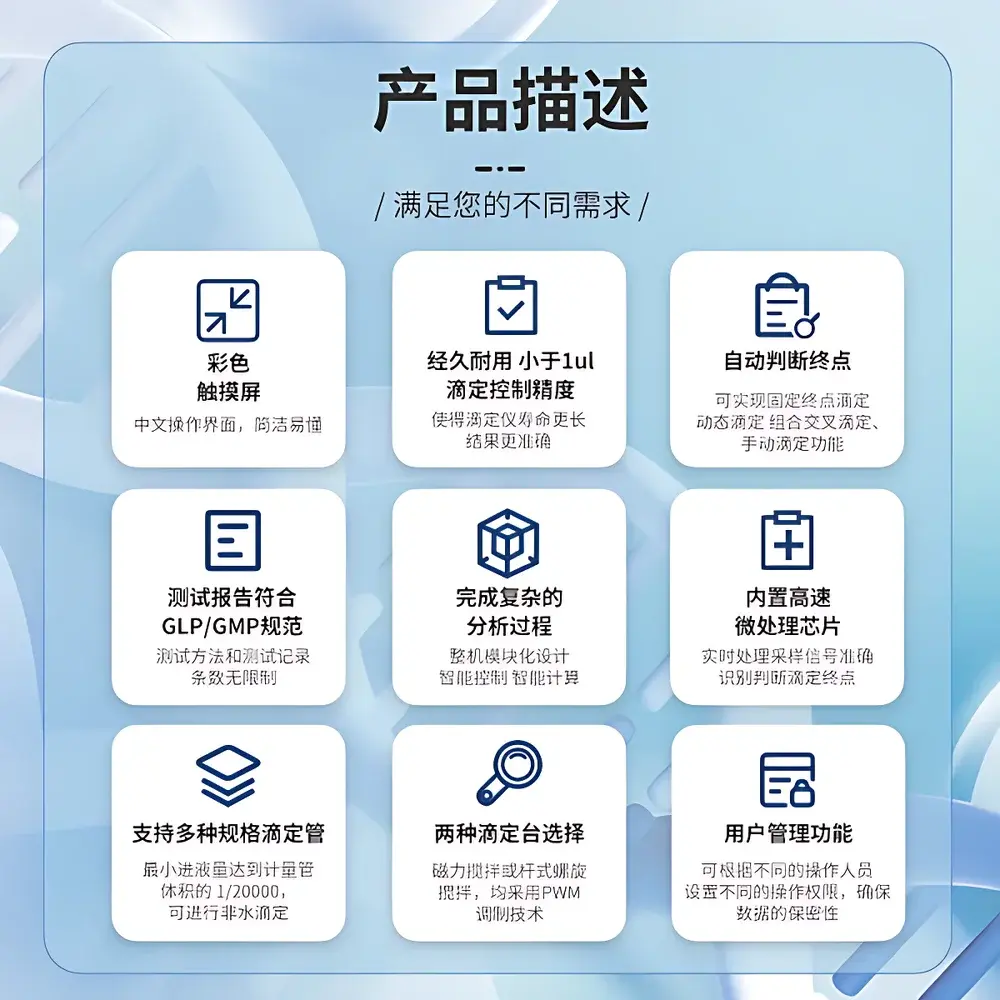
- High-stability potentiometric measurement circuitry with 0.1 mV resolution and ±0.2 mV absolute accuracy across ±2000 mV range, compliant with IEC 61000-4-30 for electromagnetic compatibility in industrial labs.
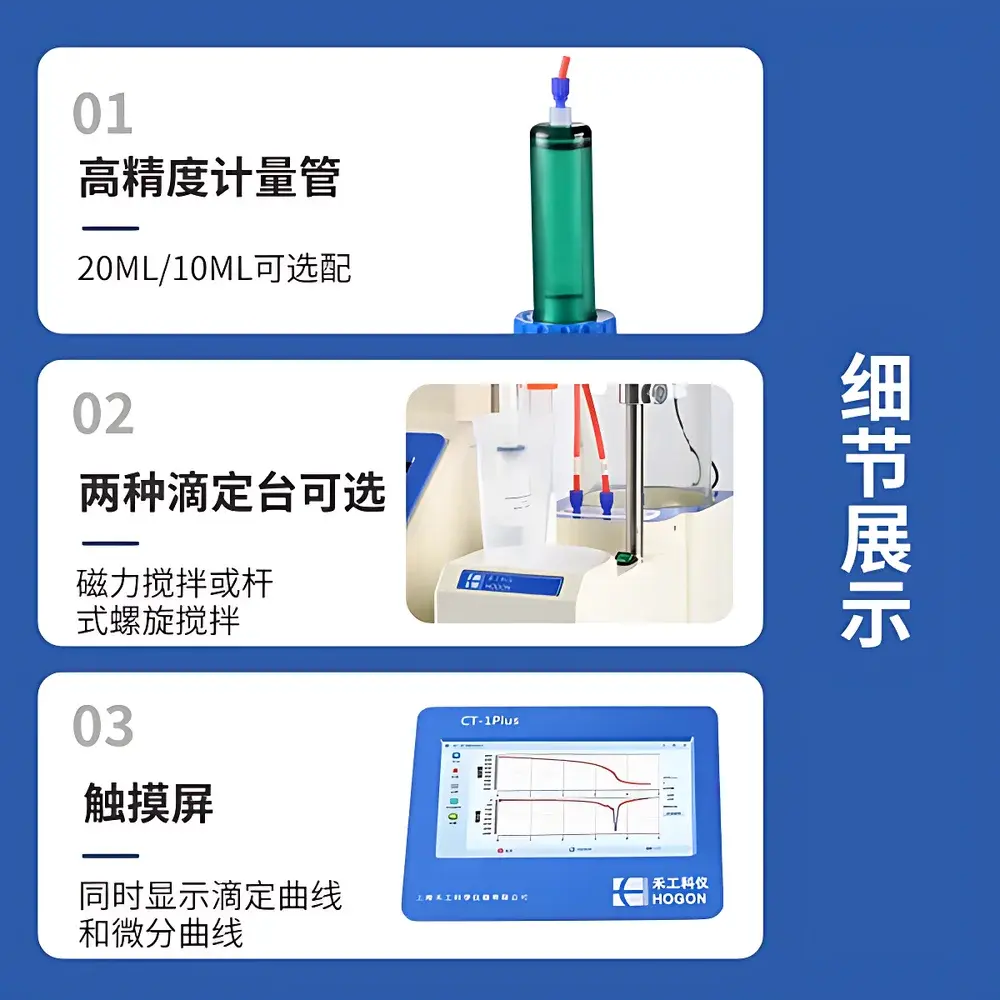
- Dual-burette configuration support: standard 20 mL glass burette (0.001 mL dispensing precision) and optional 10 mL micro-burette (0.0005 mL resolution) for sub-microliter step control in low-volume electrolyte samples.
- Programmable titration parameters—including minimum/maximum incremental volume (20–100 µL), stir speed (50–500 rpm), inter-step delay (1000–5000 ms), and derivative threshold (dE/dV ≥ 200 mV/mL)—enabling robust endpoint discrimination in complex multi-redox systems.
- Embedded method library with pre-validated VRFB electrolyte assay protocol (KMnO₄ titration in 1 M H₃PO₄ matrix), including auto-zero compensation, electrode hydration monitoring, and drift correction algorithms.
- GLP-compliant data handling: full audit trail (user ID, timestamp, parameter log, raw E vs. V curve), electronic signature support, and export-ready CSV/PDF reports meeting FDA 21 CFR Part 11 requirements for regulated battery QC labs.
Sample Compatibility & Compliance
The CT-1Plus is validated for aqueous vanadium electrolytes containing total vanadium concentrations from 0.5 to 2.5 mol/L, with individual oxidation state resolution (V²⁺/V³⁺/V⁴⁺/V⁵⁺) achievable via sequential titration under controlled acid concentration (≥0.8 M H₃PO₄). It accommodates sample volumes as low as 0.5 mL (diluted 1:20 in volumetric flasks), minimizing reagent consumption and waste generation. All hardware components—including PTFE-coated stir bars, borosilicate glass titration vessels, and chemically resistant fluid paths—meet USP material safety standards. Method performance adheres to ISO 8466-1:2022 (calibration linearity), ISO 5725-2:2019 (repeatability ≤ 0.8% RSD), and ASTM D8196-22 (vanadium redox flow battery electrolyte analysis), supporting GMP-compliant release testing in battery manufacturing facilities.
Software & Data Management
The embedded TitraSoft™ v3.2 firmware provides intuitive touchscreen navigation with multilingual UI (English, German, Japanese, Chinese), method cloning, and real-time overlay of dE/dV curves. Raw potential-time-volume datasets are stored in vendor-neutral HDF5 format with embedded metadata (sample ID, operator, ambient temperature, electrode serial number). Integrated USB and Ethernet interfaces enable secure transfer to LIMS or ELN platforms via SFTP or OPC UA protocols. Software validation documentation (IQ/OQ/PQ protocols) and 21 CFR Part 11 configuration files are supplied as part of the factory acceptance test package, enabling immediate deployment in audited environments without additional qualification effort.
Applications
- Quantitative determination of total vanadium and individual oxidation states (V²⁺, V³⁺, V⁴⁺, V⁵⁺) in spent and regenerated VRFB electrolytes for capacity fade analysis.
- In-process verification of electrolyte mixing ratios during batch preparation—critical for maintaining charge/discharge voltage window stability.
- Stability assessment of vanadium speciation under thermal stress (e.g., 40–60°C soak tests) per IEC 62933-3-2:2023 accelerated aging protocols.
- Supporting DOE-funded R&D on mixed-acid electrolytes (H₂SO₄/H₃PO₄ blends) where phosphate buffering enhances endpoint sharpness versus sulfate-only systems.
- Reference method for cross-validation against ICP-OES and UV-Vis spectrophotometry in metrology laboratories accredited to ISO/IEC 17025.
FAQ
What electrode is recommended for vanadium titrations, and how often does it require recalibration?
The ORP-101C composite electrode is factory-optimized for phosphoric acid media. Calibration against two-point Zn²⁺/Zn and Ag⁺/Ag redox buffers is required before each analytical session; slope stability >95% over 8-hour operation is verified per ASTM D1129.
Can the CT-1Plus distinguish between V⁴⁺ and V⁵⁺ in a single titration?
Yes—via controlled-potential stepwise titration using dual-indicator endpoints in buffered H₃PO₄, enabling discrete quantification of V⁴⁺ (first inflection) and residual V⁵⁺ (second inflection) as described in J. Electrochem. Soc. 168 (2021) 070532.
Is method transfer possible to other potentiometric platforms?
The validated VRFB assay protocol includes full parameter sets (burette geometry, stirring dynamics, derivative thresholds) compatible with Metrohm 905/916 and Hanna HI902C platforms, subject to electrode matching and CRM traceability alignment.
How is compliance with battery industry QA documentation requirements ensured?
Each report includes digital signatures, immutable timestamps, raw curve exports, and configurable header fields (batch ID, QC lot#, analyst ID), satisfying clause 8.2.4 of ISO 9001:2015 and clause 5.3 of IATF 16949:2016 for automotive-grade energy storage systems.





