
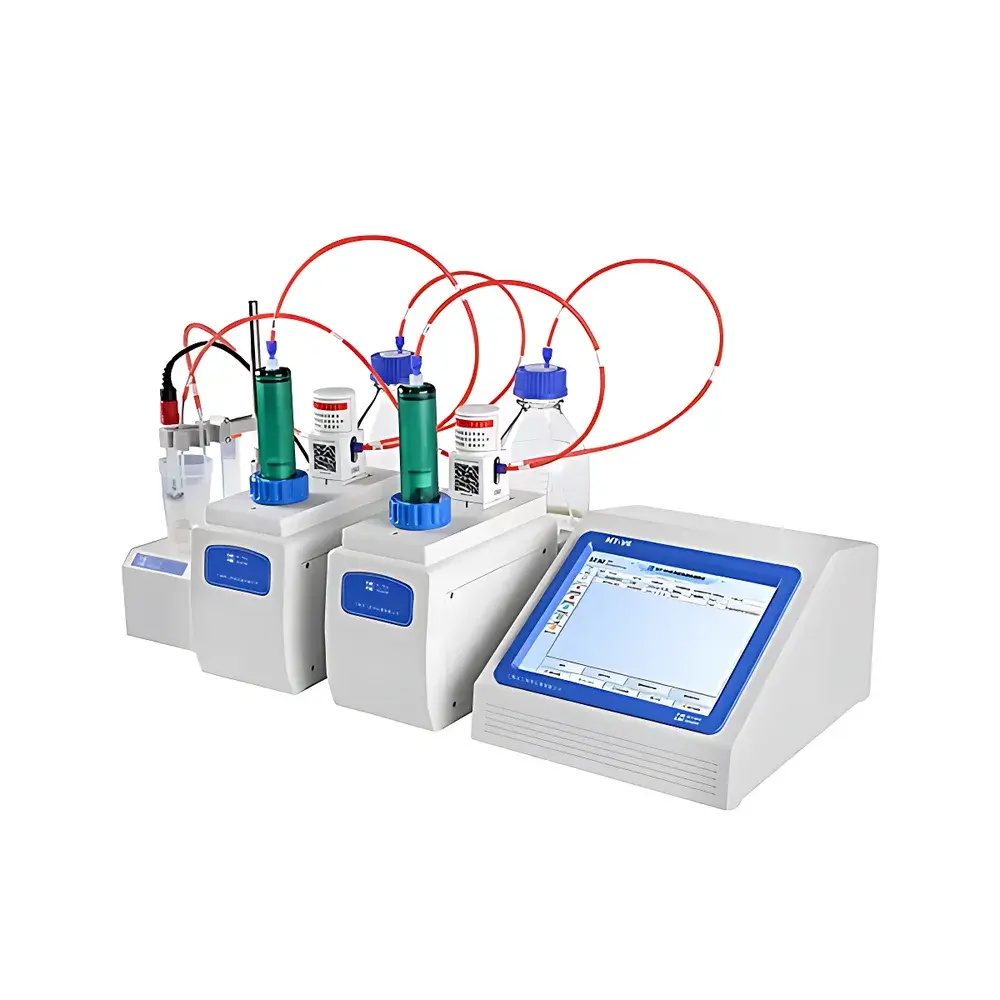
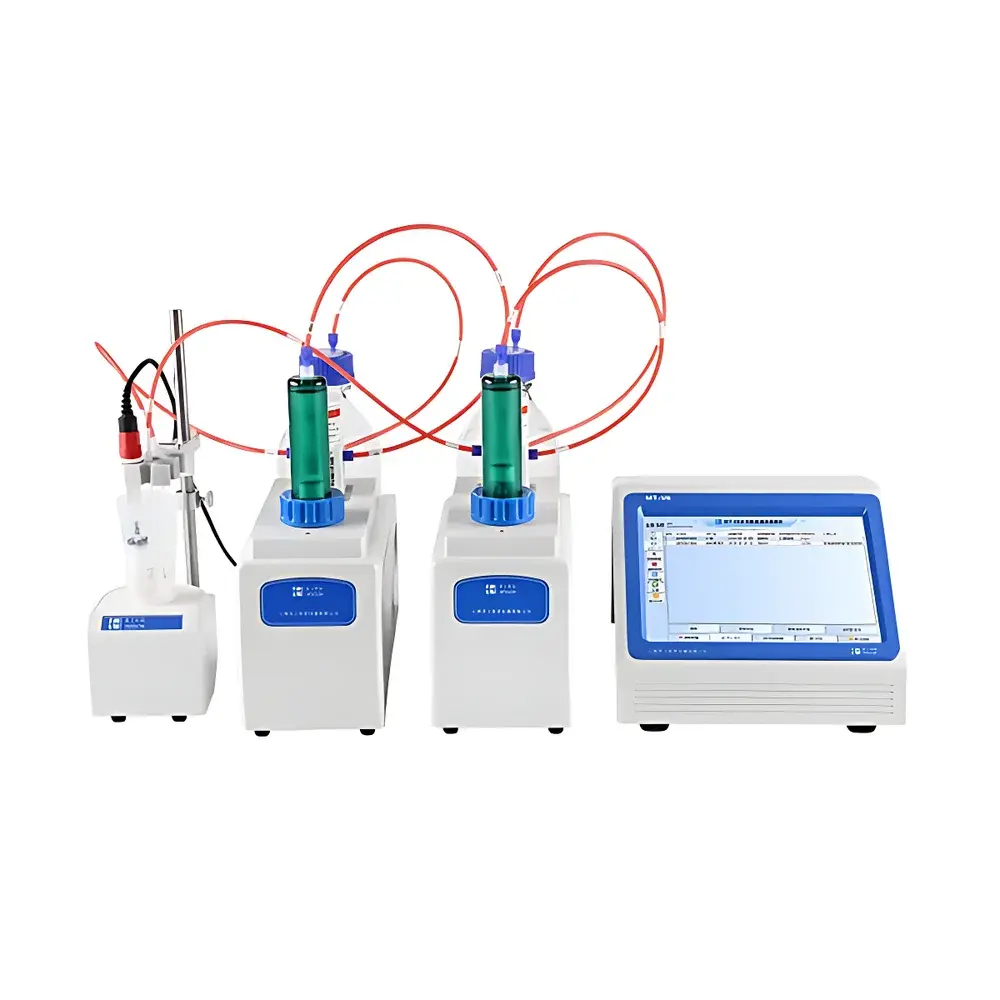
HOGON MT-V6 Automatic Potentiometric Titrator for Tetramethylammonium Hydroxide (TMAH) in Photoresist Developer Solutions
| Brand | HOGON |
|---|---|
| Origin | Shanghai, China |
| Manufacturer Type | Direct Manufacturer |
| Instrument Type | Universal Automatic Potentiometric Titrator |
| Application Scope | General-purpose & Semiconductor Process Control |
| pH Measurement Range | 0.000–14.000, Resolution: 0.001 pH |
| mV Accuracy | ±0.1 mV |
| mV Resolution | 0.1 mV |
| Burette Precision | 20 mL standard burette (1 µL increment), 10 mL optional burette (0.5 µL increment) |
| mV Input Range | ±2000 mV, Resolution: 0.1 mV |
Overview
The HOGON MT-V6 Automatic Potentiometric Titrator is an ISO/IEC 17025-aligned analytical instrument engineered for high-reproducibility potentiometric endpoint detection in regulated industrial and R&D laboratories. It operates on the fundamental principle of potentiometric titration—measuring the potential difference between a reference electrode and an indicator electrode (e.g., pH-102 glass electrode) as a function of titrant addition. In semiconductor photolithography process control, the MT-V6 is specifically configured to quantify tetramethylammonium hydroxide (TMAH) concentration in aqueous photoresist developer solutions via acid–base titration with standardized hydrochloric acid. The instrument detects the inflection point in the E–V curve (electrode potential vs. titrant volume) using first-derivative (dE/dV) or fixed-threshold algorithms, delivering traceable, GLP-compliant results without manual intervention.
Key Features
- High-precision dual-burette architecture: Standard 20 mL glass burette with 1 µL dispensing resolution; optional 10 mL burette (0.5 µL resolution) for low-volume, high-sensitivity applications.
- Dual-range mV/pH measurement circuitry: ±2000 mV input range with 0.1 mV resolution and ±0.1 mV absolute accuracy at 25 °C, traceable to NIST-certified reference standards.
- Automated endpoint recognition: Configurable derivative-based, fixed-pH, or Gran plot algorithms—each validated per ASTM E2087–22 for titration method verification.
- Integrated magnetic stirring with programmable speed (0–1200 rpm) and pause-on-addition logic to ensure homogeneous mixing during micro-dosing.
- Embedded real-time data acquisition: Records raw mV, pH, volume, time, temperature (via optional Pt100 probe), and calculated concentration—all timestamped and stored with user-defined metadata.
- Rugged industrial-grade housing: IP54-rated enclosure, corrosion-resistant fluid path components (PTFE, borosilicate glass, PEEK), and ESD-protected electronics for cleanroom-adjacent deployment.
Sample Compatibility & Compliance
The MT-V6 supports aqueous and low-viscosity organic-aqueous developer matrices typical of semiconductor TMAH-based formulations (e.g., 2.38 wt% and 0.26 wt% TMAH solutions). It complies with key regulatory frameworks governing analytical instrumentation in controlled environments: FDA 21 CFR Part 11 (audit trail, electronic signature, and data integrity modules enabled), ISO/IEC 17025:2017 (method validation support), and ICH Q2(R2) guidelines for analytical procedure verification. All titration methods—including the preloaded TMAH assay protocol—include built-in system suitability checks (e.g., electrode response time < 30 s, slope ≥ 55 mV/pH, asymmetry ≤ ±15 mV) prior to sample analysis. Calibration verification is performed using certified buffer standards (NIST SRM 186, pH 4.01/7.00/10.01) and redox standards (Ag/AgCl, quinhydrone).
Software & Data Management
The instrument runs HOGON TitraSoft™ v3.2 firmware—a Windows-compatible, GMP-ready software platform supporting full ALCOA+ data governance principles. It provides role-based user access control (administrator, analyst, reviewer), automated audit trails (with immutable timestamps and operator ID), and encrypted local database storage (SQLite3 with AES-256). Raw data files (.tdf) are structured XML-compliant and exportable to CSV, PDF, or LIMS-compatible formats (ASTM E1384, HL7). Batch reports include method parameters, calibration history, raw curves, derivative plots, uncertainty estimation (k=2, per GUM), and pass/fail status against predefined acceptance criteria. Software validation documentation (IQ/OQ/PQ protocols) and 21 CFR Part 11 compliance packages are supplied with each unit.
Applications
Beyond TMAH quantification in photoresist developers, the MT-V6 is validated for multiple electrochemical titration modes: acid–base (e.g., total alkalinity in etchants), redox (e.g., Fe²⁺/Ce⁴⁺ in plating baths), precipitation (e.g., Cl⁻ in rinse water via AgNO₃), and complexometric (e.g., Ni²⁺/EDTA in CMP slurries). Its modular design accommodates custom electrodes (ion-selective, redox, non-aqueous), multi-step titration sequences (e.g., back-titration of excess reagent), and integration with autosamplers (optional HOGON AS-12). In QC labs serving semiconductor foundries, it meets JEDEC JESD22-A108F requirements for solution stability monitoring and supports SPC charting (X̄–R, Cpk) directly from exported datasets.
FAQ
What electrode is recommended for TMAH titration in developer solutions?
The pH-102 combination glass electrode (with double-junction Ag/AgCl reference) is factory-validated for this application; its low-resistance liquid junction minimizes clogging in silicate-rich developer matrices.
Does the MT-V6 support USP or Ph. Eur. 2.2.20 compliance for titrimetric assays?
Yes—the instrument’s endpoint detection algorithms, volumetric precision, and data handling meet the system suitability and reporting requirements specified in both monographs when operated with calibrated burettes and certified reagents.
Can the MT-V6 be integrated into a central LIMS environment?
Yes—via OPC UA or RESTful API interfaces; raw data and summary reports can be pushed automatically to LIMS platforms supporting ASTM E1384 or HL7 ADT messaging.
Is temperature compensation mandatory for TMAH analysis?
While not required for endpoint detection in strong-base/strong-acid systems, temperature logging (via optional Pt100 probe) is recommended for full uncertainty budgeting per ISO/IEC 17025 Clause 7.6.3.
How frequently must the burette be recalibrated?
Per ISO 8655-2, volumetric verification is recommended before each analytical batch using gravimetric water delivery (±0.05% tolerance); full calibration is required after maintenance or every 6 months, whichever occurs first.
Related Products





