
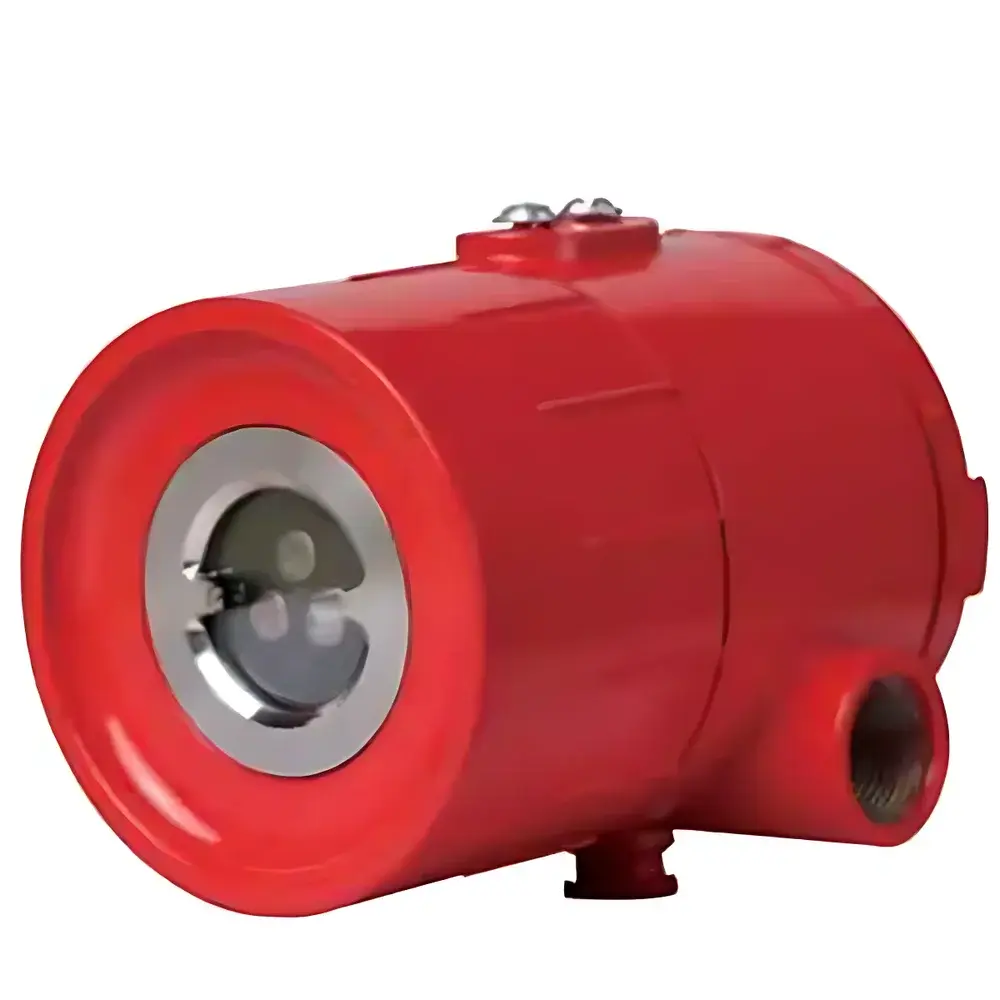
Honeywell HMS-FD-3IR Fixed Infrared Flame Detector
| Brand | Honeywell |
|---|---|
| Origin | USA |
| Model | HMS-FD-3IR |
| Explosion Protection Rating | Ex d IIC T6 Gb / Ex tD A21 IP66 T80°C |
| Optical Spectral Range | 3.8–5.0 µm |
| Field of View | 90° conical (±45° from optical axis) |
| Sensitivity Levels | 4 adjustable (Level I–IV, default Level II) |
| Response Time | 3–5 s to 0.1 m² n-heptane flame at 60 m |
| Operating Voltage | DC 18–30 V (nominal 24 V DC) |
| Current Consumption | <35 mA @ 24 V DC |
| Output Options | Relay (dry contact), 0–20 mA analog, HART®, MODBUS RTU, fire alarm system bus interface |
| Enclosure Material | Aluminum alloy (copper-free, epoxy-painted) or optional 316 stainless steel |
| Weight | 2.0 ± 0.2 kg (aluminum), 5.0 ± 0.2 kg (stainless steel) |
| IP Rating | IP66 |
| Operating Temperature | −40 °C to +70 °C |
| Relative Humidity | ≤95% RH (non-condensing) |
| Certifications | CCCF, ATEX, IECEx, UL/cUL Listed for Class I, Div 1, Groups B, C, D |
Overview
The Honeywell HMS-FD-3IR is a fixed-point, multi-spectral infrared (MIR) flame detector engineered for high-reliability, false-alarm-resistant fire detection in hazardous and demanding industrial environments. Unlike single-band IR detectors, the HMS-FD-3IR employs three narrowband infrared sensors operating within precisely defined spectral windows—centered at 4.3 µm (flame CO2 emission band), and two reference bands outside the primary combustion signature (e.g., 3.8 µm and 5.0 µm). This tri-wavelength architecture enables real-time differential analysis of radiant energy, decoupling true hydrocarbon flame signatures from background thermal noise, solar loading, or transient radiation sources. Coupled with proprietary flicker-frequency analysis (1–20 Hz modulation characteristic of turbulent flames) and adaptive digital signal processing via an embedded high-performance microcontroller, the detector achieves deterministic flame classification—rejecting non-flame IR sources including welding arcs, lightning, incandescent lighting, hot surfaces (>500 °C), and electromagnetic interference. Its non-contact, line-of-sight detection principle ensures rapid response without physical exposure to combustion byproducts or thermal degradation.
Key Features
- Triple-wavelength IR sensing (3.8–5.0 µm) with dynamic spectral ratio analysis for robust flame discrimination
- Four-step field-adjustable sensitivity (Levels I–IV) to optimize detection range versus false-alarm immunity per site-specific risk profile
- Intrinsically secure explosion-proof enclosure rated Ex d IIC T6 Gb and Ex tD A21 IP66 T80°C—certified for Zone 1/21 gas and dust environments
- True 90° conical field of view (FOV) with uniform 100% coverage across ±45° from optical axis—no blind zones or dead angles
- Dual NPT 3/4″ cable entries with IP66-rated conduit sealing capability for redundant wiring paths or dual-loop integration
- Multi-protocol digital communication: native support for HART® 7, MODBUS RTU (RS-485), and industry-standard fire alarm system bus interfaces (e.g., ONYX, Notifier, Siemens Desigo)
- Configurable 0–20 mA analog output with fault diagnostics: 0 mA = power loss/open circuit; 4 mA = normal standby; 20 mA = alarm state
- Integrated green (power) and dual-color red/yellow LED status indicators for local operational verification and alarm staging
Sample Compatibility & Compliance
The HMS-FD-3IR is validated for detection of hydrocarbon-based flame sources across diverse fuel types—including gasoline, diesel, kerosene, methanol, ethanol, isopropanol, LPG, propane, methane, and polypropylene—as specified in manufacturer test reports compliant with EN 54-10:2017 and UL 268A Annex E. Detection distances (up to 60 m for n-heptane) are determined under standardized test conditions per ISO 7240-10 and NFPA 72 Chapter 17. The device meets stringent regulatory requirements for safety-critical fire detection systems: CCCF certification for China market deployment; ATEX Directive 2014/34/EU and IECEx Scheme compliance for global hazardous area use; UL/cUL Listing for Class I, Division 1, Groups B, C, D; and FM Approval for Class I, Division 1, Groups B, C, D. All firmware and configuration parameters adhere to IEC 61508 SIL 2 functional safety requirements for fire and gas (F&G) systems in process industries.
Software & Data Management
Configuration and diagnostics are performed via Honeywell’s proprietary FDT/DTM-based engineering toolset compatible with Field Device Tool (FDT) Framework 2.0 and EDDL-compliant host systems. The detector supports full bidirectional communication—including parameter read/write, event logging (alarm history, fault timestamps, sensitivity changes), and real-time health monitoring (sensor drift compensation, ambient IR baseline tracking). Audit trails comply with FDA 21 CFR Part 11 requirements when integrated into validated control systems. Firmware updates are delivered via secure signed binary packages with cryptographic verification. All configuration data is retained during power cycling, and factory defaults can be restored via hardware reset sequence.
Applications
The HMS-FD-3IR is deployed in mission-critical infrastructure where fast, reliable flame detection is essential and false alarms are operationally unacceptable. Typical installations include aircraft hangars and maintenance facilities (per FAA AC 150/5210-22B); petrochemical and refinery flare stacks and pump stations; underground road and rail tunnels (EN 13849-1 PL e validation); ammunition and explosives storage magazines (DoD MIL-STD-1472G); pharmaceutical cleanroom utility corridors; power generation turbine halls and hydrogen handling areas; printing press solvent zones; and combustible dust processing lines (NFPA 652-compliant). Its wide temperature tolerance (−40 °C to +70 °C) and IP66 ingress protection enable unshielded outdoor mounting on gantries, pipe racks, and structural steel—eliminating need for enclosures or climate-controlled housings.
FAQ
What flame types does the HMS-FD-3IR detect?
It detects hydrocarbon-fueled flames emitting characteristic CO2 radiation in the 4.3 µm band—including liquid fuels (gasoline, diesel, solvents), gaseous fuels (methane, propane, LPG), and solid combustibles (paper, plastics) when producing sufficient radiant intensity.
Can it operate reliably under direct sunlight?
Yes. Its triple-band MIR architecture and flicker analysis inherently reject steady-state solar IR load; performance is validated under simulated full-spectrum daylight up to 120 klux per EN 54-10 Annex F.
Is field calibration required after installation?
No. The detector performs automatic baseline adaptation during initial power-up and continuously tracks ambient IR drift during operation—zero manual calibration needed throughout service life.
How is explosion protection achieved?
The aluminum or stainless-steel housing forms a flameproof (Ex d) enclosure per IEC 60079-1, containing any internal ignition and preventing propagation to the surrounding atmosphere; the Ex tD rating confirms suitability for combustible dust environments per IEC 60079-31.
What diagnostic capabilities does it provide?
Real-time sensor health monitoring, open/short-circuit detection on all outputs, supply voltage supervision, internal temperature logging, and configurable alarm/event history with UTC timestamps accessible via digital interface.







