
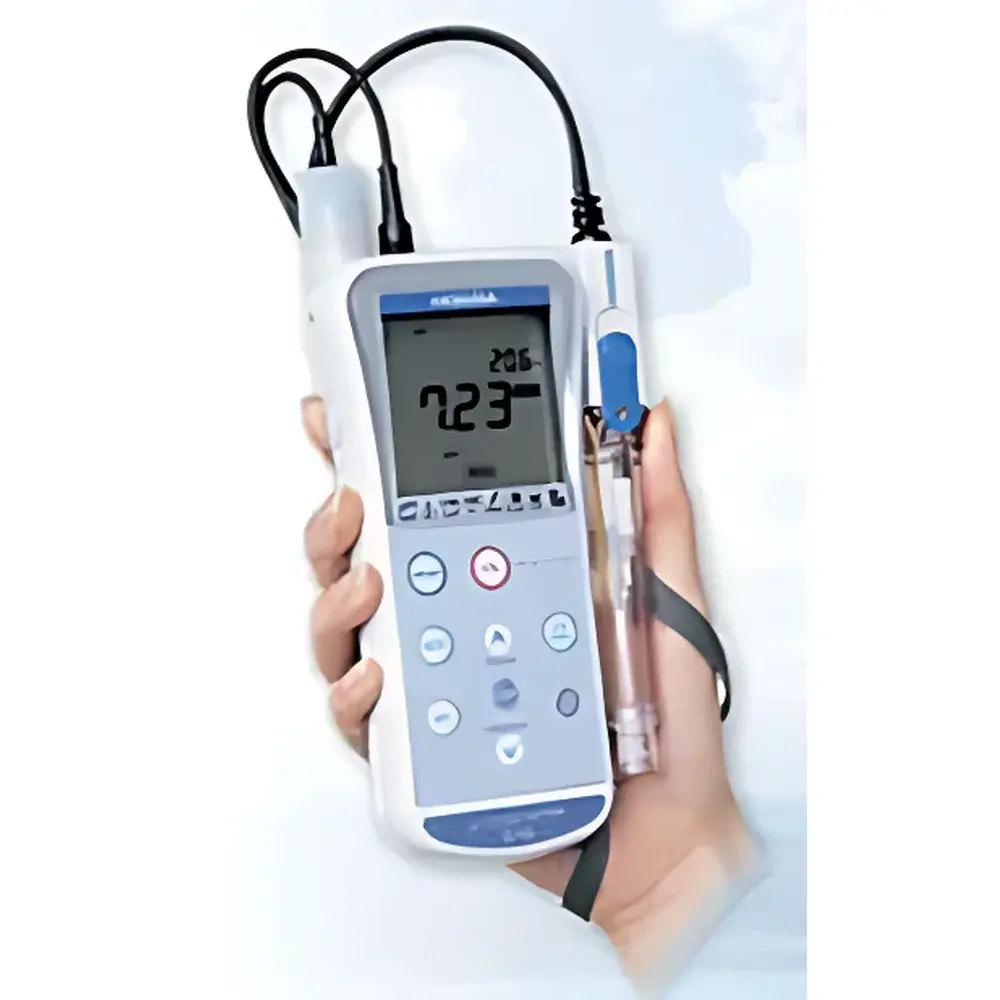
HORIBA D-50 Series Portable Multi-Parameter Water Quality Analyzer
| Brand | HORIBA |
|---|---|
| Origin | USA |
| Model | D-50 |
| Measurement Parameters | pH, Temperature, ORP, Conductivity (D-54), Dissolved Oxygen (D-55), Ion Selective Electrode (ISE) capability (D-53) |
| Enclosure Rating | IP67 |
| Power Supply | DC 3 V (LR6 batteries) |
| Weight | 300–330 g |
| Interface | RS-232C for PC/printer connectivity |
| Display | Backlit LCD with dual-channel readout |
| Data Logging | Automatic storage with timestamp |
| Self-Diagnostic Function | Yes |
| Electrode Compatibility | Ruggedized waterproof pH/ORP probes, interchangeable sensor modules |
Overview
The HORIBA D-50 Series Portable Multi-Parameter Water Quality Analyzer is an engineered field-deployable instrument designed for rapid, reliable in-situ assessment of critical water quality parameters. Built upon electrochemical sensing principles—including potentiometric measurement (pH, ORP, ISE), conductimetric detection (conductivity/resistivity), and amperometric or optical sensing (dissolved oxygen)—the D-50 platform delivers laboratory-grade accuracy in a ruggedized handheld form factor. Its modular architecture supports five distinct configurations (D-51 to D-55), enabling users to select the optimal sensor suite for site-specific monitoring requirements—from basic pH/temperature verification in wastewater influent streams to comprehensive multi-parameter profiling in drinking water distribution networks or surface water compliance sampling. The device complies with foundational measurement standards including ASTM D1293 (pH of water), ASTM D3223 (dissolved oxygen by membrane electrode), ASTM D5391 (conductivity of pure water), and ISO 7888 (electrical conductivity), ensuring data integrity across regulatory reporting contexts.
Key Features
- Rugged IP67-rated housing with shock-absorbing casing and sealed connector interfaces—certified for operation in rain, dust, and high-humidity environments.
- Interchangeable, field-replaceable sensor modules: factory-calibrated pH/ORP electrodes with reinforced glass bodies; temperature-compensated conductivity cells (K = 0.1, 1.0, 10.0 cm⁻¹); polarographic or optical DO probes; and ISE cartridges for nitrate, fluoride, ammonium, or other target ions.
- Dual-channel real-time display showing primary and secondary parameters simultaneously (e.g., pH + temperature; ORP + DO), with automatic temperature compensation applied per parameter.
- Integrated data logging with non-volatile memory supporting up to 1,000 timestamped records—retaining measurement values, date/time stamps, calibration history, and electrode status flags.
- Onboard self-diagnostic system continuously monitors electrode impedance, reference junction stability, and signal noise floor—flagging potential drift or contamination before measurement error exceeds ±0.01 pH or ±1 mV thresholds.
- RS-232C serial interface compliant with EIA/TIA-232-F specifications—enabling direct connection to Windows-based PCs running HORIBA’s optional AquaLink™ Data Manager software or standard terminal emulators for raw ASCII export.
Sample Compatibility & Compliance
The D-50 Series accommodates aqueous samples across diverse matrices: freshwater (rivers, lakes, reservoirs), wastewater (primary effluent, activated sludge), potable water (distribution points, storage tanks), and industrial process streams (cooling towers, boiler feedwater). All sensors are compatible with turbid, low-conductivity (50 mS/cm) samples when matched to appropriate cell constants or probe types. The analyzer meets essential environmental monitoring regulatory frameworks, including EPA Method 150.1 (conductivity), EPA Method 365.1 (phosphate via ISE), and USP (water conductivity for pharmaceutical use). Its design supports GLP-compliant workflows through audit-trail-capable calibration logs and user-accessible firmware revision tracking.
Software & Data Management
Data acquisition and post-processing are facilitated via HORIBA’s AquaLink™ Data Manager (v3.2+), a Windows desktop application supporting automated download, CSV/Excel export, trend visualization, and customizable report generation (PDF/HTML). The software enforces FDA 21 CFR Part 11 compliance through electronic signature capture, role-based access control, and immutable audit trails for all calibration, measurement, and configuration events. Raw RS-232 output follows NMEA 0183-inspired ASCII framing (e.g., “$HORIBA,pH=7.24,T=22.3,ORP=+128,mV*XX”), enabling integration into SCADA systems or custom Python/LabVIEW DAQ environments without proprietary drivers.
Applications
- Regulatory field monitoring under Clean Water Act (CWA) Section 402 NPDES permit conditions.
- Drinking water utility compliance testing at entry points, storage reservoirs, and tap locations per WHO Guidelines and national standards (e.g., China GB 5749-2022, EU Directive 98/83/EC).
- Wastewater treatment plant process control—nitrification/denitrification optimization via simultaneous NH₄⁺-ISE and DO monitoring.
- Environmental impact assessments (EIA) requiring spatially distributed, time-synchronized parameter sets across river transects or groundwater wells.
- Educational field labs and undergraduate environmental science curricula emphasizing method validation and uncertainty propagation in electrochemical measurements.
FAQ
What calibration protocols does the D-50 support?
The D-50 implements 1–3 point pH calibration using NIST-traceable buffer solutions (4.01, 7.00, 10.01), single-point ORP verification with Zobell’s solution (225 mV @ 25°C), and 1–2 point conductivity calibration with KCl standards (84 µS/cm, 1413 µS/cm, 12.88 mS/cm).
Can the D-50 operate submerged?
No—the IP67 rating certifies protection against temporary immersion (1 m depth for 30 min), but continuous submersion or underwater deployment is not supported; probe tips may be immersed, but the main unit must remain above water level.
Is firmware upgrade available?
Yes—field-upgradable firmware is distributed via HORIBA’s secure customer portal and installed via RS-232 connection; version history and release notes are published with each update.
Does the D-50 meet ISO/IEC 17025 requirements for accredited laboratories?
While the D-50 itself is not ISO/IEC 17025-accredited, its documented measurement uncertainty, traceable calibration procedures, and full audit trail functionality enable accredited labs to validate its use within their scope of accreditation when operated per SOPs aligned with ISO/IEC 17025 Clause 6.4 and 6.5.
What is the typical battery life under continuous use?
With alkaline LR6 batteries, average operational life is 200 hours for D-51/D-52 models and 150 hours for D-53–D-55 configurations due to increased sensor excitation power demands.
Related Products







