
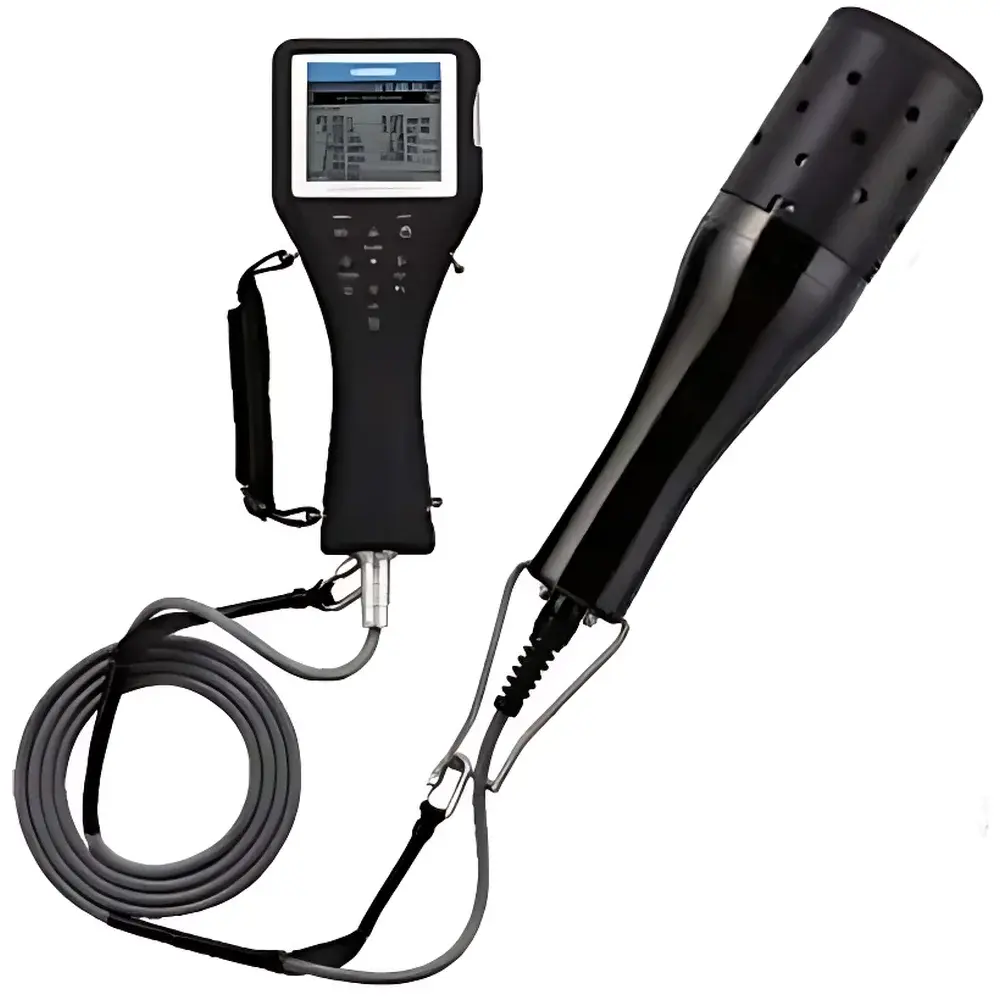
HORIBA U-50 Series Portable Multiparameter Water Quality Analyzer
| Brand | HORIBA |
|---|---|
| Origin | Japan |
| Model | U-50 Series |
| Instrument Type | Portable / Handheld Water Quality Analyzer |
| Measured Parameters | pH, ORP, Dissolved Oxygen (DO), Conductivity, Salinity, TDS, Specific Gravity (Seawater), Temperature, Turbidity (NTU), Water Depth (m), GPS Positioning |
| Turbidity Standards | U-53 — US EPA Method |
| Turbidity Resolution | 0.01 NTU |
| Operating Temperature Range | −10 to 55 °C |
| Waterproof Rating | IP68 (JIS Protection Class 8 for probe |
| Battery Life | Up to 70 hours (alkaline AA × 4, backlight off) |
| Data Storage | 10,000 measurement sets |
| Communication | USB |
| Display | 320 × 240 monochrome LCD with backlight |
| Probe Dimensions | Ø96 mm × 340 mm |
| Cable Length | Standard 2 m (optional 10 m or 30 m) |
| Probe Materials | PPS, glass, SUS316L, SUS304, FKM, PEEK, titanium, FEP membrane, POM |
Overview
The HORIBA U-50 Series is a rugged, field-deployable multiparameter water quality analyzer engineered for high-reliability environmental monitoring in diverse aquatic systems—including rivers, groundwater, wastewater effluents, estuaries, and coastal zones. Designed and manufactured in Japan, the U-50 platform integrates electrochemical, optical, and pressure-based sensing technologies into a single handheld instrument capable of simultaneous real-time measurement of up to 11 critical water quality parameters. Its operational architecture follows standardized physical measurement principles: pH and ORP are determined via glass and platinum electrode potentiometry per ISO 7888 and ASTM D1293; dissolved oxygen employs Clark-type polarographic detection with automatic salinity compensation and temperature correction per ISO 5814; conductivity utilizes four-electrode AC measurement for enhanced accuracy across high-ionic-strength matrices; turbidity adheres to either US EPA Method 180.1 (U-53 models) or EN ISO 7027 (U-54 models), ensuring regulatory traceability in compliance-driven reporting environments; and depth sensing relies on calibrated piezoresistive pressure transduction per IEC 61000-4-30. The inclusion of integrated GPS (12-channel, available on G-series variants) enables georeferenced data logging essential for spatially explicit watershed assessments and regulatory submissions.
Key Features
- Ruggedized IP68-rated probe housing (JIS Class 8) constructed from chemically inert, corrosion-resistant materials including titanium, SUS316L stainless steel, PEEK, FEP membrane, and PPS—validated for long-term immersion in aggressive freshwater, brackish, and seawater matrices.
- Simultaneous acquisition of 11 parameters: pH, pH(mV), ORP, dissolved oxygen (mg/L and % saturation), conductivity (S/m or mS/cm), salinity (ppt), TDS (g/L), seawater specific gravity (δt), temperature (°C), turbidity (NTU), and water depth (m); GPS position stamping available on U-52G, U-53G, and U-54G models.
- Dual turbidity sensor options: U-53 probes implement LED-based forward-scatter (30°) optics compliant with US EPA Method 180.1; U-54 probes utilize tungsten-lamp 90° nephelometry aligned with EN ISO 7027—both offering 0.01 NTU resolution and self-cleaning brush mechanisms to mitigate biofouling in prolonged deployments.
- Optimized polarographic DO sensor with accelerated response time (<60 s T90) and simplified membrane/electrolyte maintenance protocol—reducing field recalibration frequency and operator dependency.
- Auto-ranging conductivity module with automatic temperature compensation to 25 °C and configurable cell constant; supports linear and non-linear TDS conversion factors per user-defined solute composition.
- Intuitive multilingual interface supporting English, Japanese, Russian, Spanish, and Portuguese—designed for international field teams and cross-border environmental programs.
Sample Compatibility & Compliance
The U-50 Series is validated for use across natural and anthropogenic water matrices meeting ISO 5667-3 requirements for sampling equipment. Probe geometry and material selection ensure compatibility with suspended solids concentrations up to 800 NTU (U-53) or 1000 NTU (U-54), turbid industrial discharges, high-conductivity brines (up to 10 S/m), and low-oxygen hypolimnetic zones. All electrical safety and electromagnetic compatibility testing conforms to IEC 61326-1 (industrial environment) and IEC 61000-6-2/6-3. Measurement traceability aligns with national and international regulatory frameworks: pH and conductivity calibrations reference NIST-traceable standard solutions (e.g., NIST SRM 1699, 1711); turbidity verification uses AMCO-AEPA primary standards; and GPS positioning meets ICAO Annex 10 specifications for horizontal accuracy ≤3 m CEP (95%). The system supports audit-ready data integrity under GLP and ISO/IEC 17025 laboratory quality management systems.
Software & Data Management
Data acquisition, configuration, and post-processing are managed via HORIBA’s proprietary U-50 PC Utility software (Windows-compatible), which enables firmware updates, sensor calibration certificate import, and batch export to CSV or Excel formats with embedded metadata (date/time, GPS coordinates, operator ID, calibration history). Each stored record includes full parameter arrays plus diagnostic flags (e.g., sensor saturation, low battery, probe contact error). The instrument logs 10,000 measurement sets with timestamp, location, and environmental context—sufficient for multi-week unattended campaigns. USB communication supports direct transfer without proprietary drivers. While the U-50 does not implement FDA 21 CFR Part 11 electronic signature functionality, its immutable timestamped log structure, checksum-verified storage, and calibration event tracking satisfy core ALCOA+ (Attributable, Legible, Contemporaneous, Original, Accurate) data governance expectations for environmental QA/QC workflows.
Applications
- Regulatory compliance monitoring under Clean Water Act Section 304/308, EU Water Framework Directive (WFD) physicochemical surveys, and ISO 5667-22 field assessment protocols.
- Wastewater treatment plant influent/effluent characterization, including DO profiling across aeration basins and redox potential mapping in denitrification zones.
- Groundwater quality assessment during site remediation—tracking plume migration via conductivity–chloride correlation and ORP–redox couple interpretation.
- Marine and estuarine research requiring salinity-compensated DO, specific gravity (δt), and turbidity intercalibration for sediment transport modeling.
- Educational field hydrology labs where robustness, multilingual UI, and intuitive calibration reduce training overhead and increase student engagement with core water chemistry concepts.
FAQ
What turbidity standards does the U-50 comply with?
U-53 models conform to US EPA Method 180.1 (LED forward-scatter); U-54 models meet EN ISO 7027 (tungsten lamp 90° nephelometry). Both provide 0.01 NTU resolution and include motorized cleaning brushes.
Is the U-50 suitable for seawater measurements?
Yes—the probe materials (titanium, SUS316L, FEP) resist chloride-induced corrosion; salinity range extends to 70 ppt with automatic DO compensation; and specific gravity (δt) calculation follows UNESCO 1983 algorithms.
How many calibration points are required for accurate pH and conductivity readings?
pH requires two-point calibration (e.g., pH 4.01 and 7.00 buffers); conductivity requires four-point calibration across the measurement range for ±1% FS accuracy per IEC 62255-2.
Can depth measurements be performed beyond 30 meters?
No—the maximum rated depth is 30 m, limited by the pressure transducer’s mechanical design and JIS Class 8 sealing integrity; overpressure may compromise sensor longevity and accuracy.
Does the instrument support external power or only AA batteries?
It operates exclusively on four alkaline AA batteries; no external DC input or rechargeable battery option is provided—optimized for rapid field deployment and logistical simplicity in remote locations.







