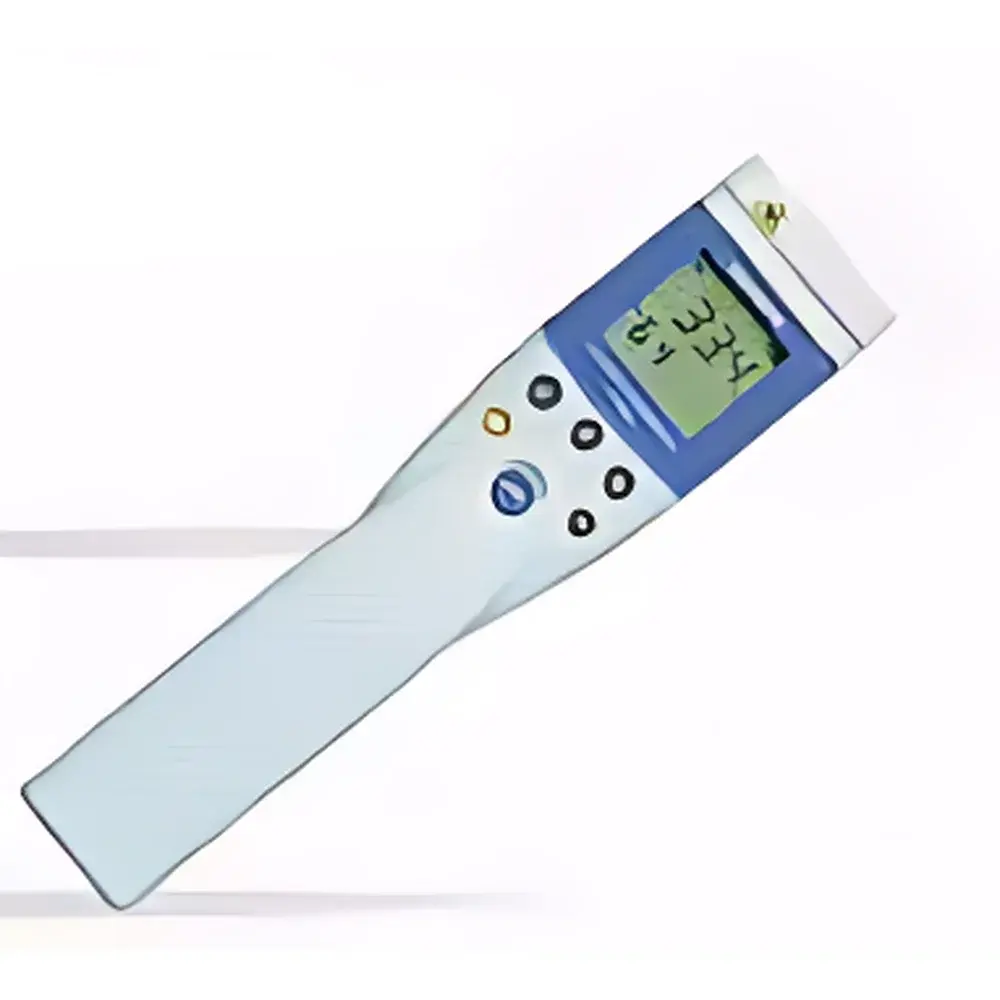
HORIBA IT-550 Non-Contact Infrared Radiometric Thermometer
| Brand | HORIBA |
|---|---|
| Origin | Japan |
| Model | IT-550 |
| Measurement Range | −50 to 500 °C |
| Spectral Response | 8–16 µm |
| Distance-to-Spot Ratio | 15:1 (1 m → Ø24 mm) |
| Emissivity Adjustment Range | 0.10–1.00 (0.01 step) |
| Accuracy | ±1.5 °C or ±1.5 % of reading (whichever is greater, at 23 ±5 °C ambient) |
| Repeatability | ±0.5 °C |
| Response Time (t₉₀) | ≤250 ms |
| Operating Ambient Temperature | 0 to 50 °C |
| IP Rating | IP54 (optional drip-proof configuration available) |
| Output Interface | Analog 4–20 mA / 0–5 V DC (configurable), RS-485 Modbus RTU |
Overview
The HORIBA IT-550 is a high-precision, fixed-mount non-contact infrared radiometric thermometer engineered for reliable surface temperature measurement in industrial process monitoring, food safety validation, and quality control environments. Based on Planck’s law of blackbody radiation, the IT-550 detects thermal energy emitted in the mid-wave infrared spectrum (8–16 µm), enabling accurate temperature assessment without physical contact—critical where contamination, motion, high voltage, or extreme thermal gradients preclude conventional probe-based methods. Its calibrated spectral response minimizes errors from atmospheric absorption and emissivity variability, while the integrated dual-beam laser sighting system provides precise spatial targeting: two coaxial visible lasers converge at the center of the measurement spot, confirming field-of-view alignment prior to acquisition. Designed for integration into continuous production lines or HACCP-compliant food processing facilities, the IT-550 operates with a fast t₉₀ response time of ≤250 ms and supports stable measurements across an extended range of −50 to 500 °C.
Key Features
- Optimized 8–16 µm spectral band for broad material compatibility—including plastics, painted metals, organic surfaces, and moist foodstuffs—while mitigating interference from water vapor and CO₂ in ambient air.
- Dual-laser aiming system with dynamic convergence point visualization ensures accurate targeting of small features (e.g., Ø24 mm at 1 m distance), corresponding to a 15:1 optical distance-to-spot ratio.
- Adjustable emissivity (0.10–1.00 in 0.01 increments) with real-time correction algorithms to accommodate varying surface characteristics—from polished aluminum (ε ≈ 0.05) to oxidized steel (ε ≈ 0.85) or baked goods (ε ≈ 0.93).
- Rugged aluminum housing rated IP54 (dust-protected and splash-resistant); optional drip-proof enclosure variants meet hygiene requirements for wet-process food manufacturing zones.
- Configurable analog output (4–20 mA or 0–5 V DC) and digital RS-485 interface with Modbus RTU protocol enable seamless integration with PLCs, SCADA systems, and centralized data loggers.
- No warm-up time required; stable operation within 1 second of power-on, supporting rapid line changeovers and intermittent monitoring tasks.
Sample Compatibility & Compliance
The IT-550 is validated for non-destructive surface temperature assessment of static or moving targets—including conveyor-belt products, sealed packaging, sterilized equipment surfaces, and oven-baked items—without altering thermal equilibrium. It complies with HACCP Principle 4 (Critical Limit Monitoring) for thermal process validation in food production, and its traceable calibration aligns with ISO/IEC 17025 requirements when performed by accredited laboratories. While not intrinsically safe, its low-power design (<1.5 W) and absence of spark-prone components permit use in non-hazardous Zone 2 environments per IEC 60079-0. The device supports GLP/GMP-aligned documentation through external data logging; though it does not natively implement FDA 21 CFR Part 11 electronic signature controls, audit-trail-capable SCADA platforms may capture timestamped readings with user authentication.
Software & Data Management
The IT-550 operates as a standalone sensor node and does not include embedded firmware-based configuration software. Setup and parameter adjustment are performed via front-panel push-button interface or externally via Modbus RTU commands using industry-standard communication tools (e.g., ModScan, QModMaster). Analog outputs feed directly into analog input modules of programmable logic controllers (PLCs), while RS-485 enables multi-drop network deployment (up to 32 units per bus). Raw temperature values, emissivity settings, and status flags (e.g., signal saturation, ambient error) are accessible via register mapping. For long-term trending, users integrate the IT-550 into existing MES or LIMS platforms using OPC UA or MQTT bridges—no proprietary drivers or cloud dependencies required.
Applications
- Continuous monitoring of baking oven belt temperatures and product surface profiles in snack food and bakery lines.
- Verification of pasteurization and sterilization cycle endpoints on metal cans, glass jars, and flexible pouches.
- Thermal validation of clean-in-place (CIP) rinse stages and steam sanitation cycles in dairy and beverage plants.
- Non-invasive temperature screening of electrical enclosures, motor windings, and bearing housings during predictive maintenance routines.
- Quality assurance of polymer extrusion die lips, injection mold cavities, and adhesive curing zones in packaging machinery.
FAQ
What is the minimum measurable spot size at 1 meter distance?
At 1 m, the IT-550 measures a circular spot of Ø24 mm (based on 15:1 D:S ratio), with full energy collection within the 90% intensity contour.
Can the IT-550 measure through transparent barriers such as glass or plastic film?
No—it cannot reliably measure through standard silicate glass (which absorbs >95% of 8–16 µm IR) or most polymeric films; direct line-of-sight to the target surface is required.
Is NIST-traceable calibration provided with the instrument?
HORIBA supplies factory calibration certificates; NIST-traceable recalibration services are available through authorized service centers upon request.
Does the device support automatic emissivity compensation using reflected temperature input?
No—the IT-550 requires manual emissivity setting; it does not incorporate auxiliary ambient temperature sensing for dynamic ε correction.
What ambient conditions limit operational reliability?
Operation is specified for 0–50 °C ambient temperature and ≤85% RH non-condensing; prolonged exposure above 50 °C may affect long-term drift performance.