
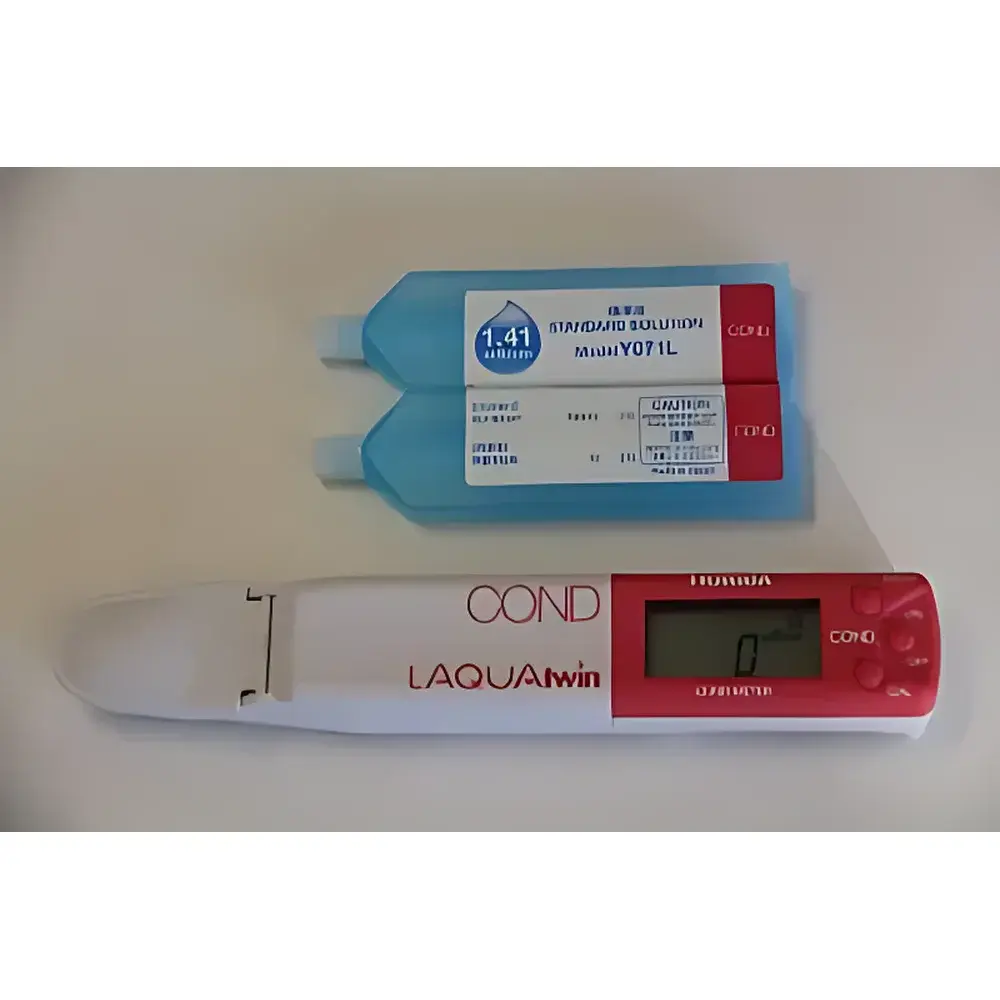
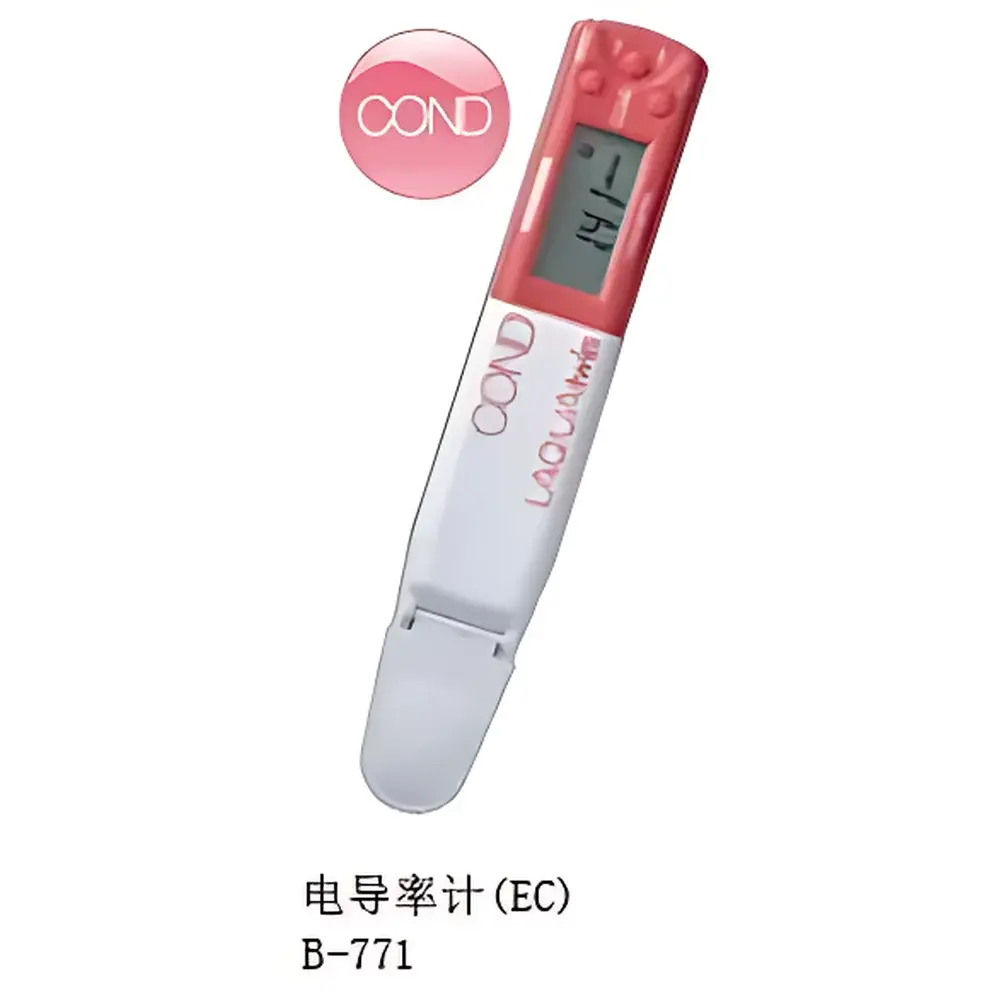
HORIBA B-771 Portable Pen-Type Conductivity Meter
| Brand | HORIBA |
|---|---|
| Origin | Japan |
| Model | B-771 |
| Portability | Pen-type |
| Conductivity Range | 0–19.9 mS/cm |
| TDS Range | 0–9900 ppm |
| Salinity Range | 0–1.1% |
| Temperature Range | 5–40 °C |
| Accuracy | ±2% F.S. ±1 digit |
| Resolution | 0.1 |
| Calibration | Two-point |
| IP Rating | IP67 |
| Power | Two CR2032 batteries |
| Dimensions | 164 × 29 × 20 mm (excl. protrusions) |
| Weight | ~45 g (instrument only) |
Overview
The HORIBA B-771 is a compact, field-deployable pen-type conductivity meter engineered for rapid, reliable measurement of electrical conductivity (EC), total dissolved solids (TDS), and salinity in aqueous samples. It employs a robust two-electrode AC excitation method—designed to minimize polarization effects and electrode fouling—ensuring stable readings across a wide range of sample conductivities (0–19.9 mS/cm). The instrument integrates automatic temperature compensation (ATC) with a fixed 2%/°C coefficient, referenced to 25 °C, enabling consistent data interpretation under variable ambient conditions. Its minimal sample requirement of just 0.12 mL supports testing in constrained environments—including environmental field surveys, aquaculture monitoring, hydroponic nutrient management, and basic laboratory QC checks—without compromising measurement integrity. Built to meet the operational demands of mobile analytical workflows, the B-771 delivers traceable, repeatable results without external power or complex setup.
Key Features
- Pen-form factor with ergonomic, one-handed operation and intuitive button interface
- IP67-rated enclosure ensures full protection against dust ingress and immersion in water up to 1 m for 30 minutes
- Two-point calibration capability using standard KCl solutions (e.g., 1413 µS/cm and 12.88 mS/cm) for optimal linearity across the measurement range
- Auto-hold function freezes the stabilized reading on-screen, facilitating documentation in non-lab settings
- Integrated temperature sensor (5–40 °C operating range) with simultaneous display of conductivity, TDS, salinity, and temperature values
- Low-power design powered by two replaceable CR2032 coin-cell batteries (typical battery life >1000 measurements)
- Compact dimensions (164 × 29 × 20 mm) and lightweight construction (~45 g without batteries) for seamless portability in backpacks, glove compartments, or field kits
Sample Compatibility & Compliance
The B-771 is optimized for use with low-to-moderately conductive aqueous solutions, including freshwater, brackish water, nutrient solutions, cooling tower water, and process rinse water. It is not intended for high-ionic-strength samples (>20 mS/cm), organic solvents, or viscous media. While not certified for regulated GMP/GLP environments, its two-point calibration traceability, documented accuracy (±2% F.S. ±1 digit), and stable electrode architecture support adherence to routine quality control protocols aligned with ASTM D1125 (Standard Test Methods for Electrical Conductivity and Resistivity of Water) and ISO 7888 (Water quality — Determination of electrical conductivity). The device complies with IEC 60529 for IP67 ingress protection and meets RoHS Directive 2011/65/EU requirements for hazardous substance restriction.
Software & Data Management
The B-771 operates as a standalone, firmware-driven instrument with no onboard data logging or PC connectivity. All measurements are displayed in real time on a high-contrast LCD screen with dual-parameter readout (e.g., conductivity + temperature). Users manually record results in field notebooks or digital logs. Though it lacks USB/Bluetooth interfaces or cloud synchronization, its simplicity ensures compliance with environments where electronic data capture is restricted or unnecessary—such as educational labs, municipal inspection rounds, or preliminary site assessments where immediate qualitative assessment takes priority over audit-trail generation. For laboratories requiring 21 CFR Part 11-compliant electronic records, the B-771 serves as a pre-screening tool; final quantification should be performed using validated benchtop systems with full audit-trail functionality.
Applications
- Environmental monitoring: Rapid EC screening of surface water, groundwater, and effluent streams per EPA Method 120.1
- Aquaculture and hydroponics: Daily verification of nutrient solution strength and osmotic balance
- Food & beverage: Spot-checking rinse water conductivity in sanitation validation (SSOPs)
- Education: Undergraduate electrochemistry labs demonstrating solution conductivity principles and temperature dependence
- Facilities management: Monitoring boiler feedwater purity and cooling system corrosion potential
- Field-based QA/QC: Supporting ISO/IEC 17025-accredited labs during sample triage prior to formal analysis
FAQ
What is the minimum sample volume required for a valid measurement?
A minimum of 0.12 mL is required to fully immerse the integrated dual-electrode sensor tip. Smaller volumes may yield unstable or non-reproducible readings.
Does the B-771 support linear or non-linear temperature compensation?
It applies a fixed 2%/°C linear temperature coefficient relative to 25 °C, conforming to standard NaCl-based compensation curves used in general-purpose conductivity applications.
Can the B-771 measure resistivity?
No—the instrument does not compute or display resistivity (Ω·cm); it reports conductivity (mS/cm) and derived TDS/salinity values only.
Is electrode cleaning required between measurements?
Yes. Rinse the sensor tip thoroughly with deionized water after each use, especially when transitioning between high- and low-conductivity samples, to prevent cross-contamination and drift.
How often should calibration be performed?
Calibrate before each measurement session or whenever ambient temperature shifts by >5 °C; additionally, recalibrate if readings deviate from known standards by more than ±5% of full scale.
Related Products





