
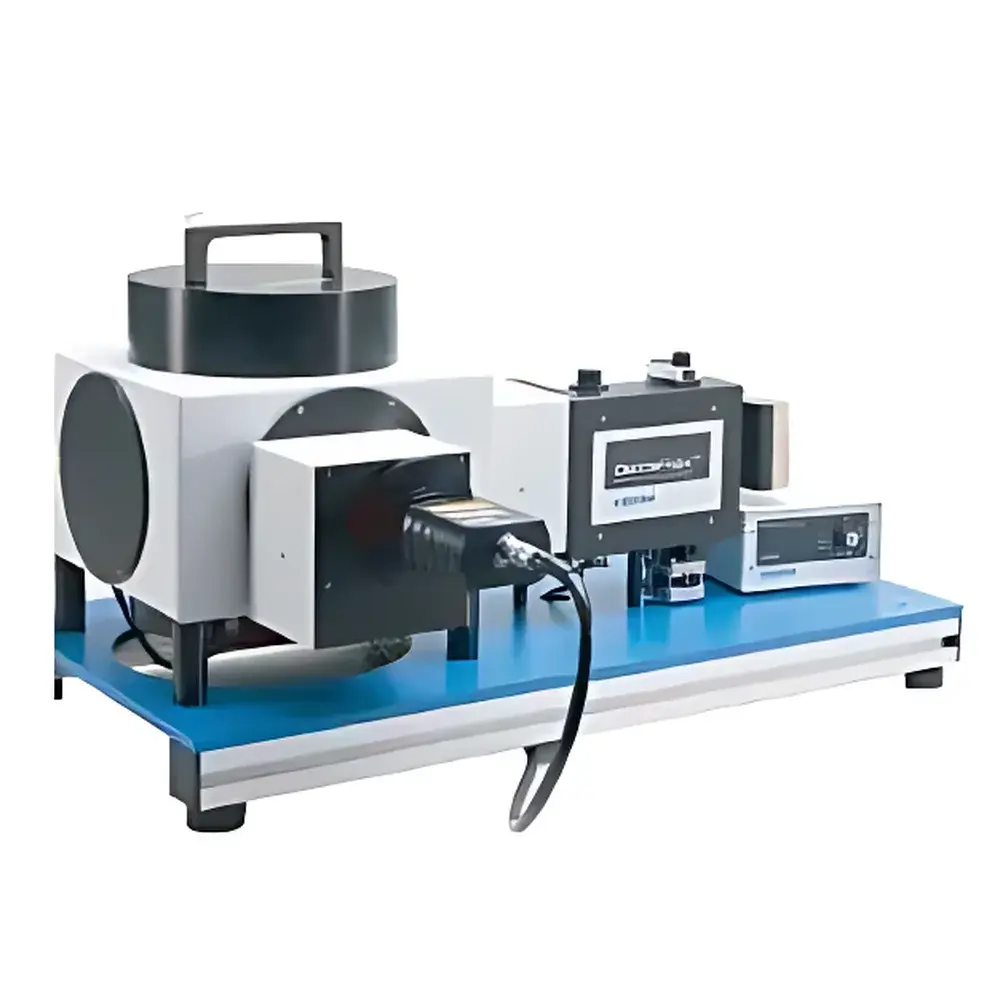
HORIBA DeltaFlex Ultrafast Time-Resolved Fluorescence Spectrometer
| Brand | HORIBA |
|---|---|
| Origin | United Kingdom |
| Manufacturer Type | Authorized Distributor |
| Product Origin | Imported |
| Model | DeltaFlex |
| Dispersion Element | Grating |
| Slit Width (Spectral Bandpass) | 1–64 nm Adjustable |
| Spectral Resolution | 1 nm |
| Sensitivity | Single-Photon Counting |
| Wavelength Accuracy | ±1 nm |
Overview
The HORIBA DeltaFlex Ultrafast Time-Resolved Fluorescence Spectrometer is a modular, TCSPC (Time-Correlated Single Photon Counting)-based platform engineered for high-precision fluorescence and phosphorescence lifetime measurements across an exceptional dynamic range—from sub-25 ps to 1 second. Leveraging HORIBA Scientific’s four-decade heritage in lifetime instrumentation—originating from the foundational Jobin Yvon spectroscopy expertise—the DeltaFlex implements a robust, research-grade architecture optimized for both fundamental photophysics and applied life science investigations. Its core measurement principle relies on pulsed excitation (via integrated semiconductor lasers or LEDs) combined with time-stamping of individual photons at the detector output, enabling direct reconstruction of decay kinetics without analog averaging artifacts. The system operates under strict timing fidelity: its DeltaHub timing electronics feature a 10 ns dead time, supporting high-repetition-rate excitation sources (up to 100 MHz) while preserving photon-counting integrity and statistical accuracy. This architecture ensures quantitative, reproducible lifetime data essential for kinetic modeling, molecular interaction studies, and microenvironmental sensing.
Key Features
- Ultra-broad lifetime coverage: 25 ps – 1 s, achieved without hardware reconfiguration—enabled by modular detector and excitation options
- DeltaHub timing module with 10 ns dead time and <10 ps timing resolution, ensuring minimal count loss at high repetition rates
- Integrated pulsed excitation sources: DeltaDiode (250–780 nm, up to 100 MHz) and SpectraLED (265–1275 nm), offering plug-and-play operation, zero alignment, and no routine calibration
- F-Link intelligent interface: automatic recognition of detectors, monochromators, and accessories; seamless software integration and firmware synchronization
- Standard picosecond PPD (Photomultiplier-based Photon Detection) module with UV–NIR spectral response; optional NIR extension to ~1700 nm via cooled InGaAs detectors
- Large-volume sample compartment with UV-grade optics, accommodating cuvettes (≥1 µL), solid samples, temperature-controlled stages, and polarization modules
- Aberration-corrected imaging spectrograph with selectable gratings, enabling time-resolved emission spectra (TRES) across 200–1600 nm
Sample Compatibility & Compliance
The DeltaFlex supports liquid, solid, thin-film, and powder samples with minimal volume requirements (as low as 1 µL in standard quartz cuvettes). Optional accessories include motorized polarizers, cryogenic stages (77 K–473 K), flow cells, and fiber-optic probes for in situ or remote measurements. All optical components meet ISO 17025 traceability standards for wavelength calibration, and spectral accuracy (±1 nm) is verified per ASTM E275 and ISO 11146. The system architecture complies with GLP/GMP documentation requirements: audit trails, user access controls, electronic signatures, and raw-data immutability are fully supported through the FluoroFit analysis suite, which adheres to FDA 21 CFR Part 11 guidelines when deployed in regulated environments.
Software & Data Management
FluoroFit—a dedicated, standalone lifetime analysis platform—is included at no additional cost. It provides over 30 built-in decay models, including multi-exponential, distributed lifetime, anisotropy, and global fitting across multiple wavelengths or conditions. Raw TCSPC histograms (.sdt or .ptu format) are stored unprocessed, preserving full experimental metadata (excitation wavelength, slit width, detector voltage, temperature, etc.). Batch processing, automated baseline correction, χ² minimization, and residual analysis are standard. Export formats include ASCII, CSV, HDF5, and native MATLAB-compatible structures—ensuring compatibility with third-party modeling tools (e.g., MATLAB, Python SciPy, OriginLab). Data security protocols enforce role-based permissions, version-controlled method files, and encrypted local storage.
Applications
- Photophysical characterization of organic fluorophores, quantum dots, and lanthanide complexes
- Protein folding/unfolding kinetics and ligand-binding dynamics via FRET lifetime analysis
- Microviscosity and polarity mapping in live-cell organelles using environment-sensitive probes
- Defect-state lifetime analysis in perovskite and OLED materials
- Phosphorescence lifetime thermometry in thermal barrier coatings and biomedical sensors
- Time-gated detection for autofluorescence suppression in tissue imaging and diagnostics
- Multi-wavelength decay monitoring for real-time reaction kinetics (1 ms temporal resolution, continuous acquisition up to 10,000 min)
FAQ
What is the minimum detectable lifetime with the standard DeltaFlex configuration?
The system achieves <25 ps instrumental response function (IRF) with the标配 PPD module and DeltaDiode excitation—enabling reliable resolution of ultrafast solvation dynamics and charge-transfer processes.
Can the DeltaFlex perform time-resolved emission spectra (TRES)?
Yes—using its aberration-corrected spectrograph and programmable slit control, it acquires full decay traces at up to 100 emission wavelengths simultaneously, generating TRES maps with 1 nm spectral resolution and ms–min temporal coverage.
Is the FluoroFit software validated for regulatory submissions?
FluoroFit includes 21 CFR Part 11-compliant features (audit trail, e-signature, data integrity controls) and may be qualified per internal SOPs for use in pharmaceutical QC or clinical assay development.
How does the DeltaFlex handle scattered light or Raman contributions in lifetime analysis?
The system integrates real-time background subtraction algorithms and offers gated acquisition modes; users may also apply iterative reconvolution fitting with measured IRF to deconvolve scatter contributions prior to decay modeling.
What detector options extend sensitivity beyond 1000 nm?
The optional NIR PPD-900C module (cooled InGaAs) extends photon counting capability to ~1700 nm with <50 ps timing resolution and dark count rates <100 cps at –20 °C.




