
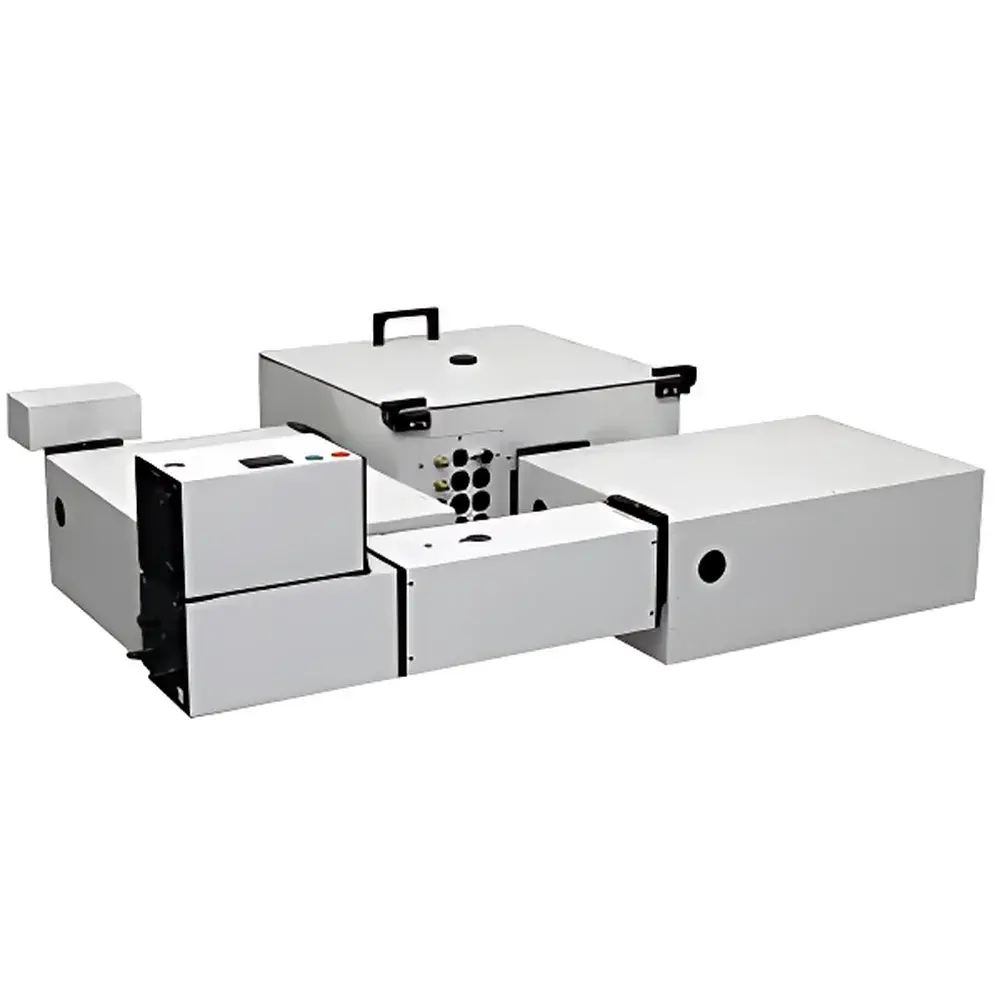
HORIBA FluoroLog-QM Modular Steady-State and Time-Resolved Fluorescence Spectrometer
| Brand | HORIBA |
|---|---|
| Origin | USA |
| Model | FluoroLog-QM |
| Instrument Type | Steady-State & Time-Resolved Fluorescence Spectrometer |
| Dispersion Elements | Dual-grating monochromator with motorized filter wheels |
| Spectral Slit Width (Spectral Bandpass) | 0.01 nm |
| Optical Resolution | 0.1 nm |
| Sensitivity (Water Raman SNR) | 35,000:1 |
| Wavelength Accuracy | ±0.3 nm |
| Excitation Sources | Continuous Xenon lamp, Pulsed Xenon lamp, CW and Pulsed Lasers (210–2200 nm coverage via modular coupling) |
Overview
The HORIBA FluoroLog-QM is a research-grade, fully modular steady-state and time-resolved fluorescence spectrometer engineered for maximum flexibility, spectral fidelity, and quantitative rigor in molecular photophysics laboratories. Based on Czerny-Turner optical architecture with a 350 mm focal length, the system employs a dual-input/dual-output monochromator design optimized for low stray light (<10⁻⁶) and high throughput. Its core measurement principle integrates photon-counting detection with time-correlated single-photon counting (TCSPC) and multi-channel scaling (MCS) for lifetime acquisition, alongside high-dynamic-range analog detection for absolute intensity and quantum yield determination. The FluoroLog-QM supports both continuous-wave (CW) and pulsed excitation modalities—enabling simultaneous acquisition of emission spectra, anisotropy, excitation spectra, synchronous scans, and time-resolved emission profiles across UV–Vis–NIR (up to 5500 nm with InGaAs detectors). Designed for compliance with GLP/GMP environments, its hardware architecture and software traceability meet foundational requirements for audit-ready data integrity.
Key Features
- Modular triple-grating monochromator with computer-controlled turret and flip mirror—enabling seamless switching between excitation and emission paths without realignment
- Motorized slit drives delivering programmable spectral bandpass down to 0.01 nm; calibrated resolution ≤0.1 nm across 185–5500 nm
- PowerArc™ elliptical reflector xenon source achieving 67% collection efficiency—reducing thermal load while maintaining high photon flux stability (±0.2% over 8 h)
- Dual detection architecture: side-on PMT (185–900 nm), red-sensitive PMT (300–1700 nm), and liquid-nitrogen-cooled InGaAs array (800–5500 nm) for phosphorescence decay analysis
- Integrated TCSPC electronics supporting up to 100 MHz repetition rate; compatible with pulsed LEDs, Q-switched lasers, OPOs, dye lasers, and supercontinuum sources
- Single-Shot Time-Domain (SSTD) phosphorescence mode—acquiring full µs–s lifetime decays from one excitation pulse, eliminating repetitive scanning artifacts
- Quadra Centric™ open sample chamber (120 × 120 × 100 mm usable volume) with motorized XYZ stage, temperature control interface (−196 °C to +300 °C), and standardized optical ports for microscope, integrating sphere, or electrochemical cell integration
Sample Compatibility & Compliance
The FluoroLog-QM accommodates diverse sample formats—including cuvettes (1–10 mm pathlength), powders, thin films, fibers, microcrystals, and biological tissues—via interchangeable holders and accessory modules. Optional accessories include a 6-position automated sample changer, diffuse reflectance probe, fiber-optic coupling kit, and vacuum-compatible cryostat interfaces. All optical components are certified for ISO 9001-compliant manufacturing, and the system’s firmware supports 21 CFR Part 11-compliant user access controls, electronic signatures, and audit trail logging when deployed with FelixGX v4.x. Data export formats comply with ASTM E2917 (Standard Practice for Fluorescence Lifetime Measurements) and IUPAC recommendations for quantum yield reporting.
Software & Data Management
FelixGX v4.5 is the native, unified software platform—providing integrated control of all hardware modules, real-time spectral visualization, and advanced post-processing. It includes built-in modules for FRET efficiency calculation (using donor-only and acceptor-sensitized decay fitting), carbon nanotube chirality assignment (based on empirical (E₁₁, E₂₂) maps), CIE chromaticity analysis, and absolute quantum yield determination using calibrated integrating spheres. Lifetime analysis employs non-linear least-squares fitting with χ² minimization, global analysis across multiple wavelengths or temperatures, and model selection criteria (AIC/BIC). Raw TCSPC histograms and MCS datasets are stored in HDF5 format with embedded metadata (excitation wavelength, detector gain, slit width, integration time), ensuring FAIR (Findable, Accessible, Interoperable, Reusable) data principles.
Applications
The FluoroLog-QM serves as a primary characterization tool in academic and industrial R&D labs focused on photofunctional materials, including organic LEDs, perovskite solar cells, lanthanide-doped nanoparticles, upconversion nanomaterials, and bioconjugated probes. Its NIR phosphorescence capability enables direct measurement of triplet-state dynamics in thermally activated delayed fluorescence (TADF) emitters. Time-resolved anisotropy resolves rotational diffusion coefficients of proteins and polymers in solution. Coupled with confocal microscopy, it delivers microscale spectral mapping of cellular Ca²⁺ indicators or mitochondrial membrane potential dyes. In catalysis research, it tracks photoinduced electron transfer kinetics in heterogeneous photocatalysts under operando conditions.
FAQ
What excitation sources are natively supported?
The system ships with a PowerArc™ continuous xenon lamp and pulsed xenon flashlamp. Additional laser sources (266–2000 nm) and pulsed LEDs can be integrated via fiber-coupled or free-space optical paths using standard kinematic mounts.
Is absolute quantum yield measurement possible?
Yes—when configured with a NIST-traceable 6-inch integrating sphere and calibrated reference standards (e.g., quinine sulfate, BaSO₄), the FluoroLog-QM meets ASTM E1590 specifications for absolute quantum yield determination.
Can the system perform time-resolved emission spectroscopy (TRES)?
Yes—using either TCSPC or MCS acquisition modes, TRES datasets (intensity vs. wavelength vs. time) are acquired with sub-nanosecond temporal resolution and exported for kinetic modeling in MATLAB or Origin.
Does the software support GLP-compliant reporting?
FelixGX supports configurable electronic signatures, role-based permissions, and automated PDF report generation with embedded raw data thumbnails, instrument configuration logs, and user activity timestamps—all compliant with FDA and EMA expectations for regulated environments.
What is the minimum detectable lifetime in phosphorescence mode?
Using SSTD acquisition with a 1 MHz pulsed laser and InGaAs detection, lifetimes as short as 1 µs are resolved with <5% uncertainty at signal-to-noise ≥100:1.




