
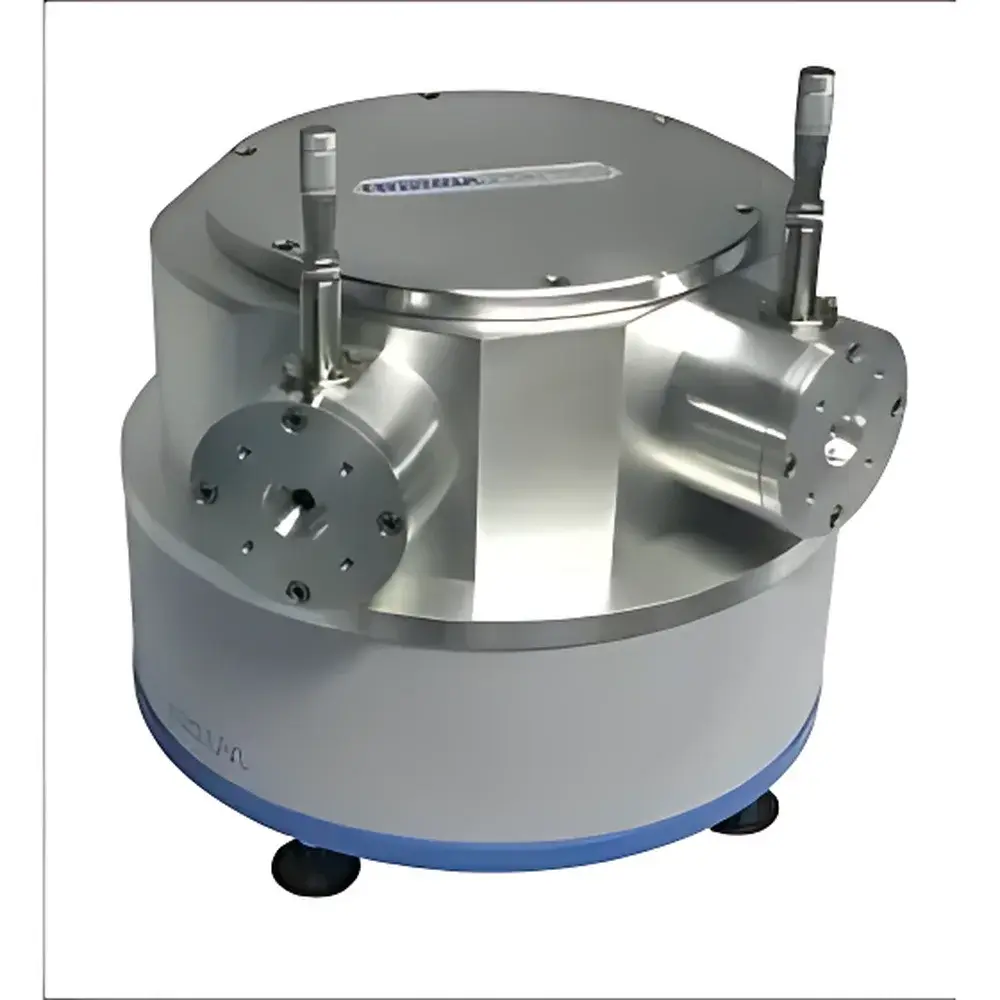
HORIBA Jobin Yvon H20-UVL Vacuum Ultraviolet Monochromator
| Brand | HORIBA |
|---|---|
| Origin | France |
| Model | H20-UVL |
| Spectral Range (Vacuum) | 100–400 nm (3–12.4 eV) |
| Spectral Range (Atmospheric) | 190–400 nm (3–6.5 eV) |
| Focal Length | 200 mm |
| f/# | f/4.2 |
| Grating Type | HJY4 aberration-corrected concave grating |
| Groove Density | 1200 gr/mm |
| Deviation Angle | 64° |
| Linear Dispersion at 100 nm | 3.6 nm/mm |
| Minimum Step Size | 0.06 nm |
| Scanning Speed | up to 400 nm/s |
| Wavelength Accuracy | ±0.2 nm (±0.06 nm with software calibration) |
| Repeatability | ±0.06 nm |
| Resolution (10 µm slit, 2 mm height, 121 nm) | <0.5 nm |
| Base Vacuum | ≤1×10⁻⁵ mbar (vacuum pump and gauge not included) |
| Vacuum Flange | DN40 KF (pump), DN25 KF (input/output) |
| Slit Width Range | 10 µm – 2 mm |
| Slit Height Options | 2, 4, or 6 mm |
| Optical Interfaces | Pre- and post-monochromator mirror chambers with toroidal mirrors |
| Sample Chamber | Accommodates up to four Ø25 mm samples |
Overview
The HORIBA Jobin Yvon H20-UVL is a high-performance vacuum ultraviolet (VUV) monochromator engineered for precision spectral selection and analysis in the critical 100–400 nm range. Operating under high vacuum (≤1×10⁻⁵ mbar), it achieves full spectral coverage from 100 nm (12.4 eV) — a regime inaccessible to standard air-path optics due to oxygen absorption — extending to 400 nm (3.1 eV). In atmospheric conditions, its usable range begins at 190 nm, enabling flexible deployment across laboratory environments without continuous vacuum maintenance. Based on the HJY4-type aberration-corrected concave grating design, the H20-UVL eliminates the need for auxiliary collimating or focusing optics, thereby maximizing throughput and minimizing alignment sensitivity. Its monolithic optical architecture ensures mechanical and thermal stability over extended acquisition periods — essential for quantitative reflectance, transmission, and fluorescence excitation measurements requiring high signal-to-noise ratio and long-term reproducibility.
Key Features
- Aberration-corrected 200 mm focal length concave grating (1200 gr/mm) with MgF₂ overcoat optimized for enhanced efficiency above 121 nm
- High-speed worm-gear drive system enabling scanning speeds up to 400 nm/s and positional resolution of 0.06 nm per step
- Dual toroidal mirror chambers: pre-monochromator chamber for efficient coupling from VUV sources (e.g., deuterium lamps, synchrotron beamlines, or laser harmonics); post-monochromator chamber for precise illumination of sample chambers or detectors
- Adjustable entrance and exit slits (10 µm – 2 mm width; optional 2/4/6 mm heights) supporting trade-offs between spectral resolution and radiant flux
- DN25 KF vacuum-compatible optical interfaces and DN40 KF flange for integrated pumping — compliant with standard UHV/VHV practices
- USB 2.0 interface with HORIBA’s native control firmware, supporting both open-loop positioning and closed-loop calibration routines for improved wavelength accuracy (±0.06 nm with software correction)
Sample Compatibility & Compliance
The H20-UVL accommodates a modular sample environment, including a dedicated sample chamber rated for up to four circular specimens (Ø ≤ 25 mm). Integrated polarization insertion ports support anisotropy studies, while optional cryogenic integration (down to 4 K) enables low-temperature VUV spectroscopy of semiconductors, superconductors, and quantum materials. The system meets foundational requirements for GLP-compliant spectral characterization when paired with traceable NIST-calibrated photodiodes or calibrated reference standards. While the monochromator itself does not carry CE or FDA certification, its mechanical and vacuum architecture conforms to ISO 27882 (vacuum component cleanliness) and ASTM E275 (spectrophotometer terminology and practice) guidelines. Vacuum integrity (≤10⁻⁵ mbar base pressure) supports compliance with ISO 14644-1 Class 5 cleanroom-compatible operation when housed in appropriate enclosures.
Software & Data Management
Control and data acquisition are managed via HORIBA’s cross-platform SpectraManager™ software suite, which provides scripting support (Python API), real-time wavelength calibration logging, and audit-trail-enabled parameter recording. All motorized functions — grating rotation, slit adjustment, and optional filter wheel actuation — are timestamped and stored with metadata (e.g., ambient pressure, detector gain, integration time). For regulated environments, optional 21 CFR Part 11 compliance packages are available, delivering electronic signature enforcement, role-based access control, and immutable acquisition logs. Raw spectral data exports in industry-standard formats (.csv, .spc, .jdx) ensure interoperability with third-party analysis tools including MATLAB, OriginLab, and IGOR Pro.
Applications
- Vacuum ultraviolet reflectance and transmittance spectroscopy of optical coatings, EUV mask substrates, and wide-bandgap semiconductors (e.g., AlN, GaN, diamond)
- Fluorescence excitation profiling of rare-earth-doped phosphors and molecular emitters with VUV-sensitive absorption edges
- Tunable VUV source generation for photoelectron spectroscopy (PES) pre-alignment and detector calibration
- Harmonic separation and filtering in ultrafast laser systems (e.g., 5th/7th harmonic selection from Ti:sapphire or Nd:YAG sources)
- Gas-phase absorption spectroscopy of atomic and molecular species (O, N, H₂, CO) in fundamental plasma and astrophysical simulation experiments
FAQ
Does the H20-UVL include a vacuum pump or vacuum gauge?
No — the H20-UVL is supplied as a monochromator-only unit. A compatible high-vacuum pump (e.g., turbomolecular pump with backing stage) and capacitance manometer are required for operation below 190 nm.
Can the H20-UVL be integrated with synchrotron beamlines?
Yes — its DN25 KF input flange, toroidal pre-chamber optics, and low-aberration design make it suitable for beamline end-station use, provided photon flux and heat load specifications are within operational limits.
What slit configuration delivers optimal resolution at 121 nm?
A 10 µm × 2 mm slit achieves <0.5 nm resolution at 121 nm, as verified by helium emission line profiling under high vacuum.
Is cryogenic sample cooling supported natively?
The sample chamber includes standardized mounting threads and thermal isolation provisions for third-party 4 K cryostats; HORIBA offers mechanical and electrical integration kits upon request.
How is wavelength calibration performed and validated?
Calibration uses known emission lines (e.g., He I at 58.4 nm, Ne I at 73.6 nm, Ar I at 104.8 nm) with optional NIST-traceable VUV spectral lamps; software stores correction maps per grating order and slit setting.




