
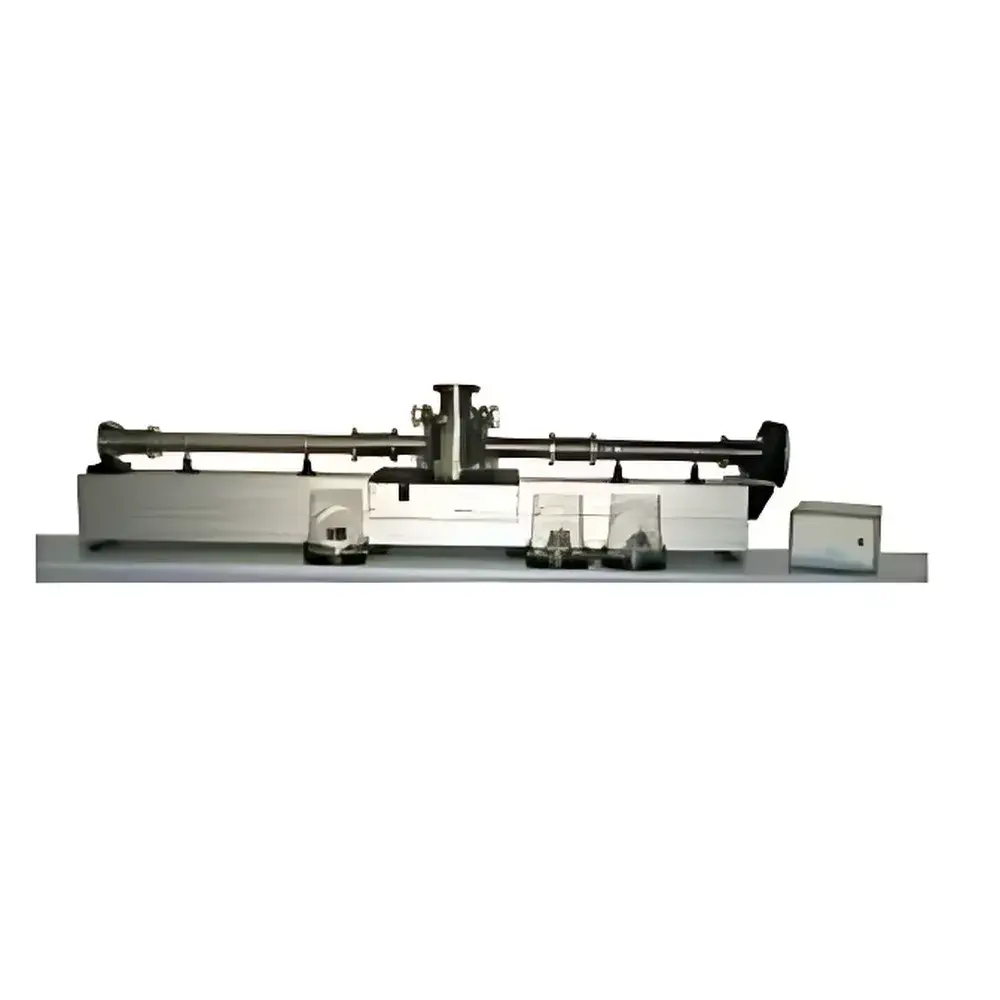
HORIBA JY PGS/PGM 1000 Vacuum Ultraviolet Spectrometer
| Brand | HORIBA |
|---|---|
| Origin | France |
| Model | PGS/PGM 1000 |
| Application Modes | Transmission/Reflection Spectroscopy |
| Optical Configuration | Aberration-Corrected Plane Grating + Toroidal Mirror |
| Focal Length | 1000 mm |
| F-number | f/48 |
| Vacuum Compatibility | UHV up to 1×10⁻⁹ mbar |
| Wavelength Range | 4–125 nm (10–310 eV) |
| Resolution (typ.) | 0.02–0.3 nm (dependent on grating selection) |
| Grating Options | 550, 1800, 3600 grooves/mm |
| Exit Slit Interface | Adjustable micrometer slits, DN100 CF/ICF152 detector flange |
| Input/Output Flanges | DN63 LF (pump), DN100 CF (UHV pump), DN40 CF (vacuum gauge) |
| Motorized Wavelength Drive | Stepper motor with USB 2.0 interface |
Overview
The HORIBA JY PGS/PGM 1000 is a high-performance vacuum ultraviolet (VUV) and extreme ultraviolet (EUV) spectrometer engineered for precision spectroscopic analysis in ultra-high vacuum (UHV) environments. Based on a patented aberration-corrected optical design, it integrates a single HJY plane grating with a toroidal mirror to eliminate coma and astigmatism across the entire spectral range—enabling simultaneous optimization of resolution, throughput, and imaging fidelity. Its grazing-incidence optical layout extends operational capability into the soft X-ray region (down to 4 nm / 310 eV), while the in-line, direct-illumination geometry ensures maximal photon flux onto the detector surface. The instrument operates in two interchangeable configurations: as a scanning monochromator (with single-channel detectors such as photomultiplier tubes or channeltrons) or as an imaging spectrograph (with back-illuminated CCD or CMOS array detectors). This dual-mode functionality is achieved mechanically—without realignment—by swapping only the exit slit assembly and detector flange, preserving optical stability and calibration integrity.
Key Features
- Aberration-corrected optical path comprising a custom HJY plane grating and two toroidal mirrors—optimized for VUV/EUV performance from 4 nm to 125 nm.
- Grazing-incidence configuration enabling access to the soft X-ray regime (4–16 nm, 77–310 eV) with high spectral purity and minimal higher-order contamination.
- Focal length of 1000 mm and f/48 aperture delivering high dispersion and low geometric distortion at the focal plane.
- Motorized wavelength drive with sub-pixel repeatability and USB 2.0 interface for seamless integration into automated beamlines and synchrotron endstations.
- UHV-rated mechanical architecture compatible with base pressures down to 1×10⁻⁹ mbar; includes DN100 CF pump port, DN40 CF vacuum gauge port, and DN63 LF roughing port.
- Modular detector interface: DN100 CF or ICF152 flange supports both single-point detectors and large-format scientific CCDs with vertical focal plane orientation for optimal quantum efficiency.
- Interchangeable grating turret (optional) supporting three standard groove densities: 550, 1800, and 3600 grooves/mm—each optimized for specific resolution-throughput trade-offs across distinct energy bands.
Sample Compatibility & Compliance
The PGS/PGM 1000 is designed for integration into UHV-compatible experimental chambers used in fundamental and applied research—including plasma diagnostics, EUV lithography source characterization, laser harmonic generation studies, and synchrotron-based photoemission spectroscopy (e.g., ARPES, XPS). Its sample chamber (optional accessory) accommodates up to four samples ≤25 mm in diameter and supports cryogenic operation down to 4 K when coupled with closed-cycle refrigerators. Polarization control is enabled via optional insertion of birefringent waveplates or multilayer polarizers in the front or rear mirror chambers. The system conforms to ISO 3543 (vacuum component standards), ASTM E1782 (spectral calibration traceability), and meets mechanical and electrical safety requirements per IEC 61000-6-3/6-4 for laboratory instrumentation. When operated under GLP/GMP-compliant workflows, its motorized wavelength control and digital interface support audit-trail-capable data acquisition when paired with validated software platforms.
Software & Data Management
Instrument control and spectral acquisition are managed through HORIBA’s LabSpec 6 software suite (Windows-based), which provides full motorized scan programming, real-time intensity monitoring, multi-detector synchronization, and wavelength calibration using known emission lines (e.g., He I at 58.4 nm, Ne I at 73.6 nm). Raw spectral data are exported in standardized formats (ASCII, CSV, HDF5) compliant with NIST SRD protocols and FAIR data principles. Optional SDKs enable Python- and LabVIEW-based custom automation for integration into larger experimental control frameworks. All firmware updates and calibration files are digitally signed and version-controlled to ensure reproducibility across long-term experiments and multi-user facilities.
Applications
- Characterization of EUV light sources for next-generation lithography, including spectral purity, bandwidth, and temporal coherence assessment.
- Time-resolved plasma spectroscopy in fusion-relevant devices (e.g., tokamaks, Z-pinches), targeting line emissions from highly ionized species (C V, O VI, Fe XVII).
- High-harmonic generation (HHG) diagnostics in ultrafast laser laboratories—resolving individual harmonic orders and measuring phase-matching conditions.
- Angle-resolved photoemission spectroscopy (ARPES) beamlines requiring high-flux, narrow-band excitation in the 10–100 eV range.
- Reflectance and transmittance measurements of multilayer optics (e.g., Mo/Si, Ru/B4C) under VUV irradiation.
- Fundamental atomic and molecular physics studies involving autoionizing resonances and Rydberg series in the 4–30 nm window.
FAQ
What vacuum level is required for optimal performance?
The PGS/PGM 1000 achieves best signal-to-noise ratio and minimizes absorption losses in the VUV/EUV range when operated at ≤1×10⁻⁸ mbar; UHV compatibility up to 1×10⁻⁹ mbar enables coupling to synchrotron beamlines and cryogenic sample environments.
Can the instrument be retrofitted with additional gratings?
Yes—HORIBA offers certified master gratings (e.g., part numbers 54403130, 54402130, 54401130) and optional motorized grating turrets for automated switching between spectral ranges and resolutions.
Is the optical alignment user-serviceable?
The in-line, fixed-optic design eliminates routine collimation requirements; however, initial alignment of front/rear mirror chambers must be performed by trained personnel using autocollimation and He-Ne reference lasers.
Does the system support time-resolved measurements?
When synchronized with external triggers (TTL input/output), the motorized grating drive and detector gating support pump-probe experiments with timing resolution limited only by detector response and laser pulse duration.
What detector types are recommended for spectrograph mode?
Back-illuminated, deep-depletion CCDs (e.g., Andor iXon, Princeton Instruments PIXIS) or scientific CMOS sensors with >90% QE in the 10–100 nm range are preferred; microchannel plate (MCP)-intensified variants enhance sensitivity for weak-emission sources.
Related Products




