
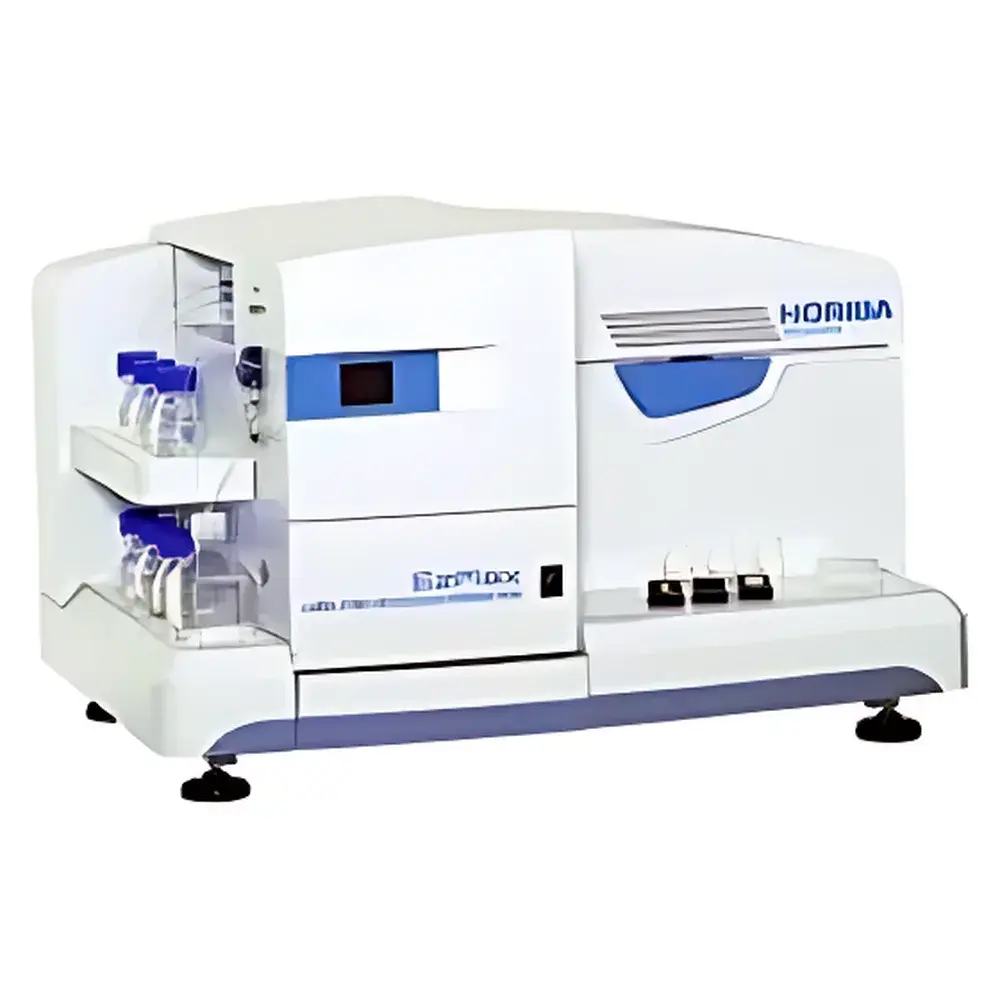
HORIBA SPRi-EzPlex Automated Surface Plasmon Resonance Imaging System
| Brand | HORIBA |
|---|---|
| Origin | France |
| Model | SPRi-EzPlex |
| Sample Volume | 200 µL (standard), optional 100/250/500 µL |
| Temperature Control Range | 15–40 °C, Accuracy: ±0.1 °C, Stability: ±0.01 °C |
| Detection Limit | 5 pg/mm² |
| Minimum Analyte MW | >240 Da |
| Sample Concentration Range | 150 ng/mL (for 100–1000 kDa) to 5 µg/mL (for 4–20 kDa) |
Overview
The HORIBA SPRi-EzPlex Automated Surface Plasmon Resonance Imaging System is an advanced label-free biosensing platform engineered for high-throughput, multiplexed molecular interaction analysis. Leveraging the physical principle of surface plasmon resonance (SPR) coupled with real-time optical imaging and microarray chip technology, the SPRi-EzPlex enables simultaneous detection and quantification of up to hundreds of biomolecular interactions on a single sensor surface—without requiring fluorescent, enzymatic, or radioactive labeling. Unlike conventional channel-based SPR instruments that measure one or few interactions in parallel, this system employs a full-field CCD-based imaging architecture to capture spatially resolved binding kinetics across an entire functionalized biochip. This design supports true multiplexed interrogation under identical experimental conditions, ensuring high reproducibility and minimizing inter-assay variability. The system is optimized for kinetic characterization (ka, kd, KD), affinity ranking, specificity profiling, and thermodynamic analysis across a broad temperature range—making it suitable for rigorous biophysical validation in regulated environments.
Key Features
- Real-time, label-free imaging of biomolecular interactions across a 2D microarray surface
- Automated fluidic handling with integrated autosampler and optional continuous-flow microspotting (SPRi-CFM) or rapid desktop arraying (SPRi-Array)
- Precise thermal control (15–40 °C) with ±0.1 °C accuracy and ±0.01 °C short-term stability—critical for temperature-dependent binding studies and Arrhenius analysis
- Integrated automatic degassing module to minimize baseline drift and bubble-induced artifacts during long-duration assays
- Direct subtraction of negative control spots for background-corrected signal quantification
- Modular SPRi-Biochips™ platform with multiple surface chemistries (CS, CO, CSe, COe, CTg, CH) enabling covalent or affinity-based immobilization of proteins, peptides, oligonucleotides, glycans, lipids, viruses, and whole cells
- Minimum detectable mass density of 5 pg/mm²; compatible with analytes ranging from small molecules (>240 Da) to intact cells
Sample Compatibility & Compliance
The SPRi-EzPlex accommodates diverse biological samples—including small-molecule drug candidates, synthetic peptides, recombinant proteins, monoclonal antibodies, DNA/RNA oligos, glycoconjugates, liposomes, bacteriophages, enveloped viruses, and adherent or suspended mammalian cells—without chemical modification or labeling. Its open microfluidic architecture supports variable sample volumes (100–500 µL), enabling efficient use of precious clinical or preclinical material. The system complies with foundational principles of Good Laboratory Practice (GLP) and Good Manufacturing Practice (GMP), supporting audit-ready operation through secure user access controls, electronic signatures, and comprehensive audit trails. While not pre-certified for FDA 21 CFR Part 11, its software architecture permits configuration to meet regulatory requirements for data integrity, traceability, and version-controlled method storage—facilitating validation in pharmaceutical development and academic core facilities.
Software & Data Management
Acquisition and analysis are managed via HORIBA’s dedicated SPRi Control & Analysis Suite, a Windows-based application supporting real-time sensorgram visualization, global fitting of association/dissociation phases, heterogeneity modeling, and heatmap generation for spatial response mapping. Raw data are stored in vendor-neutral HDF5 format, ensuring long-term archival compatibility and third-party interoperability. The software includes built-in tools for referencing, double-referencing, and zero-time alignment—essential for robust kinetic parameter extraction. All processing steps are logged with timestamps, operator IDs, and instrument metadata, satisfying ALCOA+ (Attributable, Legible, Contemporaneous, Original, Accurate, Complete, Consistent, Enduring, Available) data governance expectations. Optional integration with LIMS platforms is supported via standard API protocols.
Applications
- High-throughput screening of protein–ligand, antibody–antigen, and nucleic acid–target interactions
- Epitope binning and paratope mapping in therapeutic antibody development
- Characterization of multivalent binding, avidity effects, and cooperative assembly in macromolecular complexes
- Thermodynamic profiling of binding enthalpy and entropy via van’t Hoff analysis across controlled temperatures
- Label-free cellular adhesion and receptor engagement studies using intact cell monolayers
- Vaccine antigen–serum antibody profiling and immunogenicity assessment
- Enzyme–inhibitor kinetics and allosteric modulation analysis
- Quality control of bioconjugates and functionalized nanoparticles
FAQ
What types of biomolecules can be immobilized on SPRi-Biochips™?
Proteins, antibodies, peptides, oligonucleotides, carbohydrates, lipids, and whole cells can be covalently or affinity-coupled depending on the selected chip surface chemistry (e.g., CO for amine coupling, CTg for streptavidin-biotin, CH for His-tag capture).
Is the system compatible with kinetic analysis of low-affinity interactions (KD > 1 µM)?
Yes—the high signal-to-noise ratio, temperature-stabilized optics, and extended dissociation monitoring capability support reliable determination of slow off-rates and weak affinities when combined with appropriate immobilization density and mass transport correction.
Can SPRi-EzPlex data be exported for third-party kinetic modeling software?
Yes—sensorgram time-series data are exportable in CSV and HDF5 formats, fully compatible with industry-standard tools including Scrubber, KinExA, and custom Python/MATLAB scripts.
Does the system support regeneration of sensor surfaces between cycles?
Yes—regeneration protocols (e.g., low-pH glycine, high-salt, or chaotropic buffers) can be programmed into assay methods and executed automatically via the integrated fluidics module.
What is the typical turnaround time for a full 96-spot array experiment?
A complete cycle—including sample injection, association, dissociation, regeneration, and washing—typically requires 30–90 minutes per cycle, depending on kinetic parameters and number of replicates; throughput scales linearly with parallel spot interrogation.




