
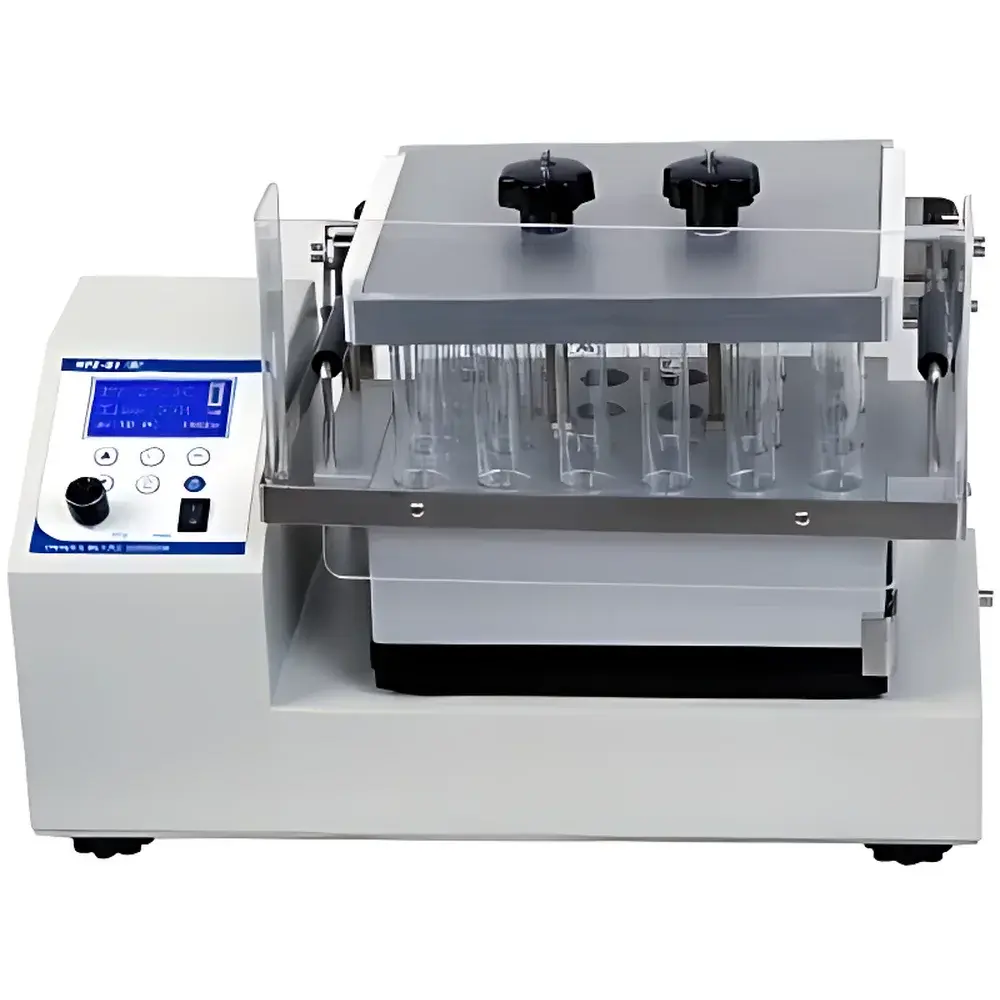
HPE-01 Parallel Concentration Evaporator
| Origin | Shanghai, China |
|---|---|
| Manufacturer Type | Authorized Distributor |
| Origin Category | Domestic (PRC) |
| Model | HPE-01 |
| Instrument Type | Automated Quantitative Concentrator |
| Rated Power | 1100 W |
| Temperature Control Range | Ambient +5 °C to 100 °C |
| Temperature Accuracy | ±1 °C |
| Rotational Speed | 50–420 rpm |
| Centrifugal Radius | 5 mm |
| Net Weight | 32 kg |
| Dimensions (W×D×H) | 490 × 320 × 355 mm |
| Sample Capacity | 24 positions, standard tube volume: 30 mL |
Overview
The HPE-01 Parallel Concentration Evaporator is an automated, vacuum-assisted sample concentration system engineered for high-throughput, reproducible solvent removal under controlled thermal and rotational conditions. It operates on the principle of simultaneous rotary evaporation under reduced pressure—leveraging centrifugal force, regulated heating, and precise vacuum control to accelerate solvent volatilization while minimizing analyte degradation or loss. Designed specifically for laboratories processing large batches of liquid samples—such as environmental monitoring labs, agrochemical testing facilities, and quality control units—the instrument enables parallel processing of up to 24 samples (30 mL tubes) without manual intervention or intermediate transfer steps. Its compact footprint and integrated safety architecture make it suitable for benchtop deployment in ISO/IEC 17025-accredited environments where space efficiency and operational traceability are critical.
Key Features
- Parallel Processing Architecture: 24-position rotor accommodates standard 30 mL test tubes; all samples undergo identical thermal, rotational, and vacuum profiles simultaneously—ensuring inter-sample comparability and eliminating run-to-run variability.
- Integrated Vacuum & Thermal Control: Built-in vacuum regulation (typically 5–50 mbar, compatible with external vacuum pumps) coupled with PID-controlled heating block (ambient +5 °C to 100 °C, ±1 °C accuracy) ensures consistent evaporation kinetics across diverse solvents (e.g., hexane, acetone, ethyl acetate, methanol).
- Centrifugal Stabilization: 5 mm eccentric radius combined with adjustable rotation (50–420 rpm) generates uniform film formation on tube walls, maximizing surface area exposure and preventing bumping or splashing—critical for volatile or heat-sensitive analytes.
- Visual Process Monitoring: Transparent polycarbonate lid allows real-time observation of sample level reduction without breaking vacuum or interrupting operation—supporting endpoint determination by visual inspection or optional external level sensors.
- Contamination Mitigation Design: Closed-loop evaporation path, non-contact sample handling, and independent tube positioning eliminate cross-contamination risks—essential for multi-analyte residue screening (e.g., multi-pesticide residue analysis per EN 15662 or AOAC 2007.01).
- Benchtop Efficiency: Compact dimensions (490 × 320 × 355 mm) and 32 kg mass enable integration into fume hoods or dedicated QC workstations without requiring floor-standing infrastructure.
Sample Compatibility & Compliance
The HPE-01 is validated for use with common laboratory glassware (e.g., borosilicate test tubes, culture tubes, and conical-bottom vials) and compatible with a broad range of organic and aqueous solvents used in extraction workflows—including those specified in EPA Method 525.3 (drinking water), EPA 8270 (semivolatiles), and SANTE/11312/2021 (pesticide residue analysis). The system supports GLP-compliant operation when paired with external data loggers recording time-stamped temperature, pressure, and rotation parameters. While the instrument itself does not include 21 CFR Part 11-compliant electronic signatures, its operational parameters are fully documentable for audit readiness in GMP-aligned food safety or environmental testing labs.
Software & Data Management
The HPE-01 operates via an embedded microcontroller interface with push-button navigation and LED-based status indicators. Although it lacks onboard data storage or Ethernet connectivity, all critical operating parameters (set temperature, actual temperature, rotation speed, elapsed time) are displayed in real time and can be manually logged or captured via external USB-connected thermocouple/vacuum transducers. For laboratories implementing LIMS integration, the device’s stable operational profile allows synchronization with third-party scheduling software through programmable start/stop triggers (dry contact I/O optional upon request). Routine calibration verification follows ASTM E29–23 guidelines for thermal instrumentation, with annual verification recommended using NIST-traceable reference standards.
Applications
- Pre-concentration of aqueous and organic extracts prior to GC-MS or LC-MS/MS analysis in environmental monitoring (e.g., PFAS, PAHs, PCBs).
- High-volume pesticide residue testing in food matrices—aligned with EU Regulation (EC) No 396/2005 and Codex Alimentarius MRL enforcement protocols.
- Post-SPE (solid-phase extraction) eluate concentration for trace metal speciation or pharmaceutical impurity profiling.
- Parallel evaporation of reaction mixtures in synthetic chemistry QC, enabling rapid yield assessment across catalyst screening libraries.
- Gravimetric sample preparation for total dissolved solids (TDS) or extractable non-volatile residue (ENVR) quantification per USP <467> or ISO 11843.
FAQ
What types of solvents are compatible with the HPE-01?
The system is compatible with low- to medium-boiling-point solvents including acetone, acetonitrile, dichloromethane, ethyl acetate, hexane, methanol, and ethanol. High-boiling solvents (e.g., DMSO, glycerol) are not recommended due to thermal load constraints and extended cycle times.
Can the HPE-01 be used under inert gas purging?
Yes—optional nitrogen inlet ports can be installed to enable gentle blanketing during evaporation of oxygen-sensitive compounds, though this requires modification by authorized service personnel.
Is method validation support available for regulatory submissions?
While the manufacturer provides technical specifications and operational guidance, full IQ/OQ/PQ documentation packages must be developed internally or by qualified third-party validation consultants per ISO/IEC 17025 or FDA requirements.
How often does the vacuum pump require maintenance?
Maintenance frequency depends on usage intensity and solvent type; oil-sealed rotary vane pumps typically require oil changes every 200–300 hours of operation when processing halogenated solvents, or every 500 hours with hydrocarbon solvents.



