
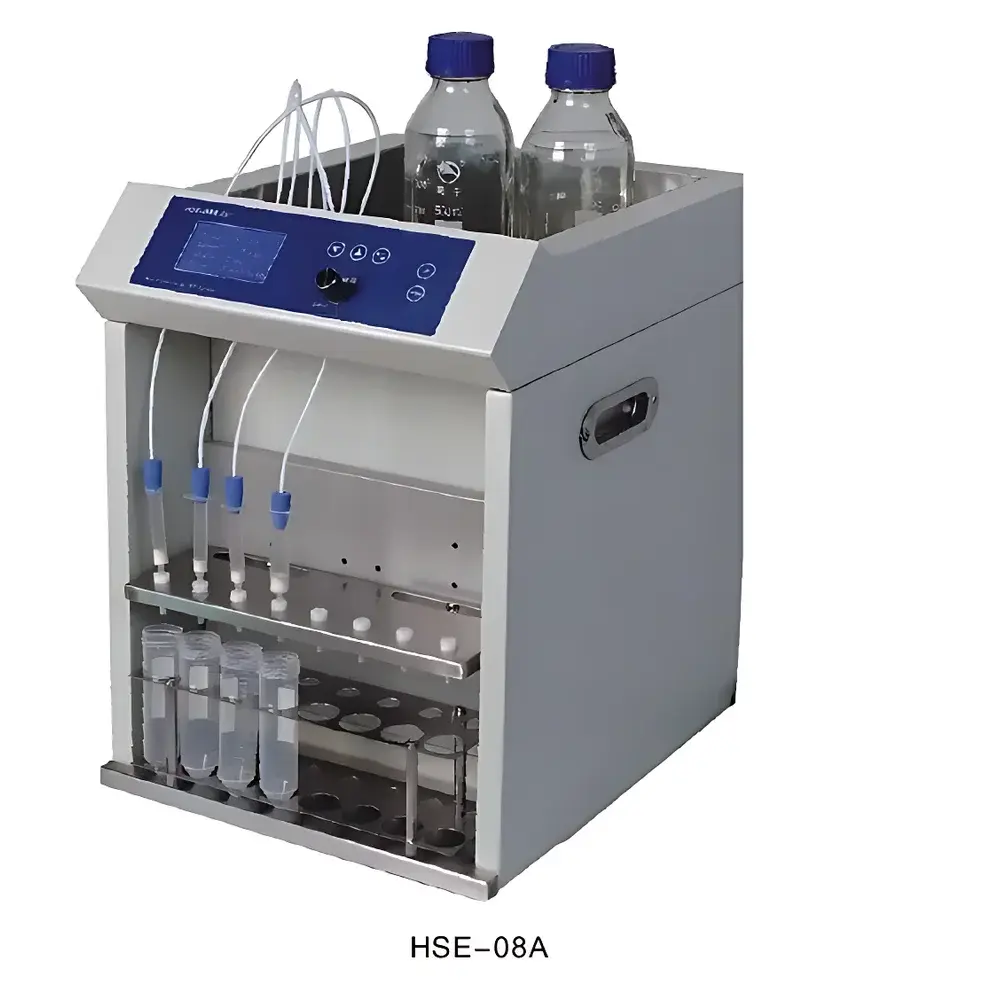
HSE-08 Multichannel CNC-Controlled Solid Phase Extraction System
| Origin | Shanghai, China |
|---|---|
| Manufacturer Type | Authorized Distributor |
| Origin Category | Domestic (China) |
| Model | HSE-08 |
| Price | USD 4,500 (FOB Shanghai) |
| Automation Level | Fully Automatic |
| Channel Count | 8-Channel |
| Extraction Mode | Column-Based SPE |
| Flow Rate Control Range | 0.1–30 mL/min |
| Eluent Compatibility | Broad-spectrum (organic solvents, aqueous buffers, acids, bases, oxidizers) |
| Sample Capacity | 8 samples per run |
| Maximum Sample Load Volume | 30 mL per column |
| Wetted Materials | 316 Stainless Steel (all fluidic pathways and manifolds) |
Overview
The HSE-08 Multichannel CNC-Controlled Solid Phase Extraction System is an engineered platform for reproducible, high-throughput sample preparation in regulated and research laboratories. It implements a dual-pressure SPE methodology—combining programmable negative pressure for precise conditioning, loading, and washing steps with positive-pressure elution for quantitative recovery—thereby eliminating gravitational variability and manual inconsistency inherent in vacuum manifold systems. The system operates on a microprocessor-driven CNC (Computer Numerical Control) architecture, where motorized peristaltic or syringe-based pumps (configurable per installation) deliver digitally defined flow rates across all eight independent channels. This architecture ensures traceable, linear flow control (0.1–30 mL/min), enabling compliance with method-defined residence times required by ISO 17025-accredited workflows and regulatory SOPs in food safety (e.g., AOAC 2012.01), environmental analysis (EPA Method 502.2, 525.3), and pharmaceutical impurity profiling (ICH Q2(R2)).
Key Features
- 8-channel parallel processing with fully independent flow control per column—enabling method-mixing (e.g., different sorbents, solvents, or flow profiles across channels)
- CNC-driven flow regulation with real-time LED digital display of rotational speed (rpm) and calibrated flow rate (mL/min); linear correlation between rpm and volumetric delivery verified per channel during factory calibration
- Positive-pressure elution module with pressure-regulated nitrogen or inert gas supply (optional integrated regulator available), ensuring uniform eluent displacement and minimizing carryover
- Chemically resistant fluid path: 316 stainless steel manifolds, PTFE-coated valves, and chemically inert polymer tubing compatible with 0.1% HNO₃, 1M NaOH, acetonitrile, dichloromethane, and hydrogen peroxide solutions
- Programmable timer function (0–99 minutes per step) with step-sequence memory for up to 5 multi-step protocols; automatic transition between load/wash/elute phases without user intervention
- Integrated leak detection and overpressure safeguard: system halts operation if backpressure exceeds 120 psi during elution or if column blockage is detected via flow deviation >±15% from setpoint
Sample Compatibility & Compliance
The HSE-08 accommodates standard 1 mL, 3 mL, and 6 mL SPE cartridges (including bonded silica, polymeric, ion-exchange, and mixed-mode sorbents) using interchangeable stainless-steel adapter fittings. Each channel supports up to 30 mL sample volume per cartridge, making it suitable for large-volume water analysis (e.g., EPA 525.3), tissue homogenate cleanup, or plasma protein precipitation workflows. All wetted materials comply with USP Class VI biocompatibility standards and are certified non-leaching under ISO 10993-12 extraction conditions. The system meets mechanical safety requirements per IEC 61010-1 and electromagnetic compatibility per EN 61326-1. While not inherently 21 CFR Part 11 compliant, audit trail functionality (user log, method versioning, timestamped run records) can be enabled via optional Ethernet-connected data logger firmware (v2.3+), supporting GLP/GMP-aligned validation documentation.
Software & Data Management
The HSE-08 operates via embedded firmware with local control only—no PC dependency—ensuring operational continuity during network outages. All method parameters (flow rate, duration, step sequence) are stored in non-volatile flash memory with checksum verification. Optional RS-232 or USB-C interface enables integration into LIMS environments via ASCII command protocol (SCPI-compliant syntax). Raw execution logs—including actual vs. setpoint flow deviation, elapsed time per step, and error codes—are exportable as CSV files for QA review. Firmware updates are performed via secure signed .bin file upload through the front-panel interface, with rollback capability and version-locking for regulated environments.
Applications
- Food & Agriculture: Multi-residue pesticide analysis in fruits, vegetables, and grains (EN 15662:2018); mycotoxin cleanup in cereals prior to LC-MS/MS
- Environmental: Trace-level PAHs, PCBs, and pharmaceuticals in surface water, wastewater, and soil extracts (EPA 1694, ISO 21675:2019)
- Clinical & Pharmaceutical: Plasma/urine deproteinization and metabolite enrichment for bioanalysis; residual solvent removal in API synthesis intermediates
- Industrial QC: Heavy metal preconcentration from electroplating baths; surfactant isolation from detergent formulations
FAQ
What types of SPE cartridges are supported?
Standard 1 mL, 3 mL, and 6 mL format cartridges with fritted polypropylene housings and common sorbent chemistries (C18, SCX, SAX, HLB, Florisil) are fully compatible. Custom adapters for 12 mL or plate-format formats are available upon request.
Is method validation support provided?
Yes—application notes, system suitability test (SST) protocols, and IQ/OQ documentation templates are included with purchase. Third-party PQ qualification assistance is available through certified service partners.
Can the system be integrated into automated laboratory workflows?
It features dry-contact relay outputs for synchronization with autosamplers or fraction collectors, and TTL-triggered start/stop signals for seamless integration into robotic liquid handling platforms.
What maintenance is required?
Quarterly verification of flow accuracy using gravimetric calibration (NIST-traceable balance), annual replacement of pump tubing, and biannual inspection of stainless-steel manifold seals constitute the recommended preventive maintenance schedule.
Does the system support gradient elution?
No—gradient programming is not implemented. However, sequential elution with up to three distinct solvents per channel is achievable via timed step transitions and external solvent switching valves.



