
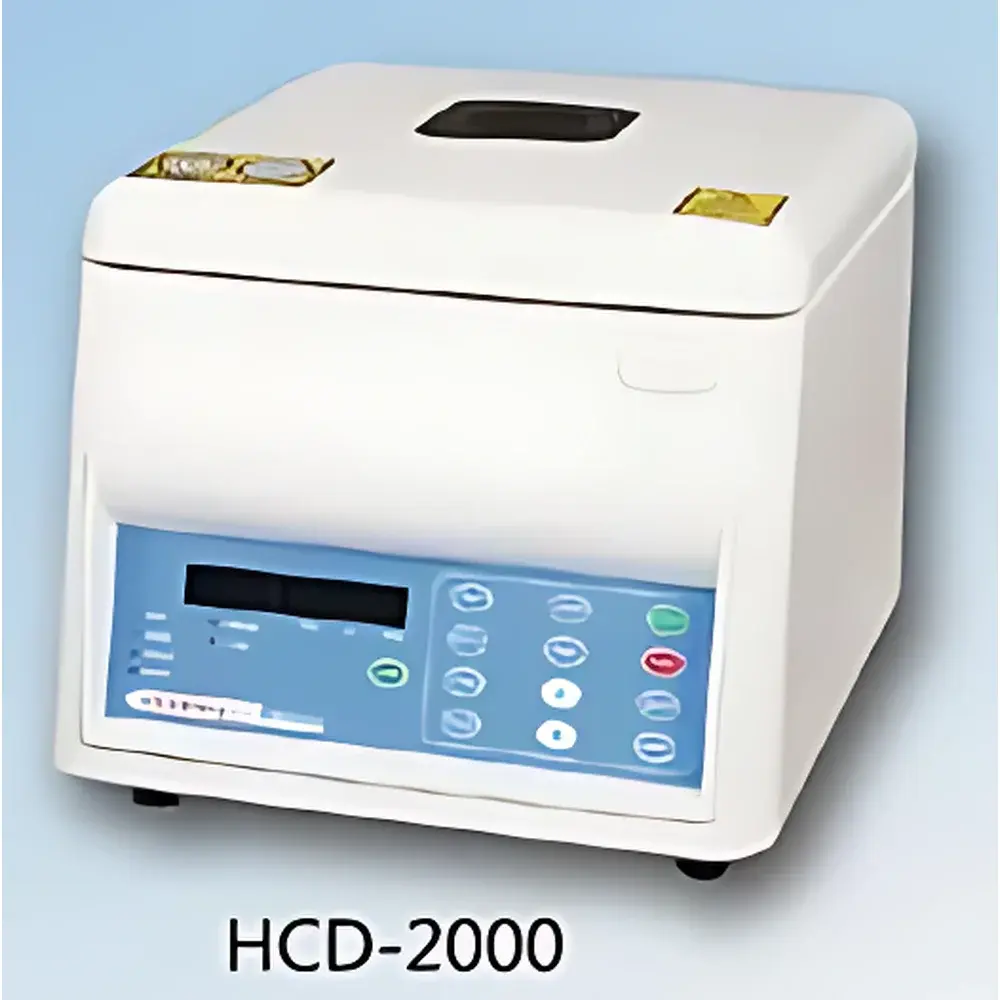
HsiangTai HCD-2000 Capillary-Specific Benchtop Centrifuge
| Brand | HsiangTai |
|---|---|
| Origin | Taiwan |
| Model | HCD-2000 |
| Instrument Type | Benchtop Centrifuge |
| Speed Range | 1,000–12,000 rpm |
| Max. RCF | 14,820 × g |
| Capacity | 24 capillaries |
| Rotor Type | Horizontal swing-out (RHT-240) |
| Dimensions (W×D×H) | 290 × 320 × 250 mm |
| Power Supply | AC 220 V, 50/60 Hz |
| Timer Range | 1–100 min |
| Motor | Brushless DC |
| Safety Features | Auto-balance detection, lid interlock, power-fail protection, soft acceleration/deceleration |
| Housing Material | ABS with transparent viewing window |
| Display | Digital speed/time setting with analog tachometer pointer |
Overview
The HsiangTai HCD-2000 is a purpose-engineered benchtop centrifuge optimized exclusively for capillary tube processing in clinical hematology, micro-volume sample preparation, and point-of-care diagnostics laboratories. Unlike general-purpose centrifuges, the HCD-2000 integrates a dedicated horizontal swing-out rotor (RHT-240) designed to accommodate standardized 75 mm or 100 mm capillary tubes—commonly used in hematocrit (HCT), plasma separation, and microhematocrit assays. Its operation relies on classical sedimentation principles under controlled rotational force, delivering precise, reproducible separation of blood components (e.g., erythrocytes, leukocytes, plasma) within narrow-diameter capillaries. The unit operates within a defined speed range of 1,000–12,000 rpm, generating a maximum relative centrifugal force (RCF) of 14,820 × g—sufficient to achieve rapid, stratified separation without tube deformation or sample leakage. Engineered for routine clinical throughput, it supports uninterrupted batch processing of up to 24 capillaries per run, minimizing operator intervention and ensuring consistent alignment across all sample positions.
Key Features
- Capillary-optimized RHT-240 horizontal rotor with precision-machined tube holders ensuring uniform radial orientation and mechanical stability at high speeds
- Brushless DC motor providing low-noise operation, extended service life (>10,000 hr MTBF), and torque consistency across the full speed range
- Dual-mode speed control: digital keypad input for exact rpm or time setting, complemented by an analog tachometer pointer for real-time visual verification
- Intelligent auto-balance system that detects mass asymmetry ≥0.5 g and automatically adjusts rotor dynamics prior to acceleration—eliminating manual balancing steps
- Integrated safety architecture including lid interlock switch (halts rotation immediately upon opening), power-loss recovery protocol, and thermal overload cutoff
- ABS polymer housing with reinforced polycarbonate viewing window enabling continuous visual monitoring of rotor behavior without compromising containment integrity
- Soft-start and soft-stop ramp profiles (programmable acceleration/deceleration rates) to prevent capillary fracture and minimize sediment resuspension during deceleration
Sample Compatibility & Compliance
The HCD-2000 is validated for use with standard glass or plastic capillary tubes conforming to ISO 8655-5 (volumetric calibration of capillaries) and CLSI H26-A3 (procedures for hematocrit determination). It accommodates both heparinized and EDTA-anticoagulated whole blood samples, as well as low-viscosity aqueous suspensions used in micro-volume quality control standards. The rotor geometry ensures uniform fill-level tolerance (±5% volume variation) without compromising sediment compaction density. From a regulatory standpoint, the device meets IEC 61010-1:2010 (safety requirements for electrical equipment for measurement, control, and laboratory use) and carries CE marking for Class IIa medical device applications where applicable. While not FDA 510(k)-cleared as a standalone diagnostic instrument, its performance aligns with CLIA-waived testing environments when operated within validated protocols and maintained per manufacturer-recommended calibration intervals.
Software & Data Management
The HCD-2000 operates as a stand-alone hardware platform without embedded firmware-based data logging or network connectivity. All operational parameters—including set speed, runtime, and actual RCF—are displayed locally via the dual-mode interface but are not stored internally or exportable. For laboratories requiring audit-ready documentation, integration with external electronic lab notebooks (ELNs) or LIMS systems must be achieved manually via operator-recorded run logs. No software drivers, USB interfaces, or RS-232 ports are provided; therefore, the unit does not support 21 CFR Part 11-compliant electronic signatures or automated traceability. Routine maintenance records, calibration certificates (per ISO/IEC 17025), and preventive servicing logs must be maintained offline in accordance with GLP/GMP documentation practices.
Applications
- Routine hematocrit (HCT) determination in outpatient clinics and field-deployable diagnostic units
- Plasma isolation from micro-volume whole blood samples (≤100 µL) for subsequent ELISA, PCR, or point-of-care immunoassays
- Preparation of packed cell volume (PCV) standards for veterinary hematology reference labs
- Sedimentation rate screening using Westergren or Wintrobe capillary formats (when adapted with compatible adapters)
- Micro-volume particle settling studies in colloidal science and pharmaceutical formulation development
- Quality assurance of capillary manufacturing batches via centrifugal stress testing
FAQ
Is the HCD-2000 compliant with ISO 15189 or CAP accreditation requirements for clinical labs?
Yes—when operated within documented standard operating procedures (SOPs), calibrated annually against NIST-traceable tachometers, and maintained per HsiangTai’s service bulletin SB-HCD-2000-Rev.3, the unit satisfies technical validation criteria for capillary-based testing under ISO 15189:2022 Clause 5.3.2.
Can the RHT-240 rotor be autoclaved?
No—the RHT-240 rotor is constructed from anodized aluminum alloy and is not autoclavable. Cleaning requires 70% ethanol wipe-down and air drying; chemical sterilants containing chlorine or strong oxidizers must be avoided.
Does the unit support variable-angle rotor interchangeability?
No—the HCD-2000 is mechanically locked to the RHT-240 horizontal rotor configuration only; no alternative rotors (e.g., fixed-angle or microplate carriers) are available or certified for use.
What is the recommended recalibration interval for speed accuracy?
HsiangTai specifies biannual verification using a certified optical tachometer (e.g., Extech 461923) with ±0.5% tolerance; deviation beyond ±1% warrants factory recalibration.
Is the viewing window rated for UV exposure during prolonged operation?
The polycarbonate window is UV-stabilized per ISO 489:2016 and withstands continuous visible-light observation but is not rated for direct UV-C irradiation or sterilization chamber exposure.



