
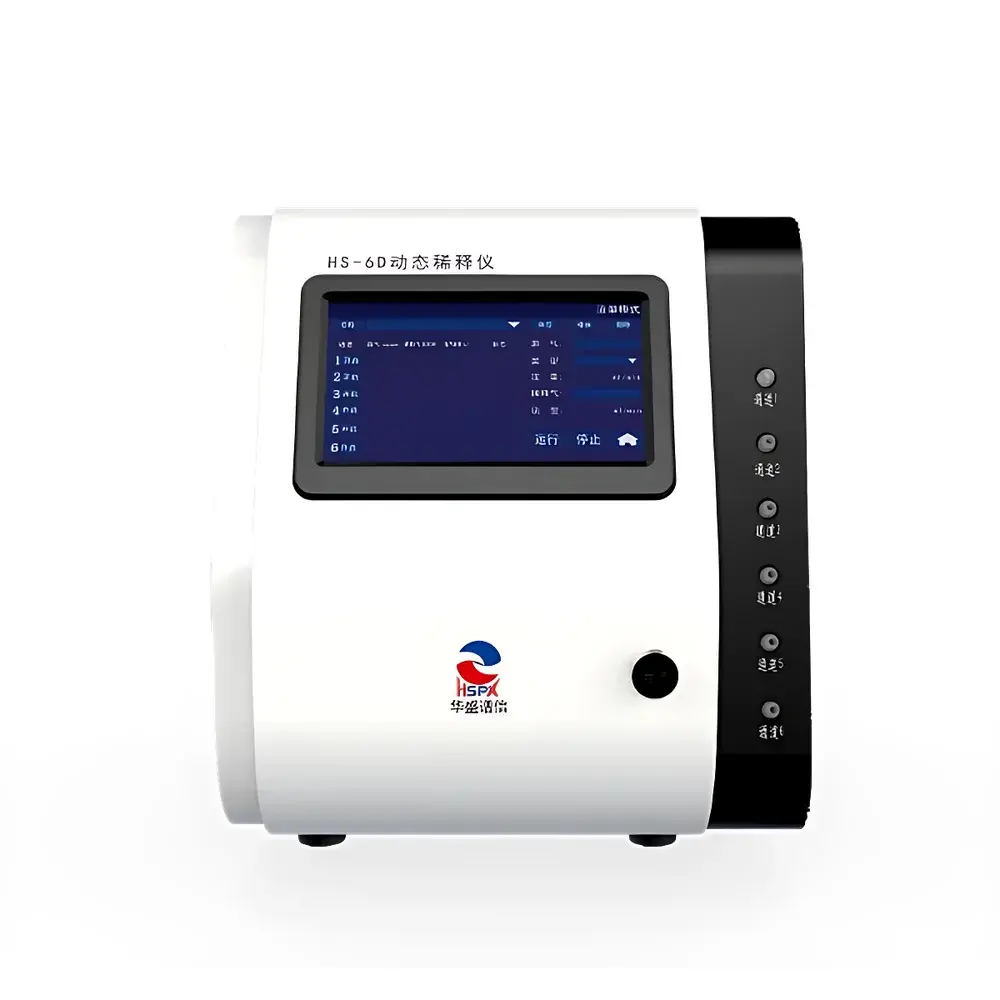
HSPX HS-6D Dynamic Gas Dilution System
| Brand | HSPX |
|---|---|
| Origin | Beijing, China |
| Manufacturer Type | Original Equipment Manufacturer (OEM) |
| Product Category | Domestic |
| Model | HS-6D |
| Pricing | Available Upon Request |
| Flow Control | Mass Flow Controllers (MFCs) |
| Display | 7-inch Capacitive Touchscreen |
| Gas Path Materials | Passivated Stainless Steel Tubing & PTFE Tubing |
| Built-in Pump | Diaphragm Pump for Ambient-Pressure Gas Sampling |
| Dilution Range | 1:1 to 1:100 (customizable) |
| Output Channels | 6 Independent Concentration Ports |
| Operation Modes | Single-point or Multi-step Sequential Dilution |
| Method Storage | Onboard Method Library with Recall Function |
| Software Interface | Single- or Multi-channel Configuration Support |
Overview
The HSPX HS-6D Dynamic Gas Dilution System is an engineered solution for precise, real-time generation of trace-level gas standards in analytical laboratories supporting environmental monitoring, emissions testing, calibration of gas analyzers (e.g., NOx, SO2, CO, VOCs), and method validation workflows. Operating on the principle of dynamic dilution—where certified reference gases are metered via calibrated mass flow controllers (MFCs) and mixed with high-purity diluent gas (e.g., N2 or synthetic air)—the HS-6D delivers stable, reproducible concentration gradients without reliance on static cylinder-based standards. Its architecture supports both ambient-pressure sampling and controlled delivery to downstream instrumentation including gas chromatographs (GC), Fourier-transform infrared (FTIR) spectrometers, and continuous emission monitoring systems (CEMS). Designed for integration into ISO/IEC 17025-accredited labs, the system adheres to fundamental metrological requirements for traceability, linearity verification, and uncertainty quantification per ISO 6145-1 and ASTM D6348.
Key Features
- High-accuracy mass flow control using thermally compensated MFCs ensures ≤±1% full-scale repeatability across the operational range.
- Chemically inert gas pathway constructed from electropolished, passivated 316 stainless steel tubing and virgin PTFE fittings minimizes adsorption, memory effects, and cross-contamination—critical for reactive or polar compounds (e.g., NH3, H2S, formaldehyde).
- 7-inch industrial-grade capacitive touchscreen provides intuitive navigation, real-time flow visualization, and contextual parameter feedback—optimized for glove-compatible operation in controlled environments.
- Integrated diaphragm pump enables active aspiration of sample gases at atmospheric pressure, eliminating need for external vacuum sources during calibration gas preparation.
- Flexible dilution architecture supports either discrete single-point output or programmable multi-step sequences (up to 99 steps), each with independent flow setpoints and dwell times.
- Onboard non-volatile memory stores ≥100 user-defined methods with timestamped versioning, facilitating GLP-compliant audit trails and rapid reconfiguration between regulatory test protocols (e.g., EPA Method 205, EN 14181).
Sample Compatibility & Compliance
The HS-6D accommodates a broad spectrum of calibration gases—including hydrocarbons (C1–C5), halogenated compounds, sulfur-containing species, and oxygenated VOCs—provided they remain chemically stable under ambient conditions and do not exceed the maximum partial pressure limits of PTFE seals (≤100 kPa absolute). It is compatible with standard CGA-170/CGA-347 cylinder connections and supports inlet pressures from 100–2000 kPa. The system conforms to mechanical safety requirements outlined in ISO 10297 and electromagnetic compatibility per IEC 61326-1. While not intrinsically safe, it may be deployed in Zone 2 classified areas when installed with appropriate ventilation and gas detection interlocks.
Software & Data Management
The embedded firmware supports both standalone operation and remote control via RS-232, USB-CDC, or optional Ethernet (TCP/IP) interface. A Windows-based configuration utility enables advanced method scripting, calibration curve import (CSV/XLSX), and export of raw flow logs with ISO 8601 timestamps. All parameter changes—including MFC zero/span adjustments—are logged with operator ID, timestamp, and pre-/post-values to satisfy FDA 21 CFR Part 11 requirements for electronic records and signatures when paired with validated IT infrastructure. Audit trail data is exportable in .csv format for third-party LIMS integration.
Applications
- Calibration and verification of portable and fixed gas analyzers used in ambient air quality networks (e.g., AQMS, urban monitoring stations).
- Generation of dynamic challenge gases for leak detection sensitivity testing (per ISO 16000-31) and sensor response characterization.
- Preparation of multi-component gas mixtures for GC detector linearity studies (e.g., FID, PID, ECD) under USP and EP 2.2.47 guidelines.
- Supporting stack testing laboratories in compliance with EPA Performance Specification 2 (PS-2) and EN 15267-3 for CEMS calibration.
- Research applications requiring tunable gas-phase reaction environments, such as catalytic oxidation kinetics or photochemical smog chamber studies.
FAQ
What is the minimum detectable dilution factor achievable with the HS-6D?
The system achieves a nominal dilution ratio of 1:100; however, effective lower limits depend on upstream source gas purity, MFC resolution (0.1% FS), and background contamination control—practical sub-ppb generation requires ultra-high-purity diluent and rigorous system conditioning.
Can the HS-6D be integrated with third-party autosamplers or GC systems?
Yes—via TTL trigger input/output ports and configurable relay outputs, enabling synchronized start/stop with autosampler injection cycles or GC oven ramp events.
Is firmware update capability available remotely?
Firmware updates are performed locally via USB flash drive; remote updates are disabled by default to maintain configuration integrity and regulatory compliance.
Does the system support automated linearity verification?
While not fully automated, the onboard method editor allows programming of bracketing checks (e.g., 10%, 50%, 90% of target) with manual verification—fully documented in the IQ/OQ protocol package.
What maintenance intervals are recommended for long-term accuracy?
MFC recalibration is advised annually or after 2000 hours of cumulative operation; tubing and seals should be inspected quarterly in high-use environments per manufacturer’s maintenance log template.




