
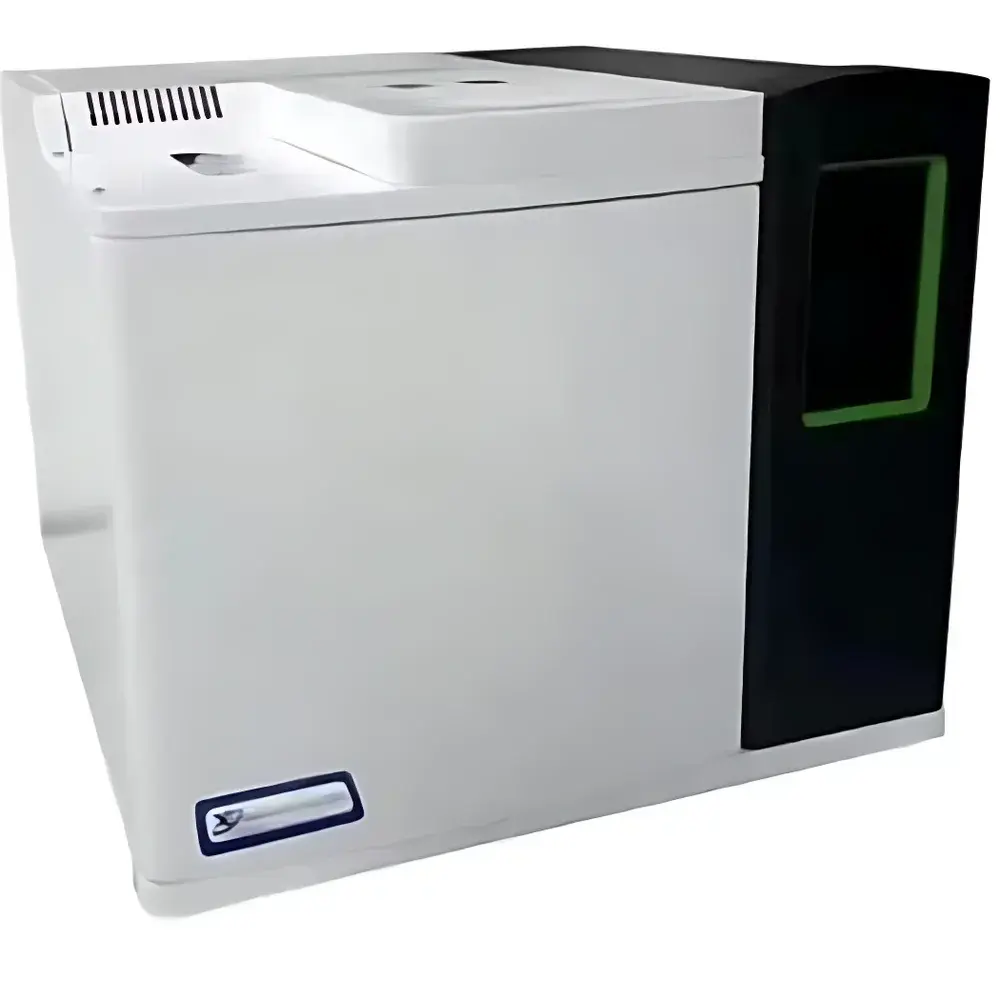
HSPX Refinery Gas Analyzer GC System
| Brand | HSPX |
|---|---|
| Origin | Beijing, China |
| Manufacturer Type | Direct Manufacturer |
| Instrument Type | Laboratory Gas Chromatograph |
| Model | Refinery Gas-Specific GC |
| Temperature Control Range | Ambient to 400 °C |
| Oven Ramp Rate | 0.1–40 °C/min |
| Cool-down Time | ~6 min (400 °C → 50 °C) |
| Carrier Gas Flow Range & Control | 0–1200 mL/min |
| Carrier Gas Pressure Range & Control | 0–0.6 MPa |
| Injector Max Operating Temperature | 400 °C |
| Injector Pressure Setting Range | 0–0.6 MPa |
| Injector Total Flow Setting Range | 0–1200 mL/min |
| Detectors | TCD and FID |
| Column Types | Packed and Capillary |
| Multi-Valve Auto-Switching | Yes |
| Signal Auto-Switching | Yes |
| Analysis Scope | H₂, O₂, N₂, CO₂, CO, C₁–C₆₀ hydrocarbons (including C₂=–C₄= olefins and C₆⁺ saturates/olefins/aromatics) |
Overview
The HSPX Refinery Gas Analyzer GC System is a purpose-built laboratory gas chromatograph engineered for the precise, high-throughput compositional analysis of refinery process gases and light hydrocarbon streams. It operates on the fundamental principles of gas-phase separation coupled with selective detection—utilizing dual parallel detection pathways (thermal conductivity detection for permanent gases and hydrogen flame ionization detection for hydrocarbons) to deliver comprehensive, quantitative speciation across a broad volatility range—from diatomic gases (H₂, O₂, N₂) and acid gases (CO, CO₂) to saturated and unsaturated C₁–C₆₀ species, including ethylene, propylene, butadiene, and higher-boiling aromatic and naphthenic fractions.
This system implements multidimensional gas chromatography (MDGC) architecture via integrated multi-port, pneumatically actuated switching valves and synchronized detector signal routing. Unlike conventional single-column GC configurations, the HSPX analyzer enables true one-injection, multi-path analysis—eliminating manual re-injection, reducing cycle time, and minimizing operator-induced variability. The oven’s robust thermal design supports rapid heating (0.1–40 °C/min) and controlled cooling (~6 minutes from 400 °C to 50 °C), ensuring consistent retention time stability across repeated runs—a critical requirement for refinery QC/QA labs operating under ASTM D1945, D1946, D3588, and ISO 6974-1 compliance frameworks.
Key Features
- Dual-detector configuration: TCD optimized for high-sensitivity detection of permanent gases (H₂, O₂, N₂, CO, CO₂) and FID calibrated for linear response across C₁–C₆₀ hydrocarbons (including olefins, diolefins, and aromatics)
- Hybrid column compatibility: Simultaneous support for packed columns (e.g., molecular sieve 5A + Porapak Q) and fused-silica capillary columns (e.g., Al₂O₃/KCl or PLOT columns) within a single analytical sequence
- Automated multi-valve switching: Precision-engineered 6- or 10-port valves with programmable timing control for backflush, heart-cutting, and column-switching operations
- Full electronic pressure and flow control (EPC/EFC): Independent regulation of carrier gas (He, H₂, or N₂), make-up gas, and detector gases across all inlets and detectors
- High-temperature injector: 400 °C maximum operating temperature with selectable split/splitless modes and pressure-programmed injection capability
- Thermally stable oven: Uniform ±0.1 °C temperature accuracy over 50–400 °C range; fast ramp and cool-down profiles validated per IEC 61000-4-30 for industrial lab environments
Sample Compatibility & Compliance
The HSPX Refinery Gas Analyzer accommodates gaseous samples delivered via gas-tight syringes, pressurized sample loops (0.25–5 mL), or direct integration with online sampling manifolds using standardized Swagelok® or VCR fittings. Sample introduction is compatible with both ambient-pressure and elevated-pressure (up to 0.6 MPa) stream interfaces. The system meets essential regulatory and industry-standard requirements for refinery gas testing—including ASTM D1945 (analysis of natural gas), ASTM D1946 (analysis of fuel gases), ASTM D3588 (heat of combustion calculations), and ISO 6974-1 (natural gas—determination of composition by GC). Data integrity features—including audit-trail-enabled method logging, user access levels, and electronic signature support—are aligned with GLP and GMP documentation expectations, and the software architecture supports optional 21 CFR Part 11 compliance packages upon configuration.
Software & Data Management
Control and data acquisition are managed via HSPX ChromoVision™ GC Workstation—a Windows-based platform supporting real-time chromatogram visualization, automated peak integration (with customizable baseline algorithms and retention time locking), and quantitative reporting per internal standard, external standard, or area-normalization methods. The software includes built-in method templates for common refinery gas standards (e.g., GPA 2261, ASTM D1945 Annex A1), configurable calibration curve management, and batch processing for unattended overnight operation. Raw data files adhere to ASTM E1947-compliant .CDF format, enabling seamless export to LIMS systems (e.g., LabWare, Thermo Fisher SampleManager) and third-party chemometric tools (e.g., MATLAB, SIMCA). All method parameters, sequence logs, and audit trails are stored in encrypted SQLite databases with timestamped user attribution.
Applications
- Refinery process monitoring: FCCU, hydrotreater, reformer, and alkylation unit off-gas composition tracking
- Fuel gas quality assurance: BTU calculation, Wobbe index verification, and sulfur compound screening (when paired with sulfur-selective detectors)
- Hydrogen purity verification in PEM electrolyzer and ammonia synthesis feed streams
- Light ends analysis in petrochemical crackers and olefin recovery units
- Environmental emissions reporting: Quantification of VOCs, methane slip, and flare gas composition per EPA Method 18 and TO-17 protocols
- R&D applications: Catalyst evaluation, reaction pathway mapping, and kinetic modeling input generation
FAQ
What detection technologies are integrated into this refinery gas analyzer?
The system employs dual parallel detection: a high-stability thermal conductivity detector (TCD) for permanent gases and a flame ionization detector (FID) with optimized jet geometry and collector design for hydrocarbons.
Can the instrument analyze both saturated and unsaturated C₂–C₄ species simultaneously?
Yes—using configured PLOT Al₂O₃/KCl or CP-PoraPLOT U columns with timed valve switching, it resolves ethane/ethylene, propane/propylene, and butanes/butenes pairs with baseline separation.
Is method validation support included with the system?
Standard delivery includes pre-validated application notes aligned with ASTM D1945 and GPA 2261, along with IQ/OQ documentation templates and retention time reproducibility test procedures.
What carrier gases are supported, and how is gas purity managed?
Helium, hydrogen, and nitrogen are fully supported; the system includes integrated gas purifiers (oxygen/moisture traps) and optional high-purity gas panels meeting CGA G-4.1 specifications.
Does the software support remote monitoring and networked deployment?
Yes—ChromoVision™ supports TCP/IP-based remote access, multi-user concurrent operation, and centralized method library synchronization across lab networks.





