
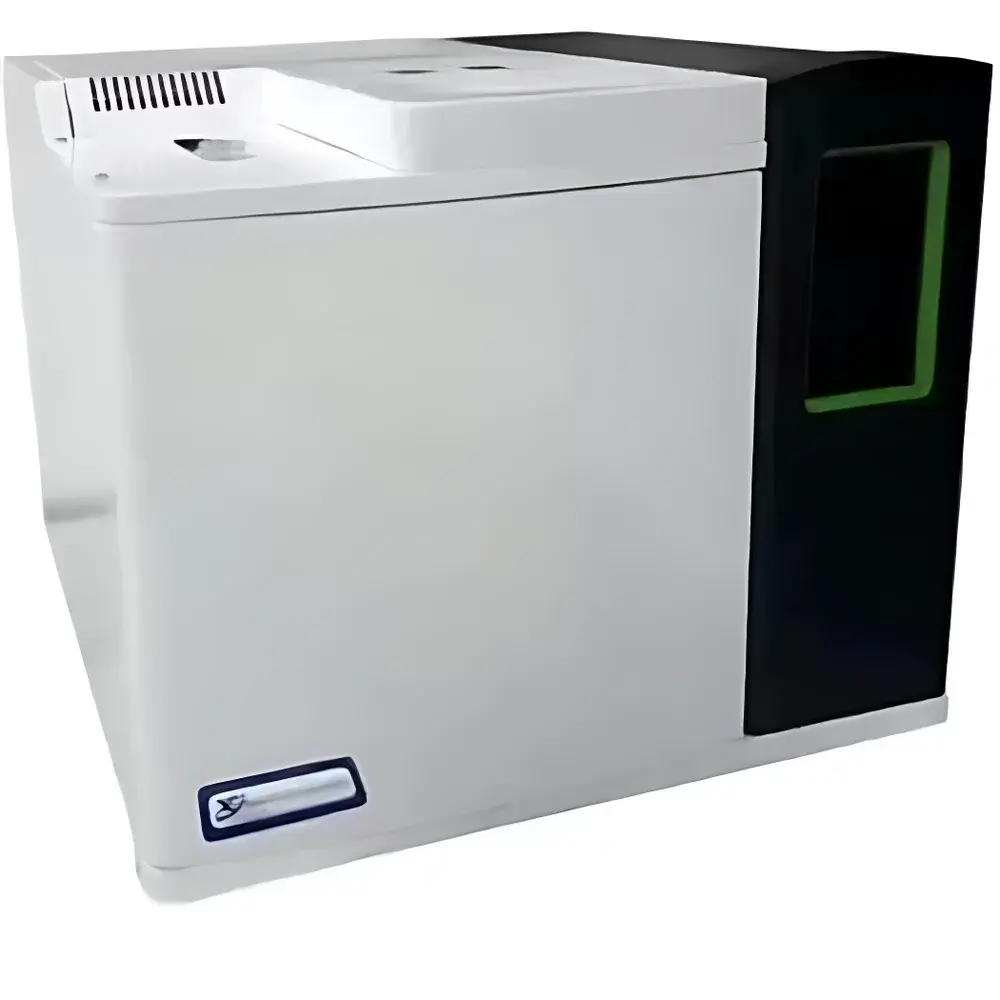
HSPX Solvent Residue-Specific Gas Chromatograph for Flexible Plastic Packaging
| Brand | HSPX |
|---|---|
| Origin | Beijing, China |
| Manufacturer Type | Direct Manufacturer |
| Product Category | Domestic Instrument |
| Model | Solvent Residue-Specific Gas Chromatograph |
| Price Range | USD 7,000 – 14,000 (FOB) |
| Instrument Type | Laboratory-Grade Gas Chromatograph |
| Primary Application Domain | Food Packaging Safety Testing |
| Oven Temperature Range | Ambient to 400 °C |
| Oven Ramp Rate | 0.1–40 °C/min |
| Oven Cool-Down Time | ~6 min (from 400 °C to 50 °C) |
| Carrier Gas Flow Range & Control | 0–1200 mL/min |
| Carrier Gas Pressure Range & Control | 0–0.6 MPa |
| Injector Maximum Operating Temperature | 400 °C |
| Injector Pressure Setting Range | 0–0.6 MPa |
| Injector Total Flow Setting Range | 0–1200 mL/min |
| Detector | Flame Ionization Detector (FID) |
| Column | Pre-configured Capillary Column for Volatile Organic Solvent Separation |
| Data System | Integrated Chromatography Workstation with Audit Trail Capability |
| Required Gases | High-Purity Nitrogen (carrier), Hydrogen (detector fuel), and Compressed Air (detector oxidant) |
Overview
The HSPX Solvent Residue-Specific Gas Chromatograph is a purpose-engineered laboratory gas chromatograph designed exclusively for the quantitative determination of residual organic solvents in flexible plastic packaging materials. It operates on the principle of capillary gas chromatography coupled with flame ionization detection (GC-FID), delivering high sensitivity, linearity, and reproducibility for trace-level volatile compound analysis. This instrument addresses critical regulatory requirements in food contact material (FCM) testing—particularly for solvent residues such as toluene, xylene, ethyl acetate, methyl ethyl ketone (MEK), butyl acetate, ethanol, and isopropanol—compounds commonly employed in gravure printing, dry lamination, and coating processes. Its thermal architecture supports precise temperature programming across the full analytical range (ambient to 400 °C), enabling robust separation of low-boiling and high-boiling solvents within a single run while maintaining column integrity and detector stability.
Key Features
- Optimized oven thermal design with rapid heating (0.1–40 °C/min) and accelerated cooling (~6 minutes from 400 °C to 50 °C), reducing cycle time between analyses without compromising retention time reproducibility.
- Dual independent pressure and flow control systems for carrier gas (N₂), detector gases (H₂ and air), ensuring stable baseline performance and consistent retention behavior across extended operation.
- High-temperature injector (up to 400 °C) with programmable pressure and total flow settings, compatible with both split and splitless injection modes for optimal sample introduction of volatile solvent extracts.
- FID detector calibrated for linear response over five orders of magnitude (typically 10⁵), supporting quantification down to sub-ppm levels in polymer matrix extracts when paired with validated headspace or solvent extraction protocols.
- Modular hardware architecture compliant with IEC 61000-6-3/6-4 electromagnetic compatibility standards and UL/CSA safety certification prerequisites for laboratory deployment.
Sample Compatibility & Compliance
This system is validated for use with standard solvent extraction methods per GB/T 10004–2008 (Chinese national standard for plastic composite films), ASTM F2497–22 (Standard Test Method for Determination of Residual Solvents in Flexible Packaging Films), and ISO 11843–2:2021 (Capability of detection—Part 2: Methodology in the linear calibration case). It supports analysis of film samples prepared via dichloromethane or toluene extraction followed by concentration and reconstitution, as well as headspace-GC workflows for non-destructive screening. The instrument’s hardware and software architecture align with GLP and GMP documentation requirements, including electronic signature support, user access level management, and audit trail logging per FDA 21 CFR Part 11 Annex 11 guidelines.
Software & Data Management
The integrated chromatography workstation provides full method development, acquisition, integration, calibration, and reporting capabilities. It supports multi-point external standard calibration curves with quadratic or linear regression, peak purity assessment via spectral deconvolution (when coupled with optional GC-MS), and automated report generation in PDF and CSV formats. All raw data files are stored with embedded metadata (operator ID, method version, instrument configuration, timestamp), and the system maintains an immutable audit trail of all user actions—including method edits, result overrides, and data deletions—for regulatory review. Data backups can be scheduled to network drives or NAS devices, and export functions comply with LIMS interface protocols (e.g., ASTM E1467, HL7).
Applications
- Quantitative analysis of residual solvents in laminated pouches, snack wrappers, coffee bags, and pharmaceutical blister lidding films.
- QC/QA release testing of incoming packaging rolls prior to filling operations in food and pharma manufacturing facilities.
- Method validation studies supporting ISO/IEC 17025 accreditation for contract testing laboratories.
- Root cause investigation of odor complaints or migration-related product recalls linked to solvent carryover.
- Supporting compliance with EU Commission Regulation (EC) No 1935/2004 and U.S. FDA 21 CFR §177.1520 for indirect food additives.
FAQ
What regulatory standards does this instrument support for food packaging testing?
It is configured to meet GB/T 10004–2008, ASTM F2497–22, ISO 11843–2:2021, and supports alignment with EU 1935/2004 and FDA 21 CFR §177.1520 through validated methods.
Is the system compatible with headspace autosamplers?
Yes—the GC inlet and timing parameters are fully configurable for integration with standard 20 mL headspace vial autosamplers (e.g., CTC PAL or Gerstel MPS series) via TTL or RS-232 handshake protocols.
Does the software support 21 CFR Part 11 compliance?
Yes—the workstation includes role-based user authentication, electronic signatures, and a tamper-evident audit trail with time-stamped event logs for all critical data handling operations.
What consumables are required for routine operation?
Standard GC consumables: FID jet assemblies, septa, liner O-rings, capillary column (e.g., DB-624 or equivalent 30 m × 0.53 mm × 3.0 µm), high-purity gases (N₂ ≥99.999%, H₂ ≥99.999%, zero-air), and certified solvent standards.
Can the system be upgraded to include mass spectrometric detection?
The platform’s mechanical and electronic interfaces support retrofitting with a quadrupole mass spectrometer (GC-MS), subject to additional vacuum system integration and software licensing.
Related Products






