
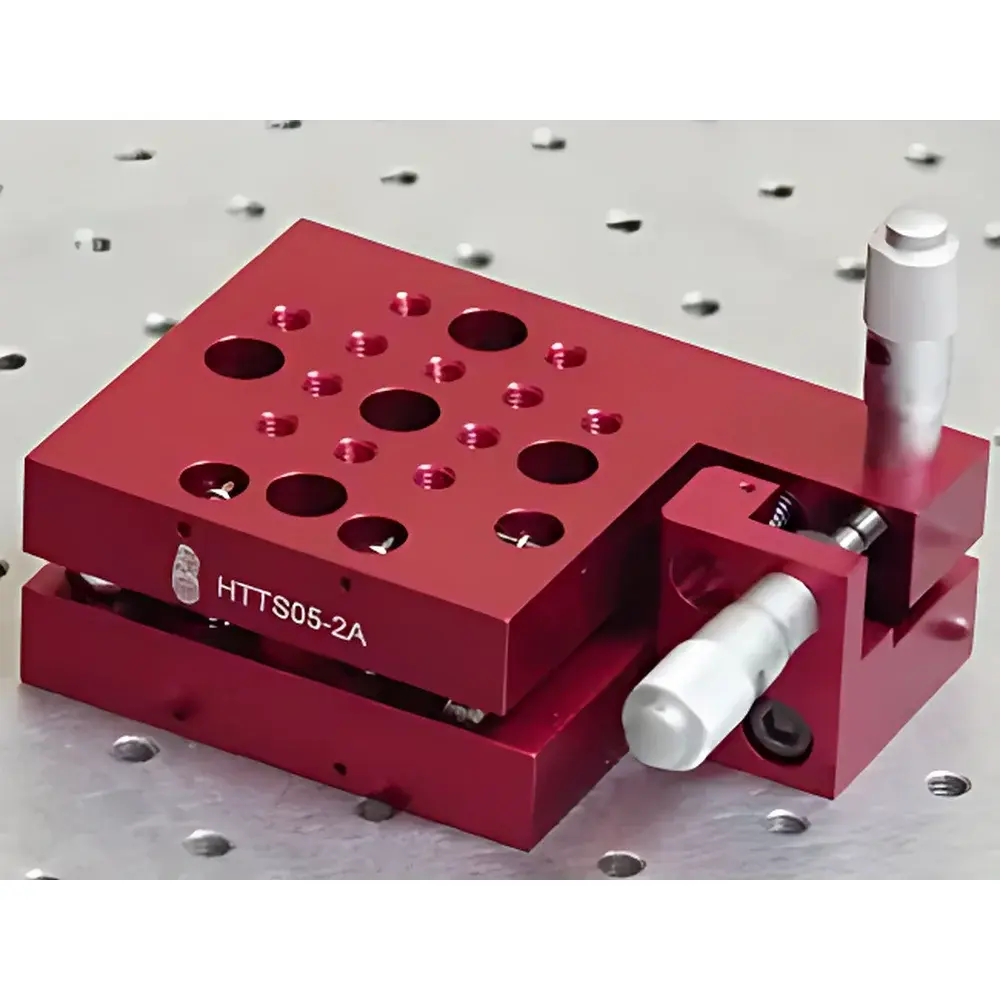
HTTS05-2A Manual Dual-Axis Tilting Stage
| Brand | Han Ding (HT) |
|---|---|
| Origin | Jiangsu, China |
| Model | HTTS05-2A |
| Type | Manual Translation Stage |
| Axis Configuration | Dual-Axis (X-Y tilt) |
| Drive Mechanism | Precision Fine-Pitch Screw with Micrometer Head |
| Return Mechanism | Tension Spring Reset |
| Mounting Standard | ISO/Metric Thread Pattern (M4/M6 Grid) |
| Compliance | Designed for Laboratory Optical Alignment per ISO 10110-7 and ANSI/OEOSC OP1.002 |
Overview
The HTTS05-2A Manual Dual-Axis Tilting Stage is an optomechanical positioning platform engineered for precise angular alignment of optical components in static or quasi-static laboratory environments. Based on the Couette-type rotational adjustment principle—where controlled torsional displacement is achieved via orthogonal fine-pitch screws acting against calibrated spring resistance—the stage enables independent, repeatable tilt adjustments along two orthogonal axes (typically labeled θx and θy). Unlike motorized goniometers or piezo-driven tip/tilt stages, this mechanical design prioritizes long-term thermal and mechanical stability over speed or dynamic response, making it suitable for applications requiring sub-arcminute repeatability without active feedback or power supply dependency. Its rigid aluminum alloy body and hardened stainless-steel screw train minimize hysteresis and creep, supporting alignment tasks in interferometry, collimator calibration, laser cavity optimization, and optical path folding setups.
Key Features
- Dual-axis independent tilt capability with orthogonal adjustment knobs—each equipped with a 0.5 mm pitch micrometer head for tactile, backlash-minimized control
- Integrated tension-spring return mechanism ensuring consistent zero-reference restoration after manual repositioning
- Standardized mounting interface: top and base plates feature metric-threaded hole patterns (M4 at 12.5 mm pitch, M6 at 25 mm pitch) compliant with ISO 8015 geometric tolerancing and widely adopted in Thorlabs, Newport, and Standa-compatible optical breadboard ecosystems
- Low-profile architecture (height ≤ 28 mm) optimized for stacking within constrained optical trains while maintaining ≥ ±2.5° total angular range per axis
- Anodized aluminum housing providing corrosion resistance and non-magnetic operation—critical for use near electron microscopes, NMR systems, or ultra-high-vacuum optical chambers
Sample Compatibility & Compliance
The HTTS05-2A accommodates optical elements up to 50 mm × 50 mm footprint and ≤ 1.2 kg mass without compromising angular resolution or mechanical resonance frequency (> 120 Hz). It supports standard optics including mirrors (dielectric, metallic, protected Au/Al), lenses (plano-convex, meniscus), waveplates, polarizers, and fiber collimators. The stage conforms to mechanical safety requirements outlined in ISO 14122-3 (permanent means of access to machinery) and aligns with optical alignment best practices referenced in ISO 10110-7 (surface form tolerances) and ANSI/OEOSC OP1.002 (optomechanical interface standards). While not certified for cleanroom Class 100 use out-of-box, its sealed screw assemblies and absence of lubricant migration make it compatible with ISO 14644-1 Class 5 environments when operated under controlled handling protocols.
Software & Data Management
As a fully manual stage, the HTTS05-2A requires no firmware, drivers, or software integration. Angular position is determined solely by micrometer scale reading and calibrated screw pitch—eliminating digital drift, electromagnetic interference, or cybersecurity dependencies. For traceable metrology workflows, users may log knob rotations alongside interferometric verification (e.g., using a Zygo Verifire or 4D AccuFiz) to generate GLP-compliant alignment records. When integrated into larger systems governed by FDA 21 CFR Part 11, the stage’s passive nature ensures audit-trail integrity: all positional changes are physically observable, manually documented, and inherently non-repudiable.
Applications
- Laser beam steering and cavity mirror alignment in CW and pulsed solid-state laser systems
- Angle-resolved reflectance/transmission measurements for thin-film characterization
- Calibration of imaging spectrometers and monochromators requiring input slit or grating tilt compensation
- Optical coherence tomography (OCT) reference arm path balancing
- Educational optics labs—demonstrating Snell’s law, polarization rotation, and beam walk-off effects
- Integration into multi-axis kinematic mounts for adaptive optics prototyping where closed-loop control is implemented externally
FAQ
Is the HTTS05-2A compatible with vacuum environments?
Yes—when specified with vacuum-compatible anodization (Type III hardcoat) and dry-lubricated screws, it operates reliably at pressures down to 10−6 Torr. Standard units are rated for ambient or low-vacuum (< 10 mbar) use.
What is the typical angular repeatability?
Under controlled lab conditions (23 ± 1°C, vibration-isolated bench), repeatability is ≤ ±8 arcseconds over 100 cycles, verified via autocollimator measurement per ISO 230-2 Annex B.
Can I mount this stage on a motorized translation base?
Yes—the standardized M6 mounting holes allow direct integration with linear stages from manufacturers including Physik Instrumente (PI), Zaber, and Standa, provided mechanical stack height and center-of-gravity constraints are observed.
Does the stage include locking mechanisms?
No built-in locks are included; however, optional friction-lock collars (sold separately) can be retrofitted to the micrometer shafts to prevent unintended drift during transport or high-vibration operation.
Is technical documentation available in English?
Yes—dimensional drawings, thread specifications, material certifications (EN AW-6061-T6), and installation guidelines are provided in English PDF format upon request.



